
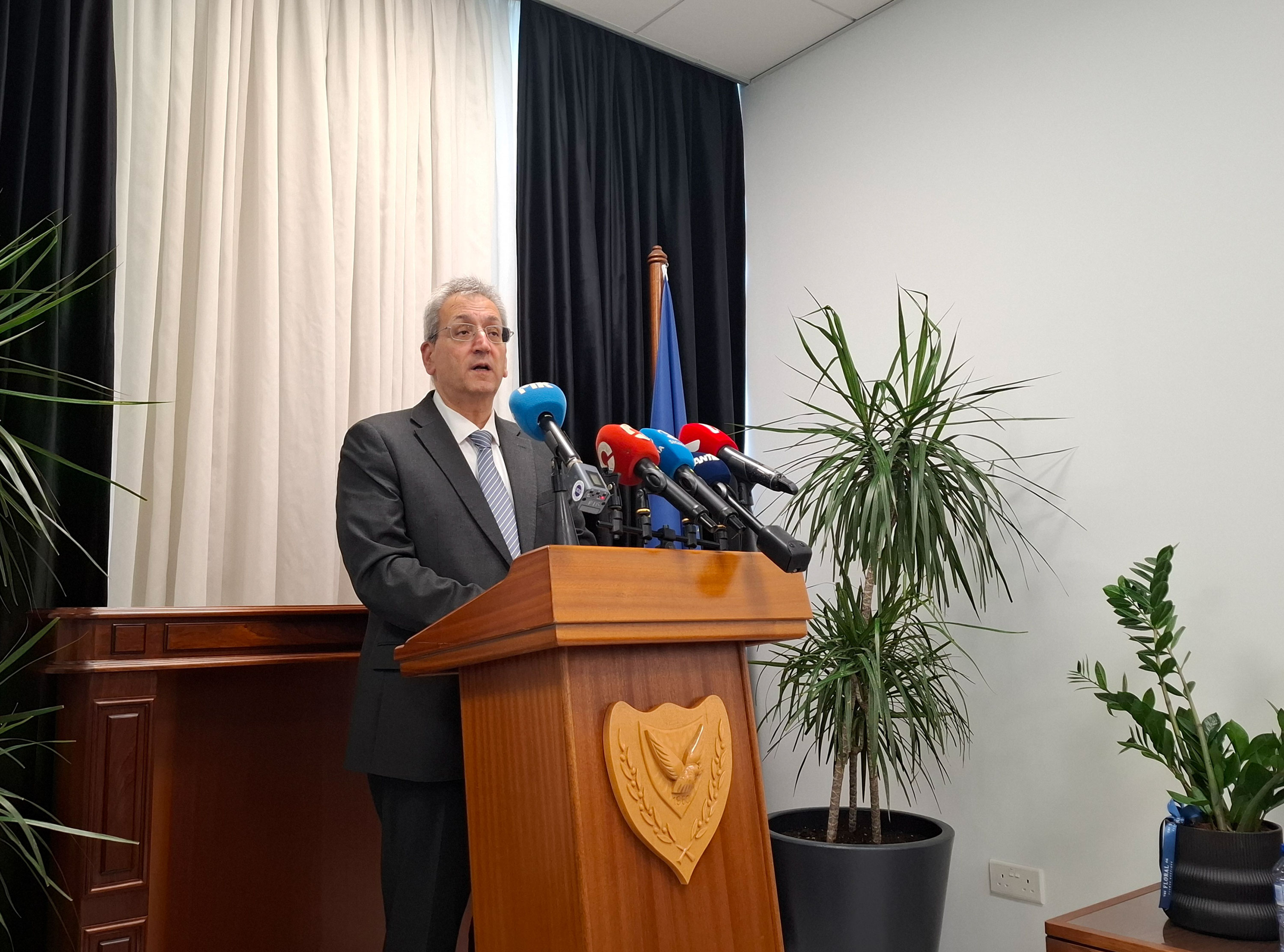
Trade unions on Friday warned that the government’s planned reform to the pension system may leave some pensioners below the poverty line, following a four-and-a-half-hour meeting of the government, employers’ organisations, trade unions, and others held to discuss the plans.
Peo leader Sotiroula Charalambous said that the poverty line in Cyprus at present is €1,018 per month, and that the government’s current plans would see pensioners earning a minimum of €900 when their pension is combined with other benefits and allowances to which they are entitled.
She did note that this figure is an increase from the current minimum of €794 per month, but stressed that “even with the reform, there will continue to be pensioners whose total income will be below the poverty line”.
Away from the matter of the poverty line, she said her union is “dissatisfied” with the fact that the government only intends to reduce the downward adjustment of pension rates for people who take early retirement from 12 per cent to 7.5 per cent.
“We are ready to discuss the issue constructively, with the main issue being that any relief must include an entire and not a partial reduction,” she said.
She also passed comment on the planned cost of the reform, saying that “we expect the finance ministry to provide the numbers”, with state actuary Costas Stavrakis having earlier said that the reform will cost the taxpayer €50 million per year for the first five years of its implementation.
Sek leader Andreas Matsas, meanwhile, said that his union “will not accept a downward differentiation of pension benefits”, and “will not accept the creation of risks in relation to future pensioners”.
He also made reference to the provisions for early retirees, saying that “we will try to ensure that the issue of the 12-per-cent adjustment can be approached adequately”.
Asked what the trade unions’ “red lines” may be in future discussions, he said that “the goal is that pensions be adequate”.
“We are undertaking a reform process, so it cannot be fragmented. It should have a beneficial result for all pensioners,” he said.
Earlier, Labour Minister Marinos Mousiouttas had said of the day’s meeting that “questions were heard, clarifications were requested, and suggestions were heard”, before confirming that going forward, similar such meetings will be held twice a week “so that we can discuss all issues as soon as possible”.
He also confirmed that the “small cheque” – a bonus payment paid to low-income pensioners who earn below a certain threshold – will “continue to exist” after the reform, but stressed that given that pensions will increase as a result of the reform “the need for social policy from the sate will decrease”.
In addition, he stressed that the government’s goal is for the reform to be on the statute books by the beginning of next year and then to be fully implemented as of February 1.
Employers and industrialists’ federation (Oev) director-general Michalis Antoniou described the day’s discussion as “very productive” and said that “several points were clarified”.
“We are optimistic that the necessary convergences will be found, so that a bill can be submitted to parliament, which has the fewest possible divergences and disagreements,” he said.
He said that “one of the facts upon which we all agreed when we started is that the effort to improve the pension system will not lead to an increase in contributions”.
Cyprus chamber of commerce and industry (Keve) secretary-general Philokypros Rousounides said the meeting had been “constructive and lively”, but expressed a modicum of doubt over the time deadlines set out by Mousiouttas.
“The timeframe which has been set out is an optimistic scenario. We will try to honour it, listening to our compatriots’ anxiety over this long-awaited reform, which we hope will ultimately end up being socially fair, but, at the same time, macroeconomically not detrimental toward public finances,” he said.





Click here to change your cookie preferences