
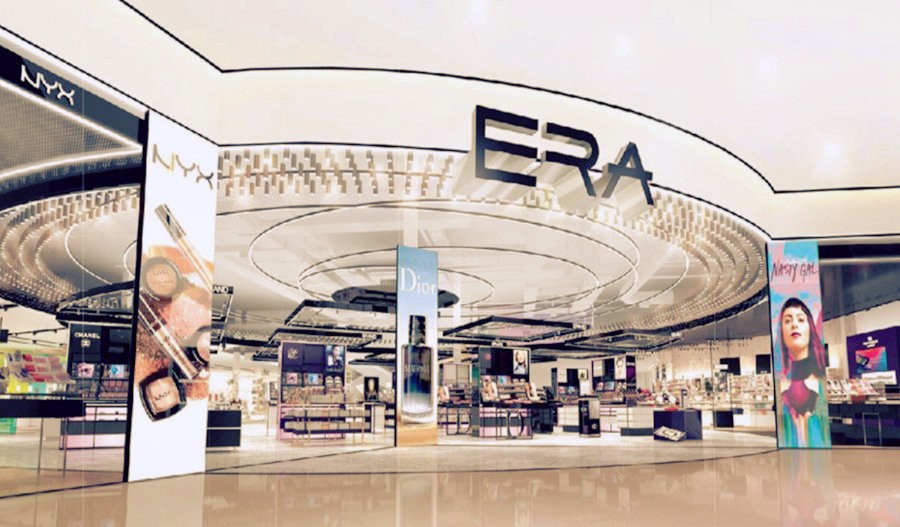
Four ERA department stores in Cyprus changed hands for a nominal €1 after Gencom Ltd agreed to take over their leases, staff and outstanding supplier orders worth about €4 million.
While the commercial terms were announced by Ermes in May 2025, a detailed competition decision published in the Official Gazette on August 28 provides a fuller picture of what was transferred, who controls the buyer and the business plan behind the acquisition.
The agreement was signed on May 8, 2025 and notified to the Commission for the Protection of Competition on June 20. It was unanimously approved on July 17, while completion of the transfer was announced on September 1, 2025.
The transaction covered ERA Mall of Cyprus in Nicosia, ERA Apollon in Limassol, ERA Korivos in Paphos and ERA Zenon in Larnaca.
Ownership of the properties did not pass to Gencom. Instead, the buyer acquired the leases of the premises, together with the stores’ furniture, infrastructure, equipment, trademarks and website domain names.
The deal also included the entire issued share capital of ULS Unique Loyalty Services Ltd, the company operating the UNIQUE customer rewards programme in Cyprus.
Gencom therefore acquired four operating department stores and the company responsible for the loyalty programme through which customers collect and redeem points. Neither the number of members nor the programme’s financial value was disclosed.
Separately, Ermes’ May 2025 announcement said that all department-store employees would transfer to the buyer.
Gencom also agreed to assume outstanding obligations connected with orders placed with suppliers for the spring and summer 2025 season, worth approximately €4.5m.
The amount was described as obligations arising from supplier purchase orders, rather than bank borrowing or wider corporate debt.
Stock remaining in the stores when the transaction was completed was not included in the €1 consideration. Instead, it was made available to Gencom on a consignment basis under separately agreed commercial terms.
Ermes also agreed to provide essential support services to the buyer, for an agreed fee, until the end of 2025.
The symbolic price reflected the financial condition of the department-store business and the commitments taken on by Gencom.
According to Ermes, the stores recorded operating losses of €1.3m in 2024, while an attempt to improve their performance would have required substantial additional investment.
The company said funding would have been needed to renovate and improve the stores, upgrade their IT systems and provide considerably more working capital.
The transfer therefore released Ermes from the future obligations of a loss-making business, while allowing it to concentrate resources on its remaining commercial activities.
Ermes’ board considered the transaction and its price fair and reasonable in view of the financial and commercial circumstances. However, the company did not appoint external advisers or independent experts and did not obtain a separate valuation opinion.
The company expected the disposal to produce an accounting gain of approximately €1m, mainly through the reversal of a lease-related provision recorded under IFRS 16.
That amount was not paid by Gencom and did not represent additional cash proceeds from the sale. It arose principally because Ermes was being released from future lease obligations.
The Gazette decision also provides further information about the ownership and plans of the buyer.
Gencom was established in Cyprus as a special-purpose company for the transaction and had no previous business activity. It is controlled by Greek company Geniki Emporiki Ilektronikou Emporiou SA, referred to in the decision as GEIL.
GEIL operates in fashion, footwear, beauty products and online retail and trades under the Politikos name in Greece.
The buyer’s group was already selling clothing and footwear online to customers in Cyprus, but did not have its own physical department-store network on the island. ERA, by contrast, had stores in four cities but had not developed an e-commerce operation.
According to the information submitted to the regulator, the plan was to combine these two operations.
Gencom would use ERA’s established physical infrastructure while developing its digital expertise and online sales presence. Through the acquisition, it gained stores, equipment, trademarks and a customer rewards programme in one transaction.
The websites listed in the decision sold brands including Calvin Klein, Tommy Hilfiger, Crocs, Guess, Lacoste, Jack & Jones, Vero Moda and Moi & Toi. Several of these brands were also available through ERA.
The commission examined the transaction in the retail markets for fashion and beauty products across Cyprus.
The €825.096m figure included in its decision was not the value of the acquisition. It was the estimated size of Cyprus’ clothing market in 2023.
The estimate was based on sales under the statistical categories covering other retail trade in non-specialised stores and clothing sales in specialised shops.
The commission noted that the figure appeared not to include all footwear sales or sales of watches and jewellery, indicating that ERA’s share of the broader fashion market could be even smaller.
ERA’s estimated share of the clothing market was placed between zero and 5 per cent. The buyer’s online presence in Cyprus was also estimated within the same range.
The exact sales figures of both businesses were removed from the published decision as confidential commercial information.
The regulator concluded that any increase in their combined market share would be negligible and would not significantly change the structure of the market.
It also noted that clothing retail in Cyprus was highly fragmented and competitive, with numerous domestic and international companies offering consumers a wide range of alternatives.
Entry barriers remained low, while consumers could readily move between retailers and shop through both physical and online channels.
No horizontal overlap was identified in beauty products because the buyer’s group reported that it did not sell such products in Cyprus. The commission also found no vertical or closely related commercial relationship between the two businesses.
It consequently concluded that the transaction created no affected market and raised no risk of significantly restricting competition.
The commission unanimously decided not to oppose the acquisition and declared it compatible with the operation of competition in Cyprus.
However, the Gazette decision records the information and business plan presented when the transaction was examined. It does not include subsequent financial results or show how the four ERA stores have performed since the transfer was completed.





Click here to change your cookie preferences