
Cyprus’ success in replacing lost Russian visitors by opening up new tourism markets has won international recognition, Deputy Tourism Minister Kostas Koumis said.
Speaking at the opening of an international development seminar in Nicosia this week, Koumis pointed to a joint report by Oxford Economics and global tourism platform TOURISE, which presents Cyprus as a leading example of tourism resilience and market diversification.
The report, entitled ‘Resilience in a World That Doesn’t Reset’, examines 85 major tourism crises over the past 25 years and identifies diversification as one of the strongest safeguards against disruption.
In the case of Cyprus, it documents how the island responded to the loss of the Russian market following Russia’s invasion of Ukraine, while emphasising the tourism sector’s performance in 2024 and 2025.
Russia accounted for more than 27 per cent of arrivals before 2022, but its share had fallen to just 1 per cent by 2025. At the same time, Cyprus expanded into other European markets, with Poland’s share rising from 2 per cent to 9 per cent.
Koumis welcomed the recognition, saying the findings reflected the approach taken by the government in recent years.
“For us, resilience is not a theoretical concept, it is an integral part of our tourism planning,” he said during his opening address.
He explained that after the loss of the large Russian market in 2022, Cyprus sought to replace that demand by developing several other geographical markets and strengthening air connectivity.
Moreover, Koumis said Cyprus had returned to high tourism demand in 2026, following the sharp disruption caused by the Middle East conflict in March.
He also referred to the measures advanced during Cyprus’ Presidency of the Council of the European Union in the first half of 2026, which placed particular emphasis on sustainable tourism development.
These included the adoption of Council conclusions entitled ‘Creating sustainable and competitive tourism for the future’, linking environmental sustainability with competitiveness and identifying resilience to climate change as necessary for the sector’s long-term future.
At national level, Koumis said the National Tourism Strategy 2035 was laying the foundations for a more sustainable, competitive and resilient tourism model.
The strategy places particular emphasis on gradually extending the tourist season and establishing Cyprus as a year-round destination. According to Koumis, the approach has already begun to deliver results, with winter arrivals increasing by more than 20 per cent over the past three years.
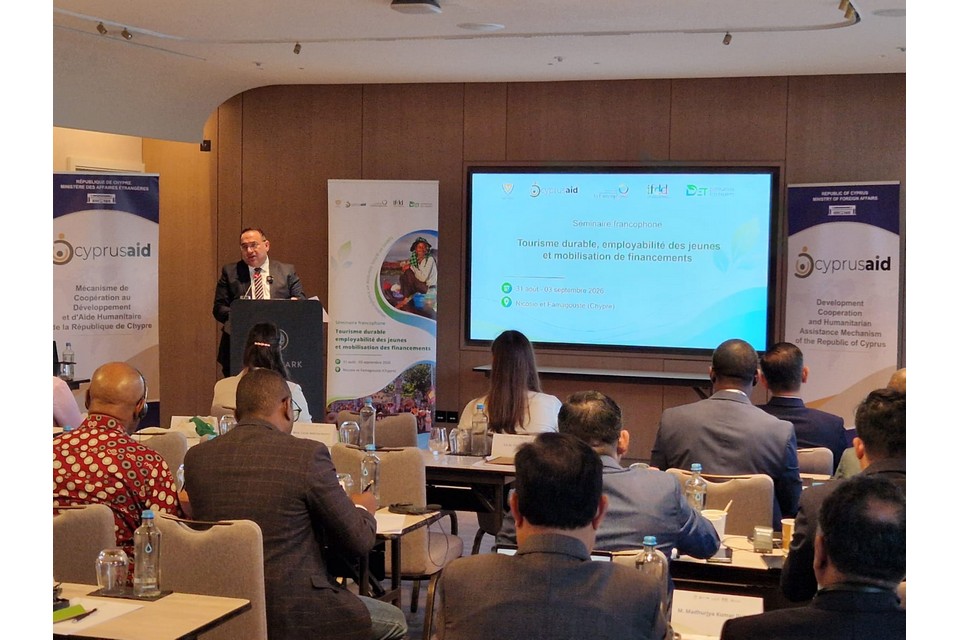
The deputy minister was speaking at the International Development Seminar on ‘Sustainable Tourism, Youth Employability and Funding Mobilisation’, held at The Landmark Hotel in Nicosia.
The event was organised by the Foreign Ministry in cooperation with the Francophonie Institute for Sustainable Development, which forms part of the International Organisation of La Francophonie.
As part of the seminar, Cyprus is hosting the Destination Eco-Talents programme for the first time, bringing together 60 experts from 30 member states of the organisation, as well as international development partners.
Concluding, Koumis reaffirmed Cyprus’ commitment to developing a tourism model that protects the environment, invests in people and supports local communities.





Click here to change your cookie preferences