
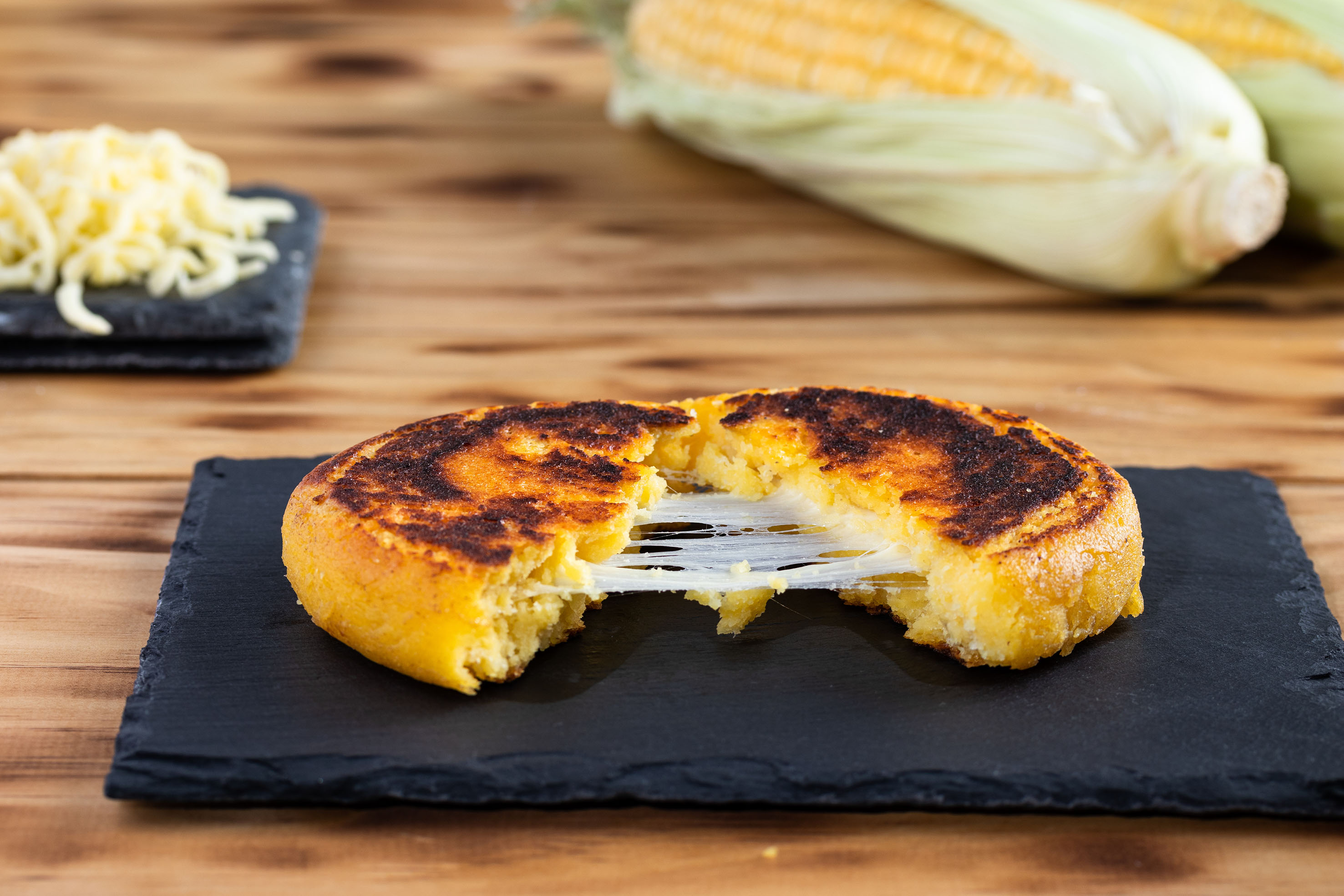
Arepas are one of Venezuela’s most enduring foods, a culinary tradition with roots that stretch back to pre-Columbian times when indigenous peoples across northern South America cultivated and processed maize as a dietary staple.
Archaeological and linguistic evidence suggests that early forms of the arepa were prepared by indigenous communities who ground maize, shaped it into round cakes and cooked it on heated stone surfaces known as budares.
With the arrival of European colonisation, the arepa adapted but did not disappear. Unlike many indigenous food traditions that were displaced, it remained a constant in local diets, gradually incorporating new fillings and cooking techniques over time.
The fundamental method, however, remained remarkably stable: a dough of ground maize shaped into discs and cooked on a flat surface. This continuity is one of the reasons the arepa is often described as a living pre-Hispanic food, still widely consumed in Venezuela today in forms that would be recognisable centuries ago.
In modern Venezuelan, the arepa is far more than a staple food; it is a national symbol. It is eaten at breakfast, lunch or dinner, and often functions as both plate and vessel, split open and filled with ingredients such as cheese, shredded beef, black beans, avocado or eggs.
Its versatility has allowed it to adapt to urban and rural life, becoming equally present in home kitchens and street-side areperas, where countless variations are prepared. Regional differences also exist, with coastal areas favouring seafood fillings, while the Andes may feature wheat-based versions known as arepas de trigo.
The cultural significance of the arepa extends into identity and migration. For many Venezuelans abroad, it represents a direct link to home. Its simplicity makes it adaptable to local ingredients, allowing it to travel while retaining its essential character.
Seasonally, arepas do not belong to a specific time of year, yet their warmth and versatility make them particularly comforting during cooler months or communal gatherings.
In Cyprus, while not traditional, the arepa finds a quiet resonance with local flatbreads and filled pastries such as pita-based sandwiches, reflecting a shared Mediterranean and global appreciation for simple, adaptable breads. Ultimately, the arepa endures as a dish shaped by history yet firmly rooted in the present, embodying Venezuela’s cultural continuity through something as humble and essential as maize and fire.




Click here to change your cookie preferences