
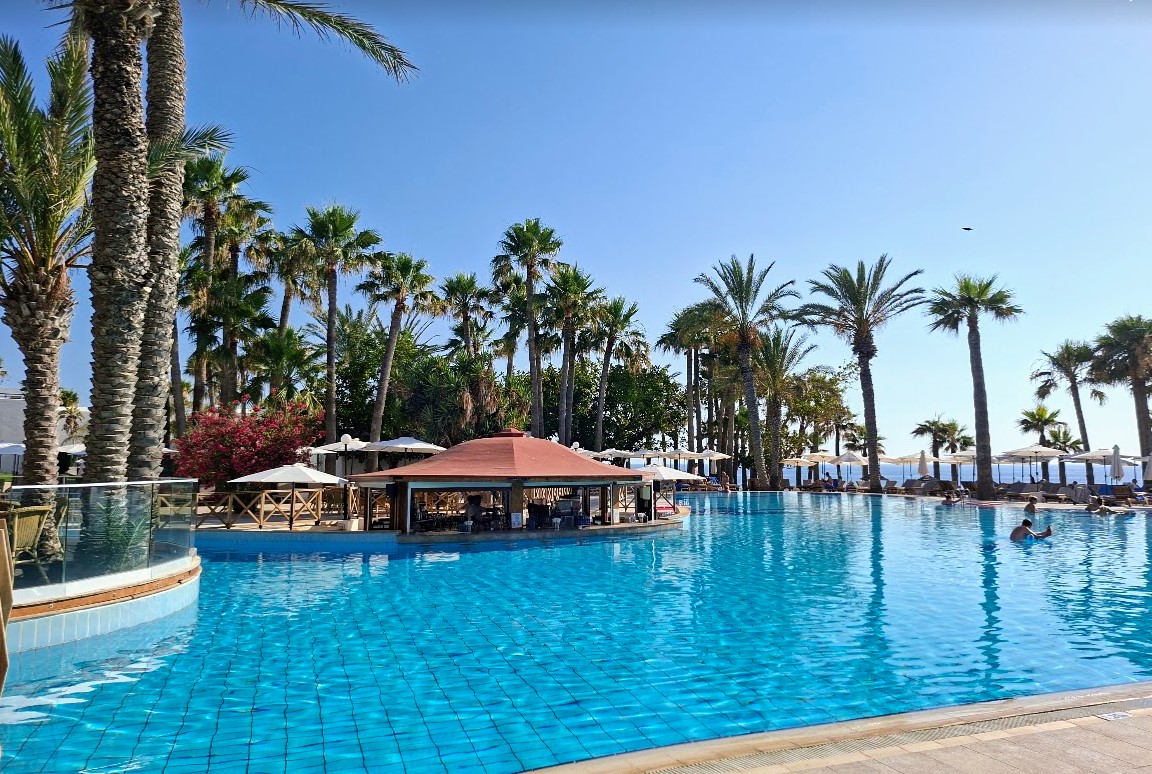
Cyprus recorded the largest fall in tourist accommodation nights in the EU during the first half of 2026, down 7.71 per cent year on year, according to a Destination Finder analysis of Eurostat data.
Romania followed with a decline of 6.71 per cent, while the EU as a whole recorded 1.321 billion overnight stays, up 1.7 per cent from the same period in 2025.
Cyprus remained under pressure in June, when accommodation nights fell 6.78 per cent from a year earlier. Nights spent by non-residents declined 6.04 per cent, while those by residents fell 19.16 per cent.
Non-residents accounted for 95.06 per cent of all accommodation nights in Cyprus during the month.
Tourist arrivals also fell during the first half, with Cyprus receiving around 1.66 million visitors between January and June, down 10.1 per cent from the same period last year.
June was somewhat stronger, with arrivals down 1.7 per cent to 489,965, while tourism revenue rose 0.2 per cent to €423.1 million.
Average expenditure per tourist increased 2 per cent to €863.62, while the average stay shortened to 8.2 days from 8.5 days a year earlier.
For the first half as a whole, however, tourism receipts fell 11.4 per cent to €1.22 billion, from €1.38bn in the corresponding period of 2025.
By comparison, several other EU tourism markets recorded growth over the same six months.
Malta posted a 9.91 per cent increase in accommodation nights, while Slovakia rose 5.86 per cent, Slovenia 5.66 per cent, Poland and Estonia 5.18 per cent each, Denmark 3.75 per cent, Hungary 3.70 per cent and Italy 3.14 per cent.
Czechia was up 2.51 per cent, Austria 1.83 per cent, Spain 1.55 per cent, Sweden 1.47 per cent, Greece 1.40 per cent and France 1.37 per cent.
Portugal recorded growth of 0.92 per cent, Germany 0.52 per cent and Croatia 0.46 per cent.
Ireland posted a 14.59 per cent increase, although Eurostat marked the tourism data as low reliability.
Meanwhile, Bulgaria was down 1.68 per cent, the Netherlands 1.50 per cent, Lithuania 1.19 per cent, Luxembourg 1.18 per cent, Latvia 1.09 per cent and Finland 0.12 per cent.
Belgium fell 1.35 per cent, with its tourism data also carrying a low-reliability flag.
Cyprus’ 7.71 per cent decline remained the largest in the EU27.
In June, the Netherlands recorded the steepest fall in accommodation nights, down 13.06 per cent, followed by Ireland at 9.87 per cent and Belgium at 9.63 per cent.
Luxembourg fell 6.93 per cent, Cyprus 6.78 per cent, Croatia 6.08 per cent and Romania 5.66 per cent.
Austria was down 4.12 per cent, Bulgaria 3.63 per cent, Germany 3.47 per cent and Finland 3.28 per cent, while France fell 1.71 per cent, Denmark 1.58 per cent, Spain 1.42 per cent and Czechia 0.83 per cent.
Lithuania, however, recorded the largest June increase at 12.67 per cent, followed by Malta at 8.54 per cent.
Poland rose 3.98 per cent, Sweden 3.75 per cent, Hungary 1.93 per cent, Estonia 1.89 per cent, Latvia 1.84 per cent, Slovenia 1.54 per cent and Greece 1.44 per cent.
Italy was up 0.63 per cent and Portugal 0.21 per cent, while Slovakia was unchanged.
At the same time, Cyprus recorded the second-largest annual increase in the EU’s restaurants and accommodation services price index in June, at 8.48 per cent under the methodology used in the analysis.
Romania ranked first at 11.02 per cent, followed by Cyprus, Bulgaria at 7.60 per cent, Greece at 6.16 per cent and Lithuania at 5.76 per cent.
Denmark recorded an increase of 5.57 per cent, Hungary 5.44 per cent, Spain 5.14 per cent, Latvia 4.89 per cent and Croatia 4.76 per cent.
The Czech index rose 4.58 per cent, Slovakia 4.57 per cent, Portugal 4.43 per cent, the Netherlands 4.40 per cent and Poland 4.33 per cent.
Elsewhere, Slovenia was up 3.92 per cent, Austria 3.73 per cent, Luxembourg 3.72 per cent, Belgium 3.60 per cent and Ireland 3.56 per cent.
Germany recorded an increase of 3.02 per cent, Malta 2.99 per cent, Italy 2.88 per cent, France 2.76 per cent, Sweden 2.64 per cent and Finland 2.06 per cent.
Estonia was the only country to record a decline in the index, down 2.30 per cent.
The measure covers restaurants and accommodation services and does not represent hotel room prices alone.
Across the EU27, the relationship between changes in the index and accommodation nights was weak.
Lithuania, for example, recorded a 5.76 per cent increase in the index alongside a 12.67 per cent rise in June accommodation nights, while Malta combined a 2.99 per cent increase in the index with an 8.54 per cent rise in nights.
Cyprus, by contrast, recorded a 6.78 per cent fall in nights alongside an 8.48 per cent increase in the index.
By the end of August, tourist arrivals to Cyprus were 7 per cent lower year on year, compared with a 10.1 per cent decline at the end of June.
August arrivals were 3.3 per cent below the same month of 2025 but 4.9 per cent above August 2024.





Click here to change your cookie preferences