
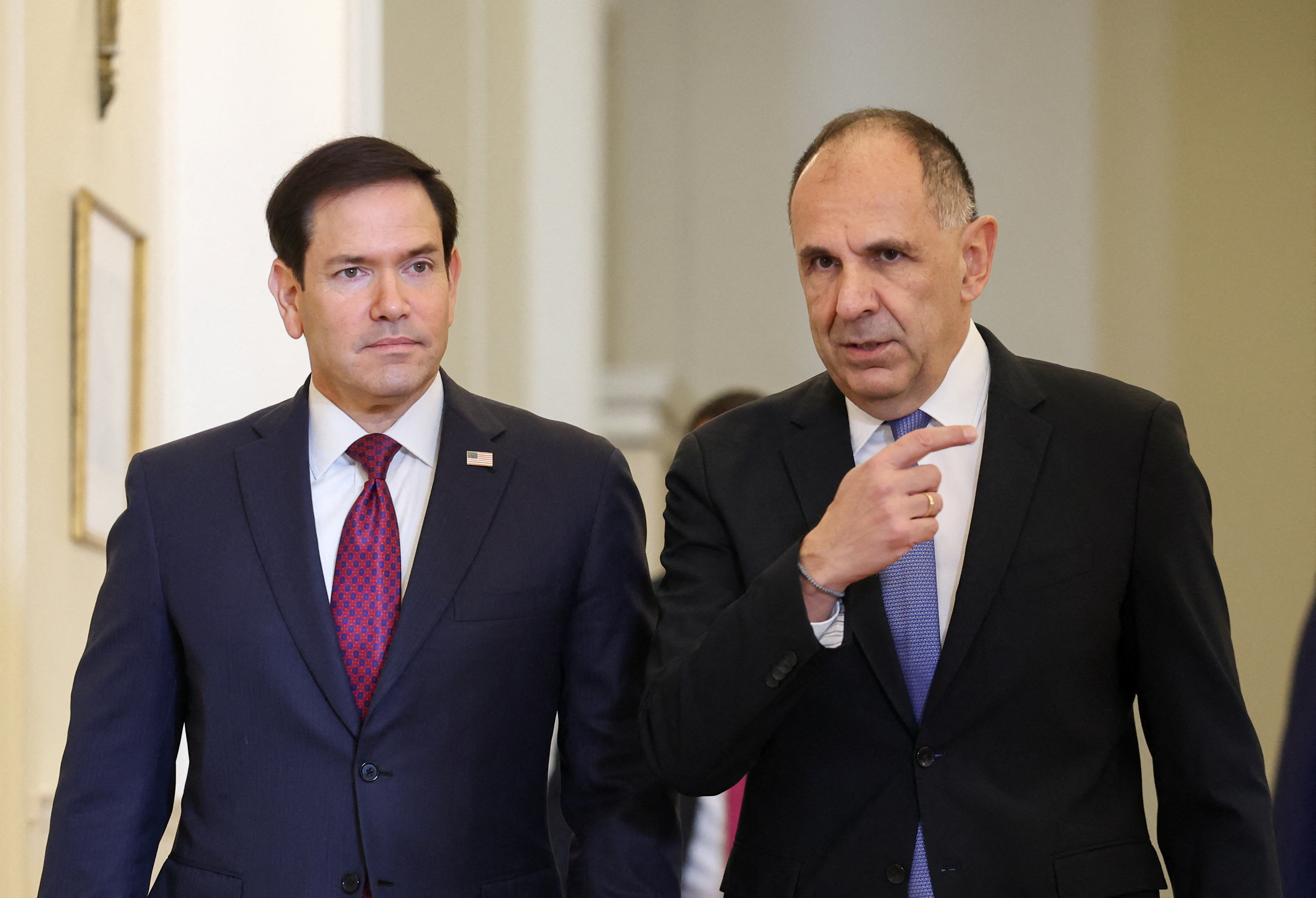
US Secretary of State Marco Rubio is visiting Athens at a time of heightened geopolitical challenges, instability and shifting regional dynamics.
The agenda for his meetings is broad and includes key issues such as energy, defence, regional security, connectivity, investment and technology. Wider geopolitical developments will also be discussed, with Athens seeking to highlight Greece’s role as a stable and reliable strategic partner of the United States in southeastern Europe and the eastern Mediterranean.
The US side has identified defence cooperation, regional security and energy security as the main pillars of the visit.
The presence of the head of the State Department in Athens is expected to reaffirm the high level of Greece-US bilateral relations and pave the way for further cooperation across a range of sectors. Rubio himself has described Greece as a “very important ally” of the United States.
Of particular political significance is the fact that Rubio is not combining his visit to Athens with a corresponding visit to Ankara. His October 5-8 tour includes Reykjavik, Athens and Lisbon, with no stop in the Turkish capital.
This development cannot in itself be interpreted as a change in US policy towards Turkey, but it adds particular symbolism to the Athens visit.
Rubio arrived in Athens on Tuesday evening, where he was welcomed by Foreign Minister Giorgos Gerapetritis. His official programme of meetings begins on Wednesday.
In the morning, the US Secretary of State will visit the foreign ministry for a bilateral meeting with Gerapetritis. Joint statements to the press will follow, before the launch of the sixth round of the Greece-US Strategic Dialogue.
The first plenary session of the dialogue will then take place, focusing on regional and international developments.
Separate working sessions involving senior officials from both countries will cover a broad range of issues, including regional affairs, international developments, security and law enforcement, energy, shipping, technology, trade, investment and defence, as well as further strengthening ties between the two peoples.
Rubio’s programme also includes a visit to the US embassy for the launch of renovation works, while in the afternoon he will meet Prime Minister Kyriakos Mitsotakis at the Maximos Mansion. The day will conclude with an official dinner in honour of the US Secretary of State.
Defence cooperation, which has deepened considerably in recent years, will form a significant part of the Strategic Dialogue.
Discussions will focus on the implementation of the F-35 programme, the modernisation of F-16 fighter jets and the further strengthening of the operational capabilities of the Greek Armed Forces. Talks are also expected to touch on new US defence procurement packages and support for existing systems.
Energy will also form an important part of the agenda. The Vertical Gas Corridor is expected to feature prominently in discussions as Greece seeks to strengthen its role as a gateway for transporting US LNG to the Balkans and eastern and central Europe.
Exploration and investment by US energy groups ExxonMobil and Chevron in Greek offshore blocks are also expected to be discussed.
The involvement of the two US companies in Greece’s energy sector strengthens the geopolitical dimension of energy cooperation, while exploration south of Crete is of particular interest.
Three cooperation documents are expected to be signed as part of the sixth Strategic Dialogue, giving practical substance to the bilateral relationship.
First, the Memorandum of Understanding on imposing import restrictions on categories of archaeological and ethnological material dating up to the 15th century AD will be renewed.
Second, Greece and the United States will sign a Letter of Intent on cooperation between the Greek Armed Forces and the Florida National Guard.
Third, a Memorandum of Understanding will be signed on the mutual recognition of seafarers’ Certificates of Competency under the 1978 International Convention on Standards of Training, Certification and Watchkeeping for Seafarers (STCW).
The aim is to facilitate the employment of seafarers and strengthen Greek-US cooperation in shipping and maritime education.
Finally, particular symbolism surrounds Rubio’s evening speech at the Pnyx, overlooking the Acropolis.
The US Secretary of State is expected to address the future of the Western world and relations between the United States and Europe in a speech carrying strong historical and political symbolism.
The choice of the Pnyx, where the citizens’ assembly met in ancient Athens, adds particular significance to the message the US side is seeking to convey.
The speech has been billed as an intervention on the need for a “great renaissance of the Western spirit”, linking Athens’ historical legacy with the contemporary debate over the future of the West.


Click here to change your cookie preferences