
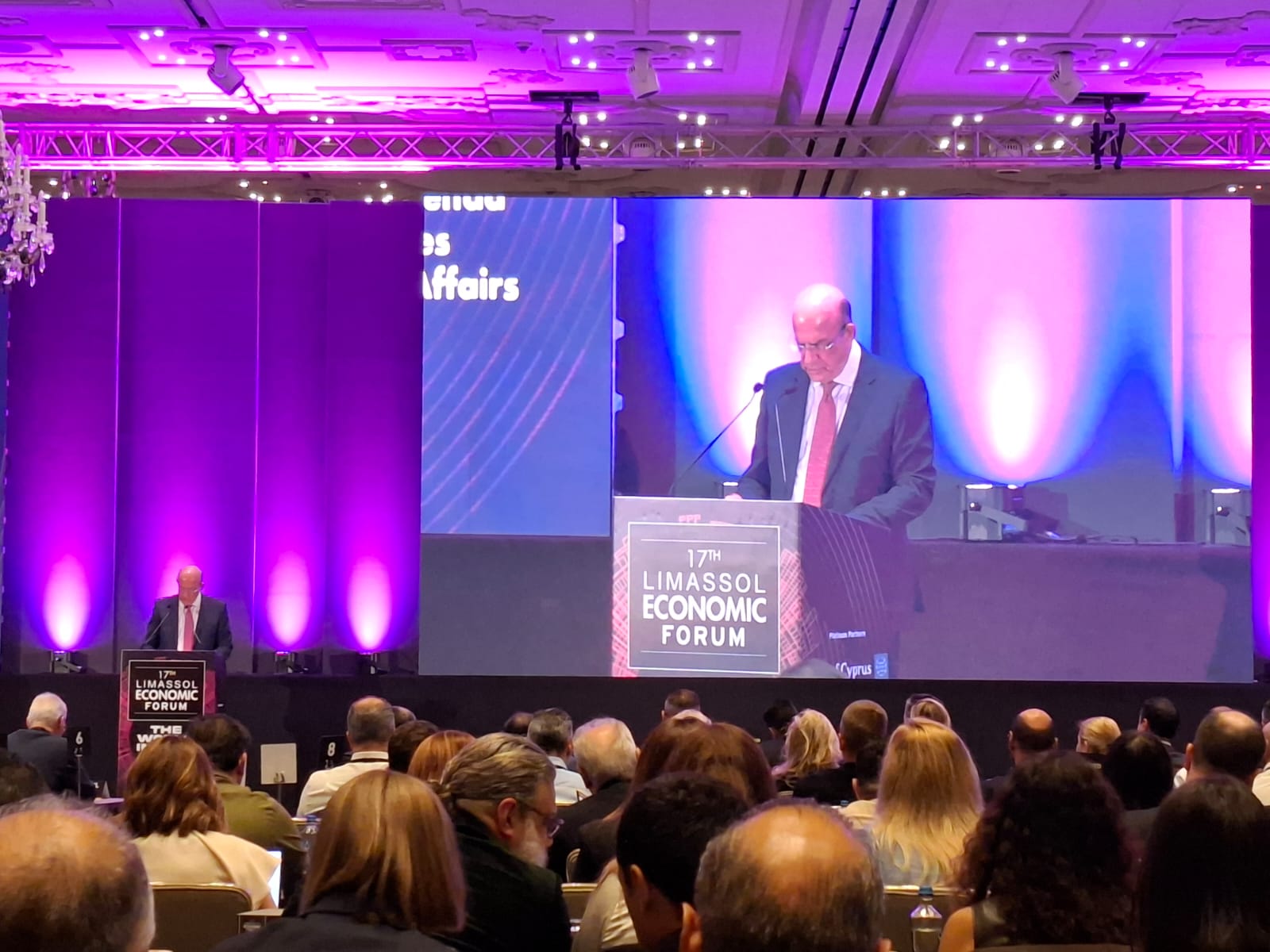
Finance Minister calls for European flexibility without sacrificing economic stability
Cyprus must balance long-term economic stability with responses to rapidly changing global challenges, Finance Minister Makis Keravnos said on Friday, warning that Europe can no longer rely on assumptions that held true 10 to 20 years ago.
Addressing this year’s Limassol Economic Forum, Keravnos said wars, geopolitical tensions, disruptions to international trade, energy challenges, technological advances and climate change were creating an unprecedentedly complex international environment.
“The wars in the wider region of Europe, geopolitical tensions and shifts, the disruption of international trade, the global energy crisis and energy challenges, the technological revolution and climate change are shaping an unprecedented and exceptionally complex international economic and political environment,” he said.
He praised the forum’s organisers, saying the event had established itself as an important platform for examining geopolitical developments, economic trends and major global challenges.
Keravnos stressed that these developments were interconnected and could not be addressed by individual countries acting alone.
“No country, however powerful it may be, can face them on its own,” he stated.
“This highlights the enduring value of the European Union,” he continued. “In times of uncertainty, European cooperation proves to be the most important tool for preserving economic stability and social cohesion.”
Changing geopolitical balances are creating new risks, while technological advances, particularly in artificial intelligence (AI), are transforming daily life, productivity and employment, as well as giving rise to new economic models.
At the same time, inflation and the rising cost of living are placing pressure on governments, businesses and households, while Europe faces the challenge of reconciling social cohesion with economic competitiveness.
Keravnos argued that Europe’s response to international competition should not involve withdrawing from the global economy, but instead combining greater autonomy with continued openness.
“The European response clearly cannot be international isolation,” he said.
“On the contrary, it must be based on a dual strategy, autonomy on the one hand and an open economy on the other,” the minister explained.
He added that this approach was reflected in the slogan of Cyprus’ presidency of the Council of the EU, “An Autonomous Union. Open to the World”.
Geopolitical developments had highlighted the risks associated with dependence on other countries, making it necessary for Europe to strengthen its capacity to act independently while maintaining international economic ties.
Fiscal stability, meanwhile, must remain the foundation of European economic policy, Keravnos said, stressing that flexibility and fiscal discipline were not mutually exclusive.
“Fiscal stability should be the main and non-negotiable framework and objective of European economic policy,” he said.
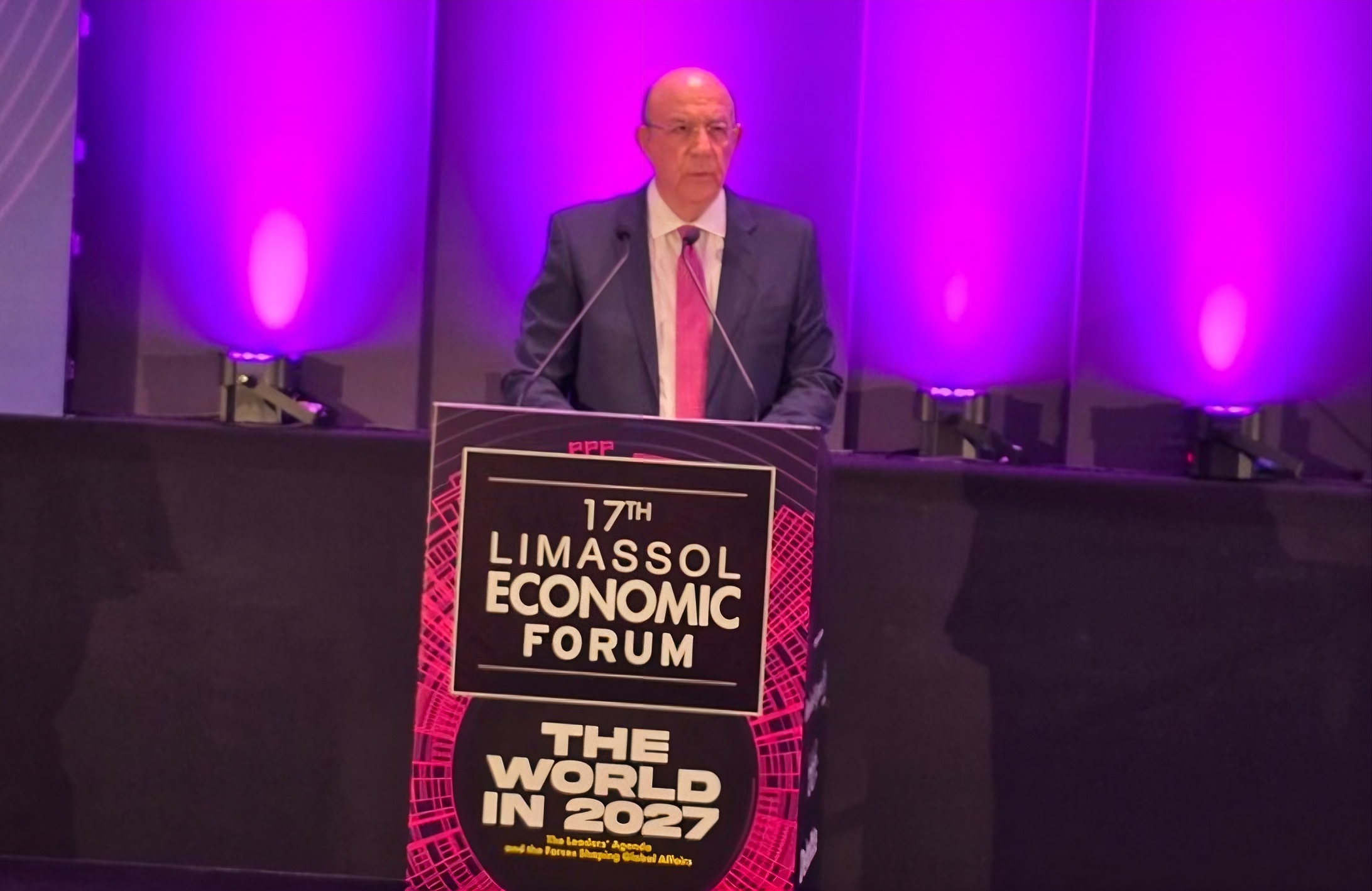
“Flexibility and commitment to fiscal stability are not mutually exclusive,” he added.
Turning to Cyprus, Keravnos said the country had strengthened its credibility and competitiveness through prudent fiscal policies, a gradual reduction in public debt, a stable financial system and structural reforms.
“The Cypriot economy has demonstrated remarkable resilience in recent years,” he said.
“Prudent fiscal policy, the gradual reduction of public debt, the stability of the financial system and the implementation of reforms have strengthened the country’s credibility and competitiveness,” the minister added.
He also highlighted the speed of the ongoing technological transition, warning that economies had to adapt to the changes it was bringing.
“Artificial intelligence is no longer optional,” he said, describing the technology as essential for improving productivity and competitiveness.
For this reason, Europe needed to increase investment in skills, research and technology, while ensuring that its existing strengths were channelled towards productive activities.
The bloc had significant advantages, including its universities, accumulated knowledge, traditions and culture, Keravnos said, but these needed to be translated into targeted investment and effective training for workers.
He also called for a reduction in bureaucracy, arguing that excessive administrative burdens could undermine Europe’s ability to respond to changing conditions.
Economic stability, he said, remained non-negotiable, but this did not mean Europe should be unable to adjust its policies to meet emerging challenges.
Turning again to Cyprus’ role within the bloc, Keravnos said the country was actively participating in European efforts despite its relatively small size, contributing to the development of common policies and solutions.
“Despite its small size, our country has demonstrated that it can make a meaningful contribution to shaping European policies and promoting common solutions,” he said.
As an EU member state in the eastern Mediterranean, Cyprus also had an important role to play in strengthening cooperation between Europe and the wider Middle East.
“Cyprus plays an important role as a bridge for cooperation between Europe and the wider Middle East region,” he said.
Energy security remains a key European priority, alongside resilient supply chains, the green transition and the development of cross-border infrastructure projects.
Cyprus was actively seeking to contribute to these efforts, Keravnos said, underlining the importance of cooperation in strengthening Europe’s energy security and addressing wider economic vulnerabilities.
He argued that current conditions demanded common action and a clear long-term vision, with Europe needing to make better use of its strengths and reinforce its economic competitiveness without increasing inequality.
The continent had the capacity to overcome its present difficulties and create better prospects for the future, provided it was willing to adapt to the changing international environment.
However, such adaptation should not come at the expense of the principles underpinning fiscal stability, economic responsibility and long-term prosperity.
“We must adapt to changing circumstances without moving away from the fundamental principles that safeguard fiscal stability, economic responsibility and long-term prosperity,” Keravnos said.
Summing up his message, he called for change without instability, adaptation without abandoning fundamental principles, and flexibility without compromising fiscal discipline.
“Change without losing stability. Adaptation without abandoning fundamental principles. Flexibility without retreating from fiscal discipline,” he concluded.



Click here to change your cookie preferences