
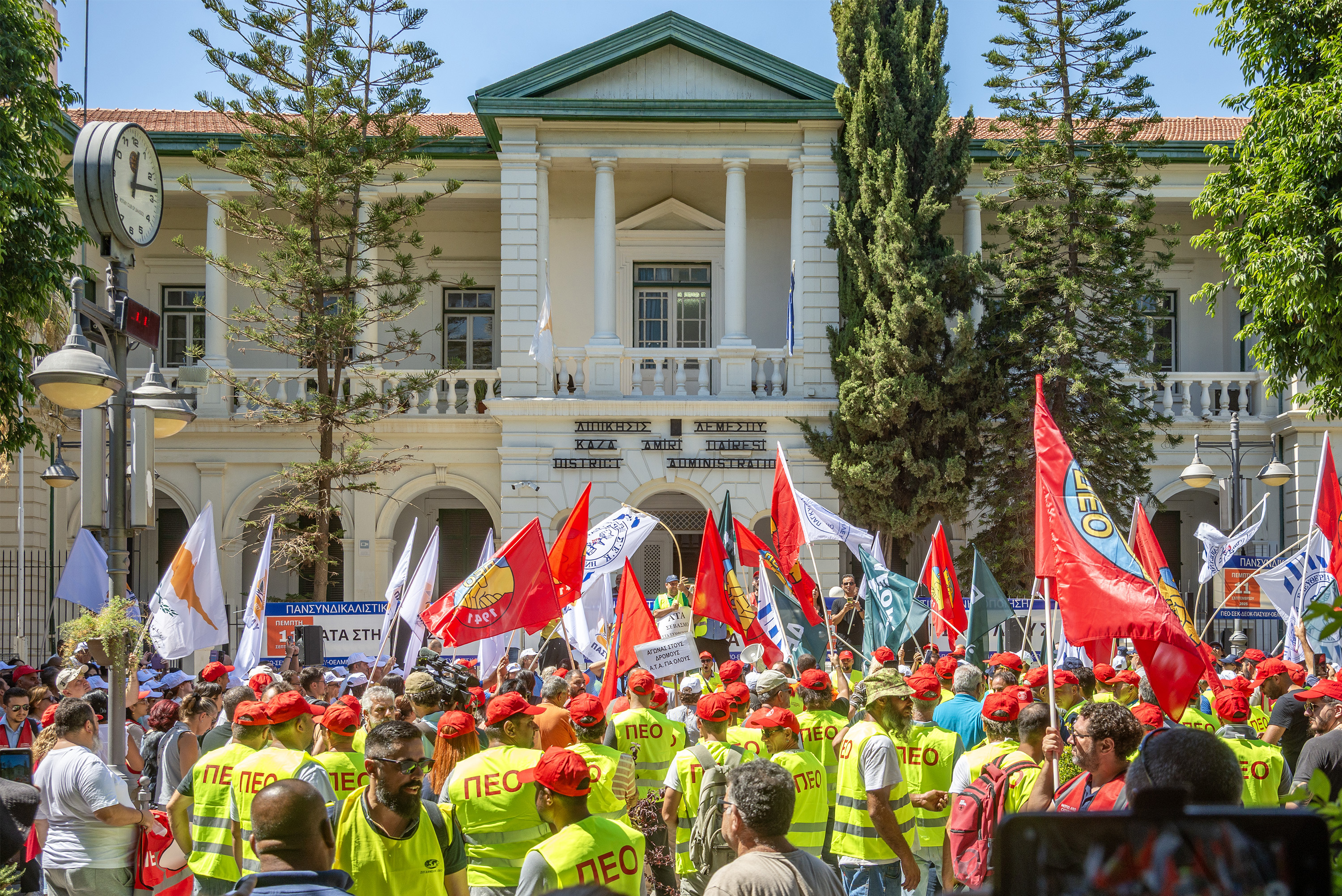
The government hopes that the contentious issue of the cost-of-living-allowance (CoLA) will at long last be settled after the employers’ side accepted its revised proposal, however the trade unions that met later on Tuesday appeared concerned and said they would be requesting an immediate meeting with President Nikos Christodoulides.
“We are concerned over the revised framework and the new approaches set out in the text that has been sent,” SEK general secretary Andreas Matsas said.
Matsas did not elaborate on the points that needed clarifying with Christodoulides.
“Our intention is to assess the facts and obtain some answers that are of particular importance,” he said.
Matsas added that the aim of the trade unions was to achieve the best possible agreement to the benefit of the workers.
PEO general secretary Sotiroulla Charalambous said that time mattered, but the content of the agreement was just as important.
Finance Minister Makis Keravnos said earlier on Tuesday that the “highest level of convergence” had been reached between the employers, the trade unions and the government, and expressed hope that the trade unions would take a decision in this spirit, which would help reach an agreement that will increase the income of workers.
The Employers and Industrialists Federation (OEV) and the Chamber of Commerce (Keve) in separate meetings accepted the differentiated CoLA framework and the ball is now in the unions’ court.
The four trade unions participating in the process – SEK, PEO, Deok and Pasydy – met on Tuesday afternoon to decide what to do with this new proposal.
Speaking after a cabinet meeting, Keravnos said consultations are continuous, both with the finance ministry and at a presidential level.
“I am looking forward to a happy ending to the process very soon,” he said.
He added that his assessment is based on “the logic which prevails among the social partners, the unions and on the employers’ side that none of us should let things lead to unpleasant developments”.
“At a time when the economy is on a good course, when there is a lack of human resources, I think logic will prevail and we will have a very good outcome soon,” Keravnos said.
The proposal, he said, was in the form of an “acceptable framework” and that some minor changes could be made, which is why consultations were continuing.
Keravnos said the government was willing to give incentives so that more employers would adopt CoLA and more employees would be covered. “This is the aim of the government,” he pointed out.
Earlier on Tuesday, deputy government spokesman Yiannis Antoniou said President Nikos Christodoulides was pressing on with efforts for an agreement and that developments could be expected soon.
Everyone is now on hold until the trade unions meet later in the day.
SEK’s general council convened on Tuesday morning, placing emphasis on CoLA.
In statements after the meeting, general secretary Andreas Matsas said the trade unions participating in the CoLA negotiating process would be meeting at 5.30pm to evaluate developments and collectively take decisions on the next steps.
Pasydy general secretary Stratis Mattheou said that during Tuesday’s meeting of the four trade unions, it was most likely that they would convene an all-trade union conference in the near future “to evaluate the situation and take decisions”.
The revised proposal sent to the employers and trade unions changes the wording of parts that led the former to reject it, namely that the finance and labour ministers would be authorised to take measures and provide incentives in order to broaden the base of workers receiving CoLA.
Sources said changes were also made to the wording of the clause linking CoLA to the national minimum wage.
Speaking after the SEK meeting, Matsas welcomed a European court decision published earlier on Tuesday, which would lead to better conditions of employment and the promotion of CoLA to cover all workers.
“It is now up to the government to utilise this decision. We are one of the five member states that has not approached the matter on the basis of obligations for member states,” he pointed out.
Matsas added that the decision met the expectations of the trade union.
For 2026, he said the union would be demanding significant pay rises during negotiations to renew collective agreements, that would take into account the disproportionate profitability of businesses in relation to the meagre increases in salaries.
These demands, he said, would also take into consideration the high cost of living and housing.
Emphasis will also be given to tax reforms, pensions, minimum wages, provident and welfare funds, health and safety at the workplace, and better personal-work time management.




Click here to change your cookie preferences