
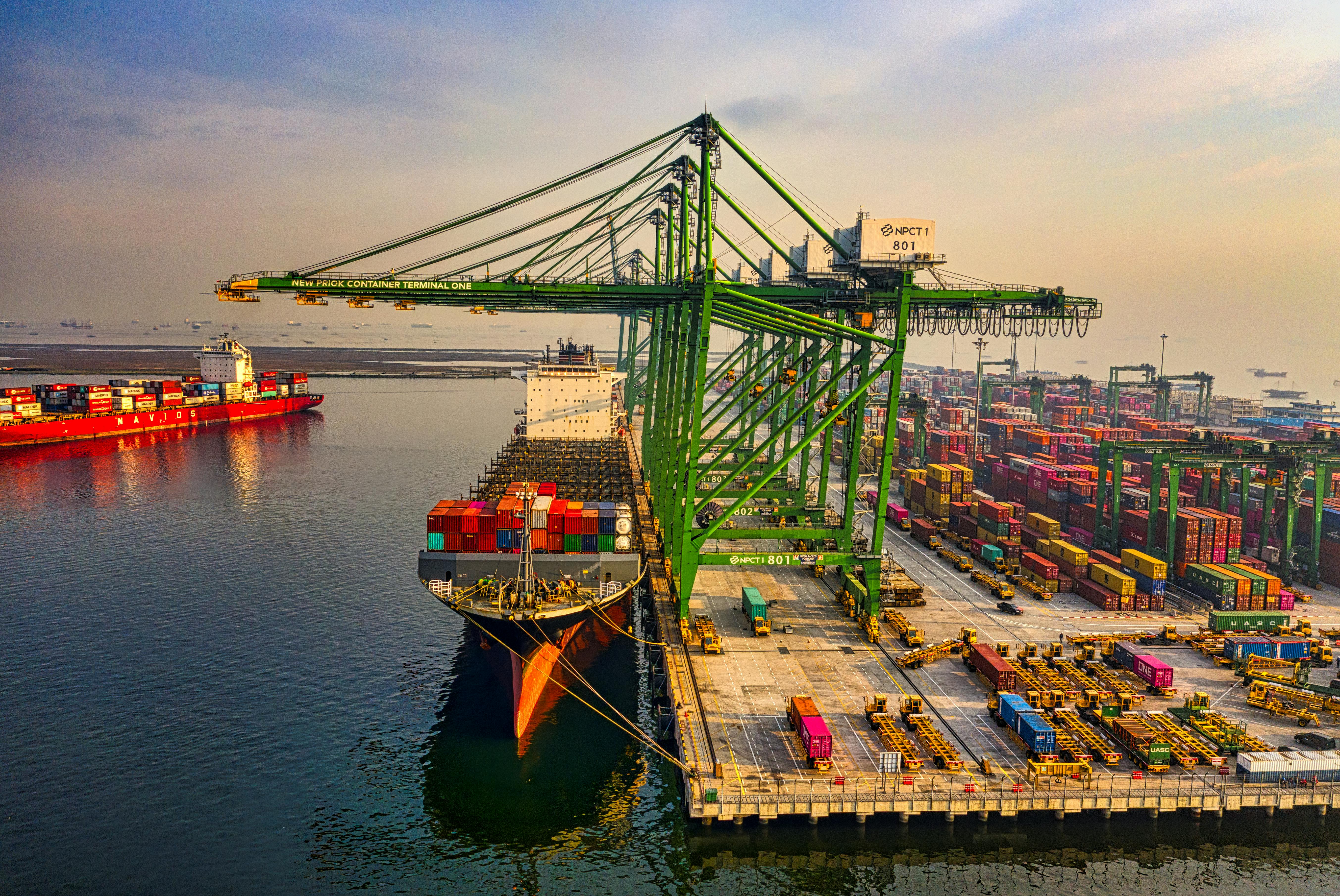
Piraeus remains Europe’s fifth-largest container port, holding its position despite the severe disruption caused by attacks in the Red Sea and the extensive rerouting of vessels around Africa.
Although the diversion temporarily weakened its long-standing advantage of proximity to the Suez Canal, the port’s overall performance proved resilient, and shipping lines are expected to restore Red Sea transits gradually in the coming months.
Across northern Europe, the three largest hubs, Rotterdam, Antwerp-Bruges and Hamburg, continue to dominate by a considerable margin.
According to PortEconomics, Hamburg delivered the strongest performance among them in early 2025, recording a rise of roughly 9.3 per cent in container throughput and overtaking both Rotterdam and Antwerp-Bruges in growth terms.
The shift reflects how evolving shipping alliances and renewed flows from Asia have favoured ports with deep hinterland connections and flexible inland rail links.
Rotterdam, meanwhile, posted stable container volumes, up three per cent to more than 10.7 million TEU, despite an overall decline in total cargo due to lower iron ore and petroleum movements.
Antwerp-Bruges reported a similar split, with total traffic contracting by 3.8 per cent but container flows rising by 1.6 per cent following a period of turbulence caused by the dissolution of older shipping alliances.
Further south, Valencia continued its steady ascent, recording a 3.6 per cent increase in TEUs and maintaining China as its most significant trading partner.
Vehicle movements remained stable, reinforcing the port’s diversified position even as total cargo edged slightly lower. A broader view of recent Mediterranean trends is reflected in analyses in ADAR’s overview of Europe’s largest port.
In Greece, Piraeus recorded a 1.66 per cent rise in container traffic for 2024, driven almost exclusively by Pier 1, where volumes surged by 32 per cent through expanded cooperation with MSC.
Activity at Piers II and III, operated by COSCO, slipped by around 2.4 per cent as the rerouting of Asia–Europe services around the Cape of Good Hope altered Mediterranean transshipment patterns.
Public data place total throughput at approximately 4.79 million TEU, confirming Piraeus’s position within Europe’s top five. The effect of the Red Sea disruption on Piraeus’s ranking is also highlighted in GTP’s reporting.
These developments mirror a broader global recovery. Lloyd’s List’s review of the world’s top 100 container ports shows aggregated throughput rising again in 2025 after several subdued years, signalling a cautious rebound in world trade.
Ports able to adjust quickly to shifting logistics patterns, whether through hinterland integration, digital infrastructure or operational agility, are capturing a disproportionate share of returning traffic.
While Mediterranean ports remain more exposed to geopolitical volatility, their emphasizing fundamentals remain intact. Should shipping lines resume the Red Sea–Suez route in the months ahead, flows through Piraeus and neighbouring hubs are likely to strengthen again.
For Cyprus, this shifting landscape carries strategic weight.
Although the island does not compete directly in container volumes, it plays a central role in European shipping as one of the continent’s largest registries and a leading ship-management centre.
Over the past two years, the Cyprus Ship Registry has grown by roughly 20 per cent in gross tonnage, reaching its highest level in two decades.
From September 2023 to the end of 2024, the flag expanded by around 18 per cent, with 198 new vessels registered and total gross tonnage surpassing 25 million.
Interest in the Cyprus Tonnage Tax System continues to rise, with the number of companies enrolled increasing by around 15 per cent.
Meanwhile, ship-management revenues, a core pillar of the sector, reached €918 million in the second half of 2024 and climbed further to €978 million in the first half of 2025, representing about 5.5 per cent of GDP for that period, according to the latest survey by the Central Bank of Cyprus (CBC).
These trends align with Cyprus’ strategic priorities for 2025–2027.
At the Maritime Cyprus 2025 conference in Limassol, regulators outlined plans to expand digitalisation, enhance port-state control, increase transparency in cargo-data flows and advance environmental objectives.
The Shipping Deputy Ministry reiterated these commitments in official statements available on the Government of Cyprus website.
Together, these developments reinforce Cyprus’ standing not only as a robust and reliable flag state but also as a maturing maritime-services hub supporting Europe’s broader shipping ecosystem, a role that takes on added significance as the island prepares for its EU Council Presidency in 2026.





Click here to change your cookie preferences