
Europe is allowing itself to be led by the US
With 2025 coming to a close, announcements for new energy developments and projects in Cyprus and the East Med have been coming in thick and fast, with something new announced every two days on average. An underlying common, factor behind many of these is a US strategy to establish energy dominance over a wide region that includes southeastern Europe and the Mediterranean, which aims to bring any dependence on Russian energy to an end and stop Chinese influence in the region.
Setting aside politicians’ tendency to overstate achievements, for the benefit of public consumption, these developments broadly follow five main strands:
- American strategy for the region: the US ambassadors to Greece and Turkey alluded to this in November
- Energy interconnectivity
- Settlement of maritime disputes
- Egypt’s insatiable thirst for natural gas and energy
- Geopolitical positioning
Even though there is frequent reference to European energy needs, the unfortunate fact is that European interests and influence in the region is largely lacking. Inexorably, Europe is allowing itself to be led by the US. Under President Trump, the US has become quite assertive in imposing its transactional energy policies, driven by both geopolitical goals and commercial interests in energy security and dominance.
American strategy for the region
The epitome of this policy culminated at the P-TEC high level summit that took place in Athens on November 6-7, attended by three senior ministers from Trump’s administration, energy ministers from 25 countries across Europe, US super-majors ExxonMobil and Chevron and the US International Development Finance Corporation and the US Export-Import Bank.
The US is promoting two energy corridors:
- A north-south corridor from Ukraine to Israel, placing Greece at the centre of it
- An east-west corridor from the Caspian to Europe, placing Turkey at the centre of it.
This strategy is led on the ground by specially chosen US Ambassadors to Greece, Cyprus, Israel and Turkey, allies of President Trump, and Massad Bulos, father-in-law of Trump’s daughter, appointed by Trump as his senior advisor for North Africa and the Middle East.
Many of the projects announced recently fall under this strand. These include:
- The Vertical Gas Corridor
- Investments in Greece’s energy infrastructure
- Deals to buy US LNG
- ExxonMobil and Chevron participation in offshore hydrocarbon exploration south and southwest of Crete
- ExxonMobil participation in block 2 in the Ionian, planning drilling in 2027
- Possible return of Chevron to Libya
- Expansion of ExxonMobil and Chevron exploration in Egypt
- Possible participation of DFC in GSI
- BlackRock expression of interest to participate in ADMIE
These fit the broader objective of American energy dominance.
Energy interconnectivity
This includes a number of projects announced recently to improve natural gas interconnectivity between Greece, Bulgaria, Romania, Moldova and Ukraine, based on LNG through Greece and Caspian gas.
It also includes electrical interconnectivity through projects such as GSI, to connect Cyprus and Israel through Greece to Europe, and GREGY, to connect Egypt and Greece to Europe.
The recently announced Lebanon-Cyprus interconnection forms part of this, but has a long way to go.
Energy interconnectivity also includes the IMEC corridor that, even though its main purpose is economic and commercial, an important element of it is energy. GSI is likely to form part of IMEC, something that would strengthen the project geopolitically.
Settlement of maritime disputes
Achieving the American energy strategy for the region requires resolution of the key problems affecting this part of the world, including maritime disputes.
Mitsotakis’ call on October 17 to convene a meeting/forum inviting Turkey, Egypt, Cyprus and Libya to meet and address disputes over maritime zones and related issues is part of this.
So is the signing of the EEZ delineation agreement between Cyprus and Lebanon, that reinforces the application of UNCLOS in the region and paves the way to renew exploration offshore Lebanon.
The US message is: “We don’t want to see any party interfere with the mutually-beneficial expansion of energy infrastructure.”
Egypt’s insatiable thirst for natural gas and energy
Egypt is the biggest country in the region, highly dependent on natural gas for its energy and petrochemicals production. Demand for gas has been increasing by about one to two per cent per year, in line with its population growth. But faltering gas production from Zohr and Egypt’s lack of new, major discoveries have left the country increasingly dependent on gas imports mainly from Israel and LNG. Egypt’s needs are so great it can absorb all free-for-export gas in the region.
Israel and Egypt signed a deal in August that would effectively double Israeli gas exports to the country, using Leviathan gas. But regional geopolitics and concern about potential impact on Israeli electricity prices have led to Israel to temporarily freeze the project, but it is about to be approved.
That forced Egypt to rely more on expensive LNG imports. Not only did the country become the biggest LNG importer this year, but it is finalising a $4billion contract to import US LNG next year.
Cyprus is coming to the rescue. Development of the 2.5tcf Cronos gasfield is well progressed, with exports destined to reach Egypt early 2028. Aphrodite could follow by 2031, provided FID is achieved by next year. Resolution of the Aphrodite-Ishai dispute makes this easier.
Egypt has been taking measures to increase domestic gas production. It has just announced $5.7billion investments to drill 480 new wells by 2030, to reverse production declines.
In November, Eni announced plans to invest $8billion over the next five years to increase gas production in the country. In the same vein, ExxonMobil and Chevron have acquired additional acreage adjacent to their existing blocks offshore Egypt.
Geopolitical positioning
The challenging politics of the region, from Gaza, to Israel, Lebanon, Syria and Libya, continue to dominate, but energy-related issues see the US quietly working towards reunification of Libya and being actively involved in the rehabilitation of Syria.
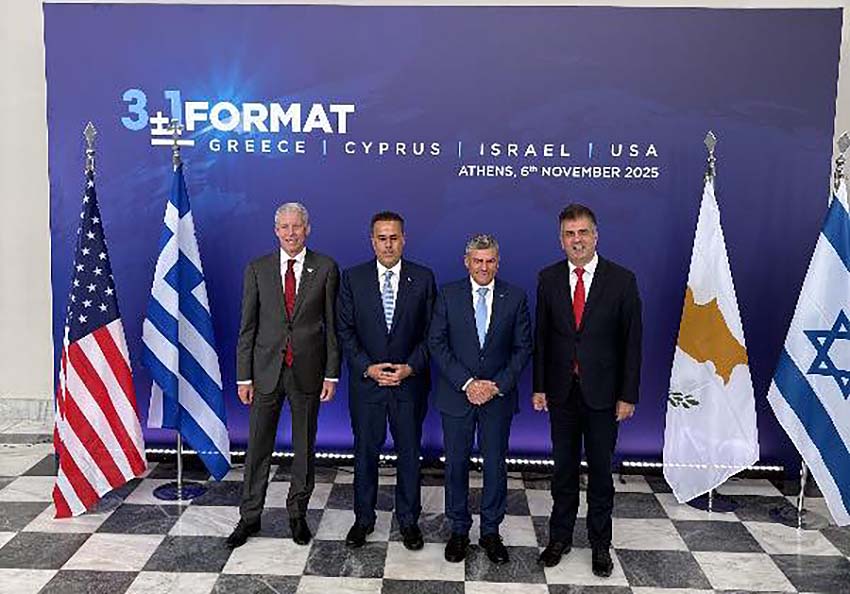
The revival of the 3+1 at the P-TEC summit is a prominent example of geopolitical positioning in the region. With the participation of the US, its purpose is to push for regional energy connectivity and security and reduction of reliance on “malign actors.”
Cyprus
The pressing issue in Cyprus is the import of gas to replace expensive, but also highly polluting, diesel for power generation. Ex-energy minister George Papanastasiou was cautiously optimistic on the prospects of completing the stalled project to import LNG to Cyprus, especially as the FSRU Prometheus is now ready.
In the meantime, he was considering a proposal by Energean to export 0.5-1.0bcm/yr gas from its Israeli gasfields to Cyprus for power generation.
With most of these developments at early stages, energy is expected to continue playing a major role next year around the East Med and the wider region.




Click here to change your cookie preferences