
The affairs of other countries will only concern the US if their activities threaten US core interests
President Trump’s National Security Strategy 2025 is a brief policy statement about a hugely controversial shift in US foreign policy away from the EU and Nato in favour of sovereign states and regional partners that set the cat among the pigeons in European capitals last week.
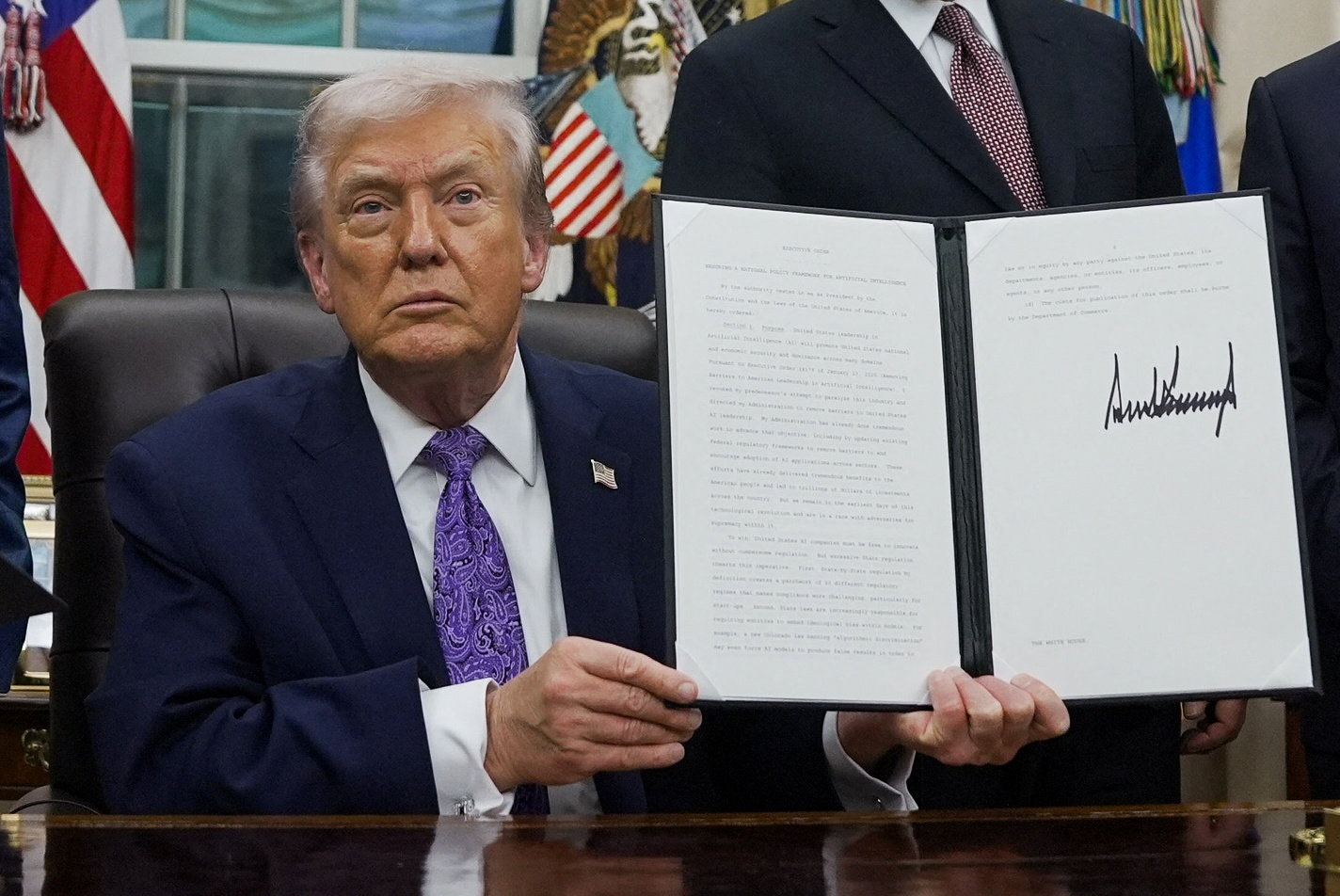
The new policy is signed off by President Trump himself in his familiar signature reminiscent of the teeth of the great white in the 1975 film Jaws. Trump loves his signature so much he shows it off every time he signs one of his many executive orders. He even claimed he prefers to sign cheques instead of making online bank transfers.
In a short introduction to the new policy, Trump explains that it is designed to ensure America remains the greatest and most successful country in history. The US is no longer prepared, however, to pay any price, bear any burden and support any friend as it used to during the Cold War.
Word War II merged into the Cold War and when that ended with the peaceful collapse of the Soviet Union in 1991, America was bound to disengage from Europe sooner or later. The only surprise is that it took so long.
We are told the new foreign policy is going to be pragmatic without being pragmatist, principled without being idealistic and muscular without being hawkish, or less rhetorically flexible and undogmatic. The new thinking is that permanent American domination of the world is not in America’s interests and that not every country, region, issue or cause engages core American interests.
The affairs of other countries will only concern the US if their activities threaten US core interests. However lofty the cause, it will no longer be of interest to America — basically the US will not allow other powers to become dominant or regionally dominant if it is contrary to US interests.
According to the US administration, the Middle East is no longer the energy source or big power competition, and the region is on the mend after the ceasefire in Gaza and the hope is that America’s involvement in the region will recede in time — hope springs eternal though probably not in Israel-Palestine. Syria remains a potential problem but Trump believes that with American, Arab, Turkish and Israeli support Syria may be stabilised.
Although China is America’s biggest rival in the world and in the Asia Pacific region, the US strategic review downplays its rivalry with the People’s Republic of China (PRC). What concerns the administration is rebalancing trade with the PRC and maintaining economic and technological superiority. As far as Taiwan is concerned, it is hoped US military superiority will deter conflict and prevent unilateral change in the status in the Taiwan straits — which is not very reassuring for Taiwan.
In Central and South America, US core interests are fully engaged automatically as it regards itself as the pre-eminent country in the western hemisphere. The Trump doctrine on the western hemisphere builds on the Monroe doctrine that warned off European interference in the new world in the 19th century that was primarily directed at Spain, France and Russia.
The Trump doctrine in the 21st century for the western hemisphere is primarily directed at Chinese economic expansion there — in Panama in particular — and the control of illegal immigration and the importation of illicit drugs into the US.
The US is currently engaged in military operations against Venezuela and has also threatened Columbia as its next target — both are sources of narco trade and illegal immigration.
Mass migration in the US as well as Europe is a major concern of Trump’s national security strategy. The draconian steps taken in the US to stop and reverse immigration are not always the actions of a civilised state but as Trump was elected to stop and reverse immigration, he is free to do so if it is lawful under the US constitution.
What is difficult to comprehend is US national security concerns about immigration in Europe and its support for hard right parties — misnamed patriotic parties — which some European countries condemned as an interference in their internal politics.
There are well-known historical reasons why Europeans mistrust extremist parties of the hard right, and they do not take too kindly to lectures on democracy or that they are in danger of civilisational erasure — which is what happened to Native Americans in the US but not at all likely in Europe.
The EU and other transnational bodies are condemned as undermining political liberty, national sovereignty, censorship of free speech, suppression of political opposition and loss of national identity and national self-confidence — assertions that are not supported by facts.
In a passage that should worry Europe and Ukraine, the document complains that previous US administrations had allowed European allies to offload the cost of their defence and suck the US into conflicts central to their defence but marginal to the US.
The US now accepts not only that American military interventions worldwide were wrong but implicitly that Nato expansion eastwards into Russia’s backyard was also wrong. The new strategy is to end Nato as a perpetually expanding alliance, which must be music to the ears of Russian President Putin.
It is, however, a slap in the face of Ukraine that committed itself to Nato membership at huge cost to its people only to discover that it seems the US regrets encouraging Nato’s eastward enlargement and wants to end its further expansion in Russia’s backyard.
The 2025 US national security strategy does not take sides between Ukraine and Russia. It laments the deterioration of relations between Europe and Russia on account of Russia’s invasion of Ukraine and sees its role as being to manage their relationship diplomatically to restore strategic stability in the Eurasian landmass and mitigate the risk of conflict between Europe and Russia.
So, would someone please tell Nato secretary-general Mark Rutte to stop talking up the prospect of war in Europe against Russia? He should talk softly about peace if he wants to be taken seriously as a military leader.
Most military commanders with experience of war think it is a mug’s game.
US President Dwight D Eisenhower Supreme Allied Commander 1944-45 and president 1952-60 said as much: “I hate war as only a soldier who has lived it can, only as one who has seen its brutality, its futility, its stupidity.”




Click here to change your cookie preferences