
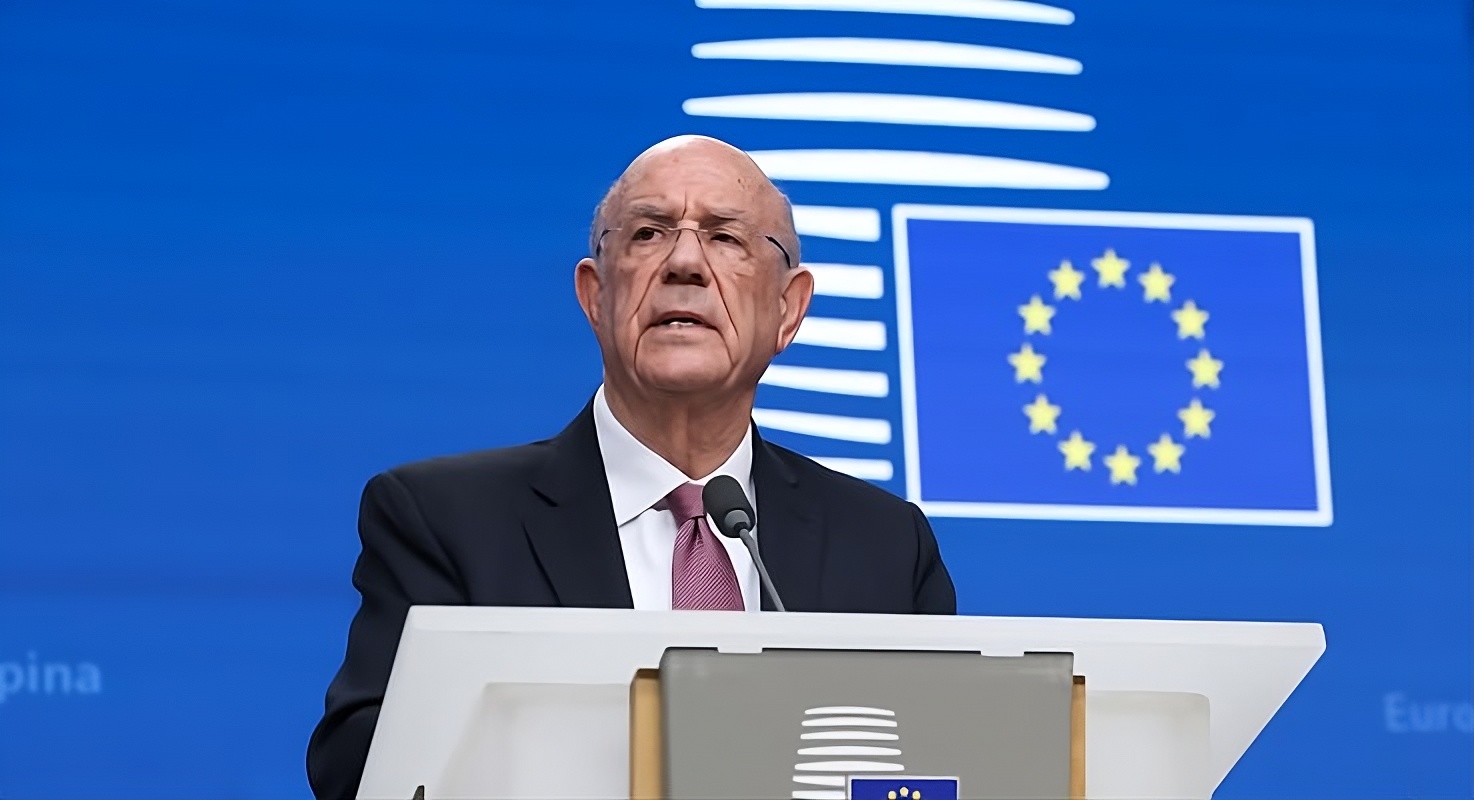
EU finance ministers assess economic impact of Middle East conflict
Finance minister Makis Keravnos, who currently serves as president of the EU Economic and Financial Affairs Council (ECOFIN), on Tuesday reassured the international community that life in Cyprus continues normally and safely, despite the island’s indirect involvement in the ongoing war in the Middle East.
Speaking upon his arrival at the ECOFIN council meeting, Keravnos delivered a message of stability and normality, stressing that Cyprus remains secure even though it lies in a region affected by the conflict involving Iran.
“Cyprus geographically is located in the wider region where there are currently some hostilities due to the war with Iran,” said Keravnos.
“We have taken certain precautionary measures,” he added.
“Life in Cyprus is proceeding normally and safely,” he continued. “The airspace is always open.”
The Cypriot Finance Minister further used his brief interaction with the media to express his “sincere thanks for the immediate reaction of the European Union regarding the protection of our citizens”.
At the same time, the finance minister indicated that the economic implications of the ongoing conflict would be discussed during the ECOFIN meeting.
The issue had already been examined a day earlier during discussions at the Eurogroup meeting, although no formal decisions were taken at that stage.
Keravnos explained that European finance ministers would assess how the evolving situation could affect the broader economic outlook.
“The ministers will discuss today the situation in the international economy and in the European economy and how it is affected by all the negative developments,” Keravnos concluded.
Following the meeting, Keravnos said that finance ministers held an extensive discussion on the potential impact of the war in the Middle East on the European economy.
Although no specific decisions were taken, ministers highlighted the importance of strengthening the resilience of the European energy market through the promotion of necessary infrastructure projects, including electricity interconnections between EU member states.
During a press conference after the meeting, Keravnos said that ministers had been briefed by the European Commission on the latest economic developments “in light of recent geopolitical events“, with particular emphasis on the impact of the war involving the United States and Israel against Iran on fuel prices and the wider economic environment.
Within the same context, the minister informed his counterparts about the situation in Cyprus and expressed his “deep appreciation” for the immediate solidarity shown by European partners.
“I would like to take the opportunity to publicly thank Greece, France, Italy, Spain and the Netherlands for their tangible support,” said Keravnos.
“This support underlines the importance of European unity and solidarity,” he added.
Beyond the immediate impact of the conflict on the energy market, discussions also focused on electricity interconnections between EU member states.
Keravnos pointed out that 25 of the EU’s 27 member states are already interconnected, although this has not prevented energy prices from remaining at elevated levels.
The meeting also addressed developments related to Ukraine, with the European Commission presenting ministers with an overview of the country’s immediate financing needs and the progress of European and international support.
At the same time, ministers reviewed the condition of the Russian economy.
According to Keravnos, the Russian economy showed “signs of increased pressure” during 2025, demonstrating that the European approach is having an impact on Russia’s ability to continue the war.





Click here to change your cookie preferences