
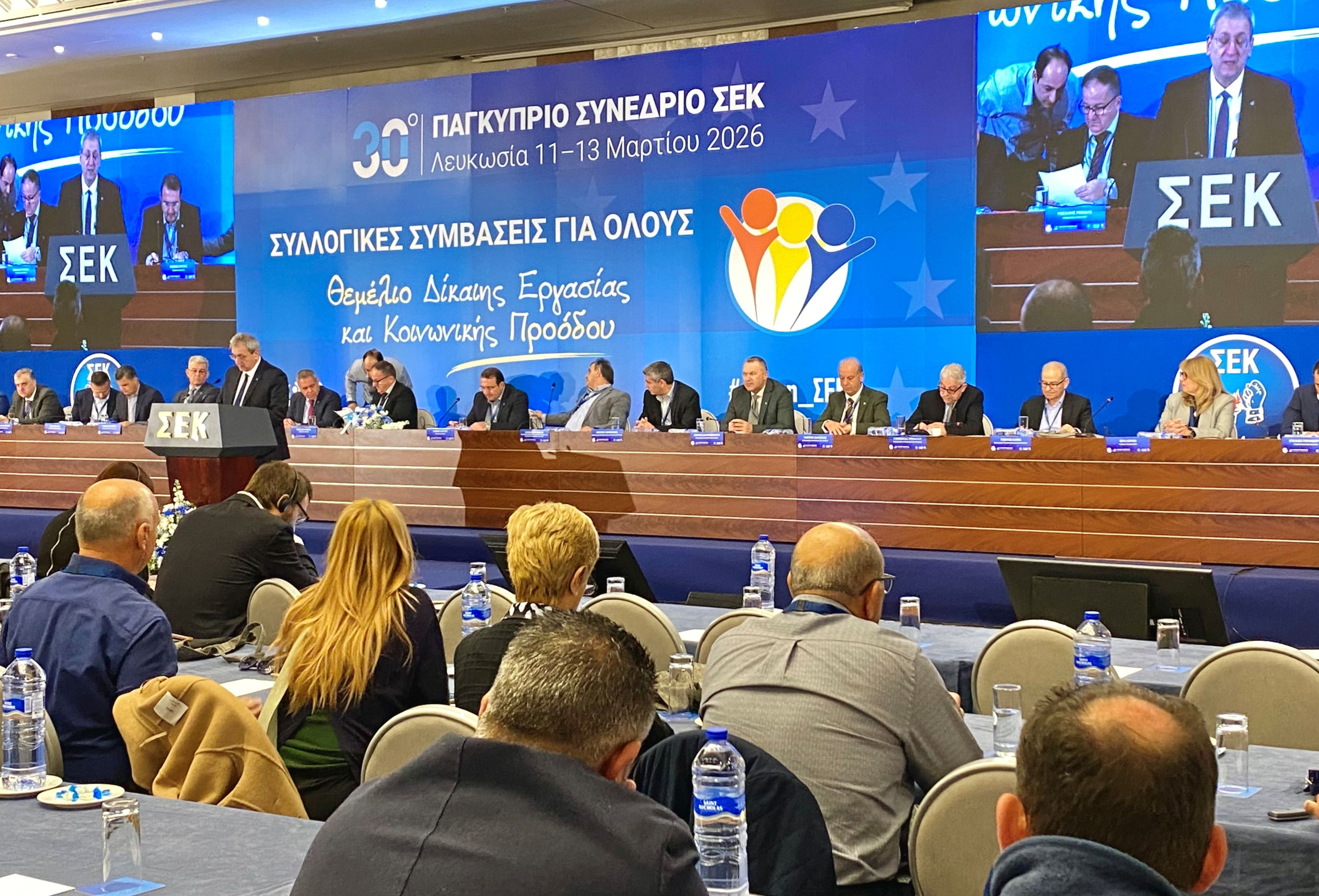
Building a pension system that honours a lifetime of work while supporting younger generations is both the greatest challenge and the greatest opportunity, Labour Minister Marinos Moushiouttas said on Thursday.
Addressing the second day of the 30th congress of SEK in Nicosia, Moushiouttas outlined his ministry’s priorities and stressed the importance of social dialogue and realism in discussions on pension reform, which he described as the flagship of the ministry’s social agenda.
“The aim is to conclude discussions on the reform in the new House within 2026 so that it can be implemented in 2027,” he said, adding that full implementation could take “at least three years”.
Parliamentary elections will be held on May 24.
Moushiouttas said the timeline confirmed that the reform was a “measurable political commitment that requires cooperation and responsibility from us all”.
The minister praised SEK for its struggles over the decades and noted that “social dialogue, when it is substantive and sincere, acts as a pillar of social peace, progress and cohesion”.
He furthermore referred to efforts to strengthen collective agreements, improve the minimum wage and close the gap of pay inequalities.
A bill is expected to be submitted to the House by the end of March, which he described as “an institutional intervention directly linked to strengthening collective negotiations and ensuring that the minimum wage is adequate”.
“The contribution of trade unions is necessary to draft in unison the important policies we have before us,” he added.
Delegates to the congress had the opportunity to ask questions, which had to do inter alia with delays in the payment of social insurance benefits and the possibility of cutting high pensions to strengthen lower ones.
Moushiouttas admitted benefits should be paid sooner and that digitalising them – expected to be concluded in June – would contribute towards this.
Replying to pension reform questions, the minister said discussions were still ongoing and, although he was not against the proposal to take from one and give to the other, a better alternative had been found.
This, he explained, involved correcting weaknesses in the social insurance system to prevent losses and then strengthening pensions.
He also said that for at least the next decade the retirement age would remain at 65.
SEK general secretary Andreas Matsas, taking the podium, said it was evident that “a fresh breeze was blowing at the ministry”.
Referring to the pension system, Matsas added: “We cannot make concessions that would adversely affect workers in their new capacity as pensioners.”
The congress began on Wednesday and will conclude on Friday with the approval of a joint policy paper and elections for the union’s leadership.





Click here to change your cookie preferences