
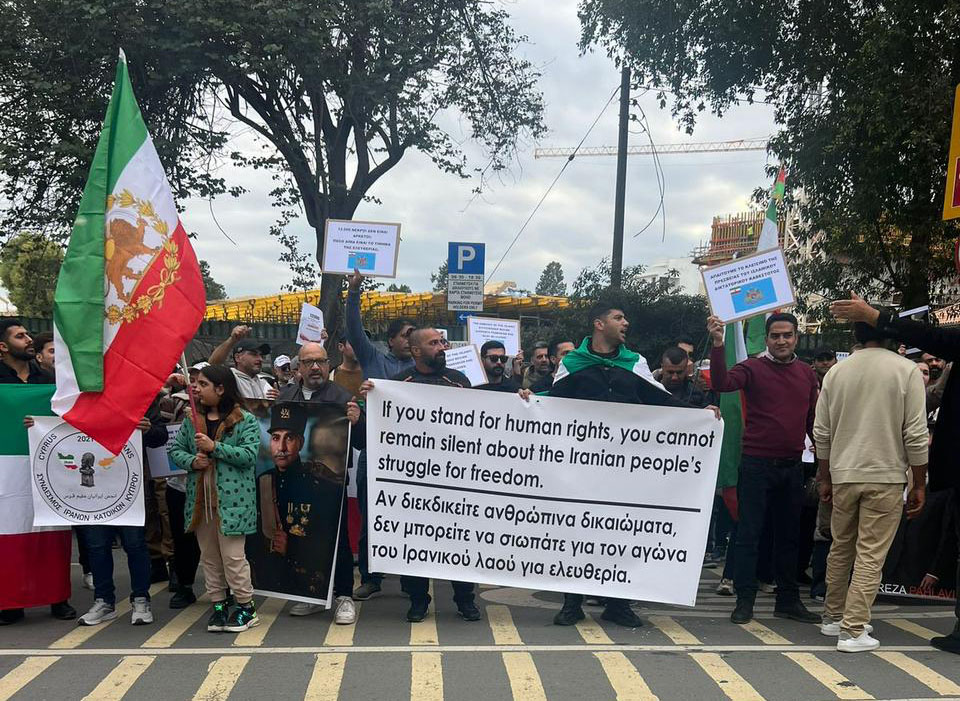
What the Iranian diaspora in Cyprus think of the war
The whole world is watching the US and Israel’s war with Iran. But no-one’s watching as attentively – or with such a knot in their stomach – as the Iranian diaspora, including of course in Cyprus.
According to figures supplied by the Iranian embassy, there are currently around 3,000 Iranian citizens in the Republic, of whom 90 are students, and around 15,000 in the north, of whom almost a third (4,500) are students.
Many, or most, haven’t lived in Iran for years – but that doesn’t lessen the distress of watching their country get bombed, unable to communicate with loved ones and increasingly afraid for their safety.
One interviewee was unavailable at the appointed time, then sent a text postponing our interview: “Yesterday was a difficult day in Tehran, and I don’t have any news of my mother as they bombed the area very near my mum’s house. I’m trying to find a way to call her. Things are going towards very bad…”
“They are attacking civilians now,” came the grim addendum in a follow-up text.
That person – as implied by their addendum – is vehemently against the war. Others, paradoxically, are mixed, their sadness tempered by hopes of regime change. “We asked for this war. We screamed for this war,” the Cyprus Mail was told by a student in the north, who declined to be named for fear of reprisal.
The situation is apparently different once you cross the Green Line. Iran’s Revolutionary Guard (IRGC) has a presence in the north, says that student, and has threatened those involved in protests. Many Iranians there, according to another source, arrived quite recently – and include high officials “with no money problems” who’ve bought homes where they plan to send their families for safety, if the regime collapses.
Iranians in the Republic, on the other hand, are almost uniformly anti-regime, having arrived years ago as refugees and asylum seekers – though there’s still some diversity in their backgrounds and occupations.
58-year-old Ali, for instance (not his real name), is a house painter. Maryam (30) and Reza (44) work in media. Sara (43, not her real name) is a life coach. Hoseyn (44) is a car body repairer.
Reza is the most gung-ho when it comes to the war, which he calls an ‘intervention’ – a way “to crack down on oppressive forces” and level the battlefield, weakening the mullahs and allowing the Iranian people, led by crown prince Reza Pahlavi, “in the right time, when they have enough support and strength, [to] take to the streets and hopefully topple the regime”.
Some of the others are more ambivalent. Even Ali, however, who admits he feels awful at the moment – “I hear the bad news from Persia, and it’s like going through hell every day” – vacillates between pain and hope for a new Iran.
“Because enough is enough,” he declares. “How much killing, how much will they torture people – and for what? For an ideology that doesn’t make sense in 2026.”
Ideology is the major reason why dissidents flee – though not the only one. Ali’s own case is intriguing. He was making decent money when he left in 2001, working on a natural-gas pipeline project – but, because his extended family included some known Communists, “I wasn’t allowed to work in a bank, say, or a refinery, or a government job”, leaving him oppressed and resentful.
In other words, the regime didn’t alienate him due to being a theocracy. It wasn’t Islam, or the moral codes. The problem was the mullahs acting like any corrupt one-party state, saving the plum jobs for ‘their’ people and forcing menial jobs on everyone else.
Political and economic reasons often dovetail. 22-year-old Ghazal, the youngest person we talked to, is also a student in the north. She left in 2023 after the protests sparked by the death of Mahsa Amini, another 22-year-old who died in custody after being arrested for not wearing hijab.
“They started killing the young generation, which is my age,” she says. “So I couldn’t see any future there, that’s why I left my country.” Yet Ghazal wasn’t part of the protests, nor is she especially political. Instead, she mentions that salaries are very bad in Iran, and “you can’t enter a really nice company which is connected to the government” unless you know someone. Corruption again.
Then again, in many other cases, it is indeed theocracy and moral codes that drive people out.
Everyone seems to have a horror story – especially the women. Maryam’s mother was arrested for wearing makeup, Sara’s for wearing nail polish. Maryam herself, while on holiday in Iran (she’s lived in Cyprus since she was six years old), was accosted by morality police and threatened with arrest for sampling a single pistachio from a market stall during Ramadan, when Muslims are supposed to be fasting.
“My whole life was a nightmare. I mean, because of the regime,” says Sara, who fled Iran in 2016. “Because of living under the stress of them. Always feeling that somebody is checking you. Somebody is looking if your hair is out. Somebody will take you to jail, and lash you.”
At 19 – some 24 years ago, when morality codes were admittedly more draconian – she was arrested in the street for wearing hijab improperly (it was loose, and her hair was showing), spent a night in prison unable to sleep, afraid she might be raped at any moment – meanwhile, her parents were frantically trying to bribe her way out – then the next day received 70 lashes.
The blows were delivered in a very specific way, with a policeman holding the Koran under the arm doing the whipping – presumably so the lash wouldn’t land full-force. Still, “it wasn’t just for show. All of my back was just… The skin was gone”.
24 years later, Iran is at war – and “I hope every day that I wake up and I see that it’s finished,” she sighs. “I never imagined that this regime is so interwoven everywhere – that it’s so difficult to cut all of its hands. It’s like…”
“An octopus,” says Reza.
“Like a big octopus,” she agrees. “A monster octopus.”
What will happen in the war? Ali says the US needs to commit ground troops – adding that, if they do, they’re unlikely to face much resistance, since the army deeply resents the IRGC and won’t agree to being used as cannon fodder.
This regime, says Reza, “has absolutely zero legitimacy, both on the world stage and also with its own people… They will be gone one way or the other – maybe soon, maybe a little bit later.”
But then what? Surely he agrees that the US and Israel want a weakened Iran? Even if the war is won, and the government falls, might this be a case – from Iranians’ point of view – of ‘The operation was a success, but the patient died’?
“Iran has already been weak for decades,” replies Reza. “Because of sanctions, because of [the regime] not investing in the country and its people, and trying to fund militia groups and proxies across the region. So Iran has been on the downhill road since the revolution in 1979…
“Of course Iranians are not naïve. They know that each country has their own agenda, they have their national interests. But what’s different this time is that their interest” – meaning the US and Israel’s – “is aligned with the people’s interests.”
Meanwhile the war continues, and so does the diaspora’s somewhat schizophrenic reality: deeply invested in their homeland, yet also apart from it.
It’s hard to know how far these liberal-minded, righteously angry exiles (who are either secular, or Christian converts) are representative of the whole population. Still, they insist that those inside Iran are just as fed up – and willing the regime to lose – as most of those in Cyprus.
Communication is extremely limited, with the internet down and phone calls expensive (and closely monitored). Still, Sara reports that she received a voicemail from a friend a few days ago: “I am afraid,” said her friend, “when I don’t hear bombing” – since it means the war may be ending, with the regime still intact. That’s quite a statement.


Click here to change your cookie preferences