
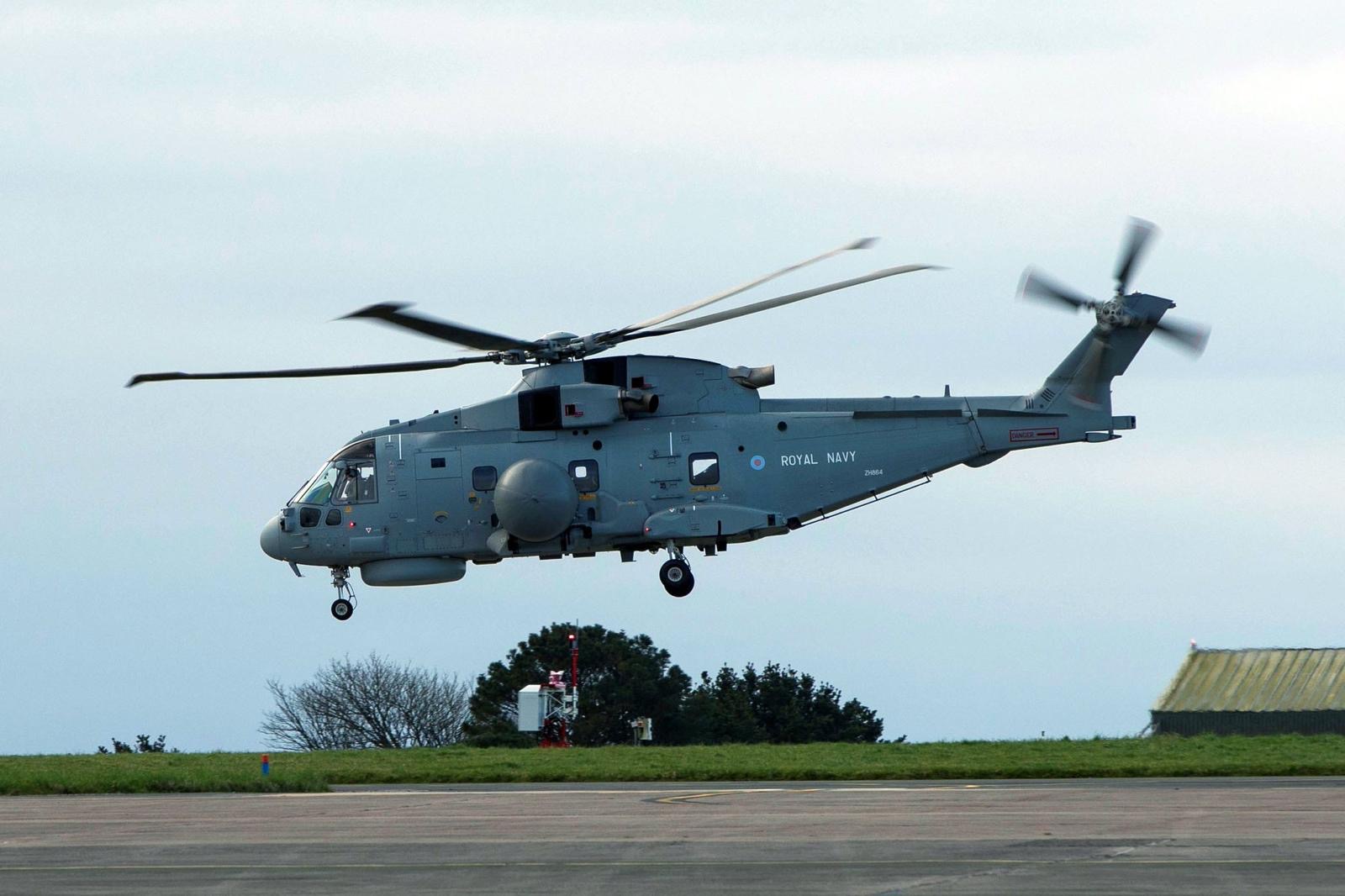
Two more Merlin Mk2 helicopters have arrived at Cyprus’ British Akrotiri air force base, the British defence ministry has said.
The helicopters’ arrival brings the total number of British Merlin helicopters on the island to four, with the ministry saying that the helicopters can “fly up to a mile in height” and that they will “provide airborne surveillance and long-range maritime, land, and air tracking capabilities”.
They will join a growing array of British military equipment in Cyprus, with eight Typhoon fighter jets and eight F-35 fighter jets currently stationed at Akrotiri, alongside three AW159 Wildcat helicopters and the initial two Merlin Mk2 helicopters.
According to the BBC, the Wildcat helicopters are equipped with “short-range air defence missiles”, while the Merlin helicopters are equipped with “early warning radar” systems.
At sea, the Type 45 destroyer warship the HMS Dragon was sent from the United Kingdom’s mainland to the waters off Cyprus, but has now docked for maintenance and is as such out of action.
The continued bolstering of the UK’s military presence on the island comes after British forces’ Cyprus commander major general Tom Bewick said the British bases on the island could “easily be targeted again”, with a little over a month having passed since Akrotiri was hit by an Iranian-made drone.
“One would be a fool not to take the Iranians at their word,” he told the BBC, though he did stress that the damage caused by the drone was “minimal”.
He did, however, say that he “suspects” that those who coordinated the tack “hit what they were aiming at”.
That target is estimated to be a hangar at the base which houses American Lockheed U-2 reconnaissance aircraft, which are known to fly reconnaissance missions over the Middle East from Akrotiri as part of what is known as “Operation Olive Harvest”.
The bolstering of the UK’s military presence on the island comes with the Cypriot government appearing minded to attempt to renegotiate the British bases’ status, with President Nikos Christodoulides having said on Tuesday that he has a “specific plan” for the bases’ future.
Earlier, the European Council had declared last month that it stands ready to assist” the Cypriot government in discussions regarding the bases’ future and stating that it “acknowledges the intention of Cyprus to initiate a discussion with the UK” on the matter.
Prior to that summit, Christodoulides had promised that “we are going to have an open and frank discussion with the British government” over the future of the bases.
Those comments come a day after he had described the bases as a “colonial remnant”, though he did say that the “level of cooperation” between the British and Cypriot governments is “extremely positive”.
Later, deputy government spokesman Yiannis Antoniou said that the government has sought and received legal advice regarding the treaty which established the bases, adding that “the issue of security is complex and will be the subject of discussion with the British side”.
The Treaty of Establishment of the Republic of Cyprus entered force in 1960, having been signed by the leaders of the Greek Cypriot and Turkish Cypriot communities of the day Archbishop Makarios III and Dr Fazil Kucuk, who would go on to become the republic’s first president and vice president.
Its first article states that “the territory of the Republic of Cyprus shall comprise the island of Cyprus, together with the islands lying off its coast, with the exception of the two areas … which shall remain under the sovereignty of the United Kingdom” – the base areas in Akrotiri and Dhekelia.
In a later article, the same treaty states that “the United Kingdom authorities shall have the right for United Kingdom military aircraft to fly in the airspace over the territory of the Republic of Cyprus without restriction other than to have due regard for the safety of other aircraft and the safety of life and property in the Republic of Cyprus”.
More recently, Kourion mayor Pantelis Georgiou had said he believes that communications antennae installed at the base may be linked to an elevated risk of cancer and said that like the central government, he, too, is seeking legal advice regarding the British government’s plans.
However, others have warned that the political situation on the island is not conducive to a renegotiation of the bases’ status, with former Turkish Cypriot leader Mehmet Ali Talat having told the Cyprus Mail that it is “impossible” to abolish the bases without first solving the Cyprus problem.
“The Greek Cypriot leadership wants to say, ‘I am the state and I am the sole decision-maker on such matters’. It is impossible for the Turkish Cypriot side to accept this. Therefore, it would be best to address the issue by prioritising a solution to the Cyprus problem,” he said.
Nonetheless, he said that once that Cyprus problem is resolved, “the British sovereign bases must certainly be removed”.



Click here to change your cookie preferences