
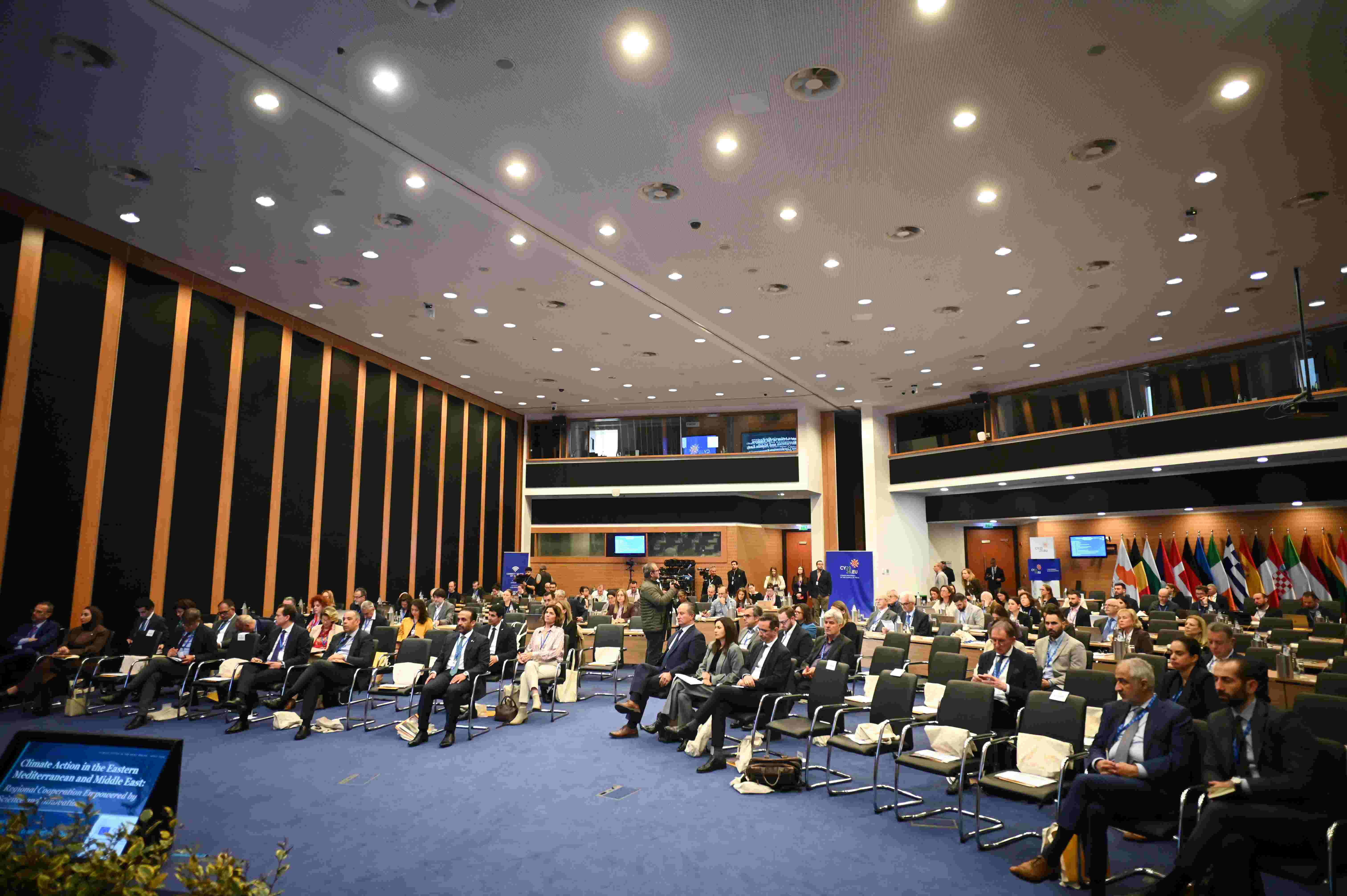
Cyprus used a conference held under its presidency of the Council of the European Union on April 8 and 9 to adopt the Nicosia Call for Action, a statement urging stronger regional cooperation on climate action across the Eastern Mediterranean and Middle East through science, innovation and diplomacy.
The conference, entitled “Climate Action in the Eastern Mediterranean and Middle East: Regional Cooperation Empowered by Science and Innovation”, brought together government officials, policymakers, prominent scientists and representatives of international organisations.
The focus was scientific cooperation and science diplomacy within the Eastern Mediterranean and Middle East (EMME), which the statement described as one of the world’s regions most affected by climate change.
It also pointed to ongoing regional and international initiatives, including the European Commission and European External Action Service’s joint communication, “The Pact for the Mediterranean – One Sea, One Pact, One Future”, as a practical framework for cooperation based on both existing and new initiatives, while stressing the need for “coherence, complementarity and alignment of efforts”.
At the same time, the conference underlined that the Mediterranean remains a strategic space linking Europe, North Africa and the Middle East, and said its future “must be shared through balanced, inclusive and mutually beneficial cooperation”.
The statement added that shared challenges, including climate change, environmental degradation, economic disparities, migration pressures and security risks, require strengthened and sustained regional cooperation to safeguard ecosystems and livelihoods across the region.
That agenda, it said, also entails “societal changes in consumption behavior and responsible utilisation of natural resources by citizens and industries”.
Moreover, the conference recognised that progress towards the 2030 Agenda for Sustainable Development depends on effective and timely action on climate change, particularly in vulnerable regions such as the EMME.
In that context, it underlined the role of science and innovation in addressing the region’s climate challenges, while also stressing the need for stronger cooperation in energy, climate-friendly urban planning, water, food, health and cultural heritage.
It also said science diplomacy provides a practical framework for cooperation in addressing shared transboundary challenges, through scientific evidence, joint risk assessment and collaborative knowledge production, including where political dialogue may be limited.
The conference adopted the Nicosia Call for Action, reflecting what it described as the shared scientific understanding and discussions held, while highlighting priority areas for stronger cooperation across the region.
The statement also invited authorities and stakeholders across the Mediterranean, including governments, regional and international organisations, EU institutions, academies of sciences in the region, partner countries, research centres, financial institutions and civil society actors, to take note of the call and reaffirm their commitment to stronger cooperation in science and innovation on climate change across the Mediterranean basin.
Under the call’s strategic priorities, the conference emphasised the importance of investing in education, capacity building, skills, youth empowerment, mobility and cultural exchange across the Mediterranean.
It added that stronger links among universities, research institutions, civil society, local communities and innovation ecosystems can expand opportunity, foster mutual understanding and support a stronger sense of shared ownership across Mediterranean societies.
Particular focus, it said, should be placed on science capabilities, skills development, vocational training, entrepreneurship, and initiatives empowering youth and women in shaping the region’s environmental, economic and social future.
The statement also stressed the need to strengthen durable cooperation in science and innovation across the Mediterranean, including between universities, research centres and industry.
Priority actions, it said, should include “accelerating the energy transition and cooperation on renewable energy and clean technologies”, “strengthening regional value chains” in sectors such as agriculture, health, cultural heritage and critical raw materials, and “improved resource management” alongside better conditions for the circular economy and the sharing of best practice examples.
It also pointed to the need to advance digital and transport connectivity linking Mediterranean economies, reduce dependence on fossil fuels, promote a sustainable and regenerative blue economy, and strengthen resilience to climate change and water scarcity, particularly in urban areas.
The statement added that particular importance was given to the development and sharing of scientific infrastructures, data systems and regional modelling capabilities as common platforms for evidence-based policymaking and cooperation.
The conference also emphasised that effective climate action in the EMME requires integrated systems transformation across interconnected domains, including energy, water, food systems, ecosystems, health, cities, infrastructure and related socio-economic transitions, rather than isolated sectoral interventions.
In that regard, it said the Sustainable Development Goals provide an integrated framework for action, linking climate mitigation and adaptation with resilience, equity, health, social cohesion and long-term economic prosperity.
The statement also highlighted the need to establish inclusive and robust governance arrangements to ensure sustainable funding for cooperation in science and innovation focused on climate change and its effects on the Mediterranean region.
It said these arrangements should foster co-ownership, improve coordination among existing initiatives and help align scientific knowledge, public policy and investment priorities.
Priority initiatives, it added, should include strengthening inclusive and participatory governance to ensure long-term stakeholder buy-in, enhancing governance at national and local levels, developing stronger investment cases for climate-related science and innovation cooperation, mobilising public and private finance, and supporting implementation pathways that connect research outcomes with practical policymaking and investment decisions.
Governance approaches, the statement said, should remain flexible and inclusive, allowing for variable participation and gradual development of cooperation based on shared interests and capacities.
Implementation, it added, should be supported, where appropriate, by measurable targets, common indicators, periodic review and transparent monitoring arrangements, in order to translate shared ambition into practical and accountable progress.
The conference also highlighted the role of science diplomacy, describing it as “both diplomacy for science and science for informed diplomacy”, while presenting it as a mechanism connecting scientific cooperation with policy dialogue.
It said this can enable collaboration across diverse political contexts and support the translation of scientific knowledge into coordinated action.
At the same time, it stressed that successful implementation of the Pact will require strong partnerships at both scientific and political level among governments, international organisations and research institutions.
Large-scale regional initiatives, including energy interconnections, research and innovation networks, climate services, water cooperation frameworks and other cross-border infrastructure and resilience projects, can serve as flagship examples of the benefits of deeper Mediterranean cooperation when backed by sustained political commitment, it said.
Such initiatives, it added, should be developed in close cooperation with the scientific community and respond to concrete regional needs, including sustainable water management, climate-resilient agriculture, climate-friendly urban planning, renewable energy and clean technologies, protection of marine ecosystems and biodiversity, public health resilience, and the safeguarding of cultural heritage.
In its final appeal, the statement said the EMME region has long been a crossroads of civilisations, cultures and economic exchange and that “today it must also become a space for strengthened cooperation, grounded in scientific knowledge and shared responsibility.”
It called for sustained commitment and inclusive, science-based action on climate change across the EMME, recognising that shared environmental challenges require collective action to build resilience, prosperity, peace and stability for present and future generations.
At the same time, it recognised that the region is also characterised by political instability and recurring conflicts, which exacerbate environmental and humanitarian vulnerabilities.
As such, it called for all relevant stakeholders to promote the protection of infrastructure critical to the well-being of citizens and to maintaining climate resilience, regional stability and sustainable development efforts.




Click here to change your cookie preferences