
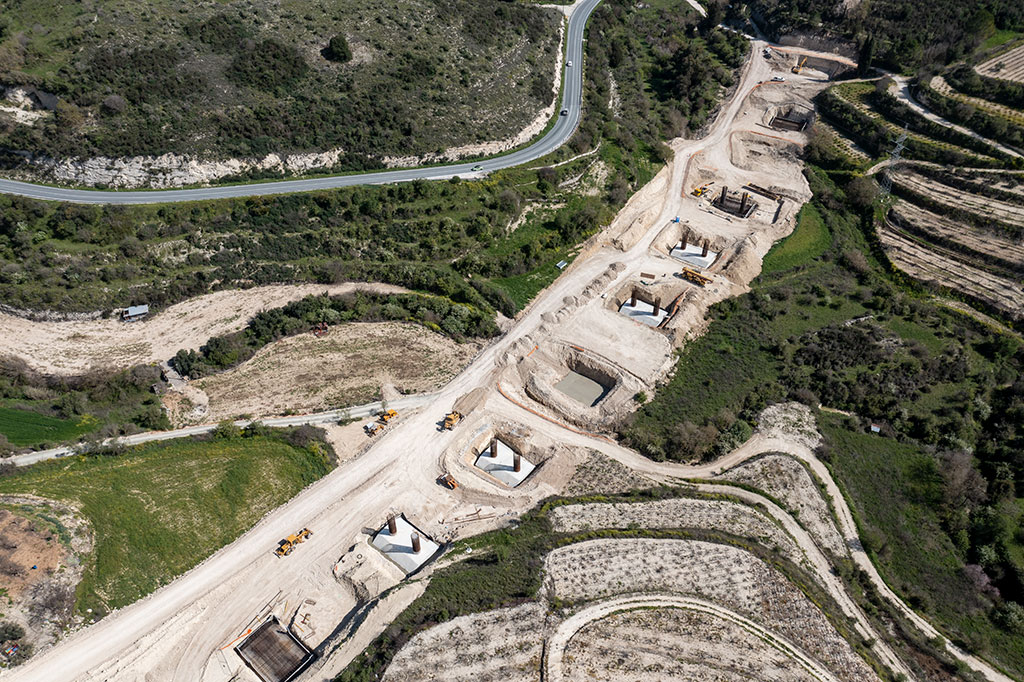
Former Disy leader Averof Neophytou on Saturday expressed bemusement at the rising costs of construction for the new road which, if completed, will link Paphos with Polis Chrysochous, with the latest tender for the road’s construction drawing bids which will cost the taxpayer almost twice the originally forecast budget.
Neophytou is uniquely placed to comment on the matter, having previously served both as public works minister and as the mayor of Polis Chrysochous, and wrote in a post on social media that he had warned the government back in 2024 against terminating public works contracts with the aim of driving down costs.
“With the government’s justification that it dares to terminate them in order to finish them faster and cheaper for the taxpayer, I had pointed out that exactly the opposite will happen,” he said.
Thus far, discussions in earnest have only taken place regarding the first phase of the project, which will connect the village of Ayia Marinouda, just outside Paphos, and the village of Stroumbi, which is located roughly halfway between the road’s two endpoints – a distance of around 15.5 kilometres.
Initially, the government had signed a contract with Greek construction firm Intrakat – now known as Aktor – in 2021, aiming to have the first phase complete by the start of 2025.
However, that contract was torn up in 2024, with the public works department later lamenting that Intrakat’s “demand for additional costs and time to complete the project” were deemed to be “extremely problematic and excessive”.
Of this, Neophytou said on Saturday that “the reason for the termination, according to the government, was the contractor’s reasonable demands for an additional €25 million”, with the original contract, signed in 2021, having been worth €73m plus value added tax.
“If the additional €25m had been granted, the road would have been finished by now at a cost of €98m,” he said, before pointing out that “after almost two years of delays, the bids were reopened, and the lowest bid is €125m”.
He pointed out that the government had already paid €16m to Intrakat for the work on the road it had performed so far, meaning that the total cost of the project will now cost €141m.
“If the bid is awarded in the end, without counting any extras which will arise during the execution of the project, [there will be] a total cost of €141m,” he said.
He said that compared to the total cost of €98m which Intrakat had requested, “in the end, the project will cost us an additional €43m”.
“And, as I predicted then, it will not be finished during the term of the current government,” which expires in February 2028.
Two new bids for the completion of the road have been submitted so far, with one having been submitted by under-fire construction company Cyfield, worth just shy of €125m.
The other bid was jointly submitted by the Cypriot subsidiary of Lebanese firm Araco and Bulgarian construction company Geostroy, and is worth almost €129m.
Both of these bids are far higher than the amount estimated by the public works department when it put the project back out to tender last summer, with the department at the time saying that the road would cost a total of €90.2m plus VAT.
On this matter, it said that the tearing up of the original contract and increases in the cost of construction materials in recent years had led to the estimate rising from the originally forecast €73m.
As well as Intrakat’s demands for more money, the department had last year decried a “long delay in the execution of the project” and a “very slow pace of work” during the time in which Intrakat held the rights to construct the road.
It added that “in essence, from April 2024, work stopped being carried out other than excavations in a small section”, thus leaving “no other option than to terminate the contract”.
Additionally, it said that Intrakat’s final request for more funds had amounted to a request for €34m extra, which would have brought the total cost of the project to €107m, and an extension of almost five years on the project’s completion deadline.
“Considering that these demands were made with the project only 21.1 per cent complete, it can be reasonably concluded that there would be additional demands and extensions before the project was complete,” it said.




Click here to change your cookie preferences