
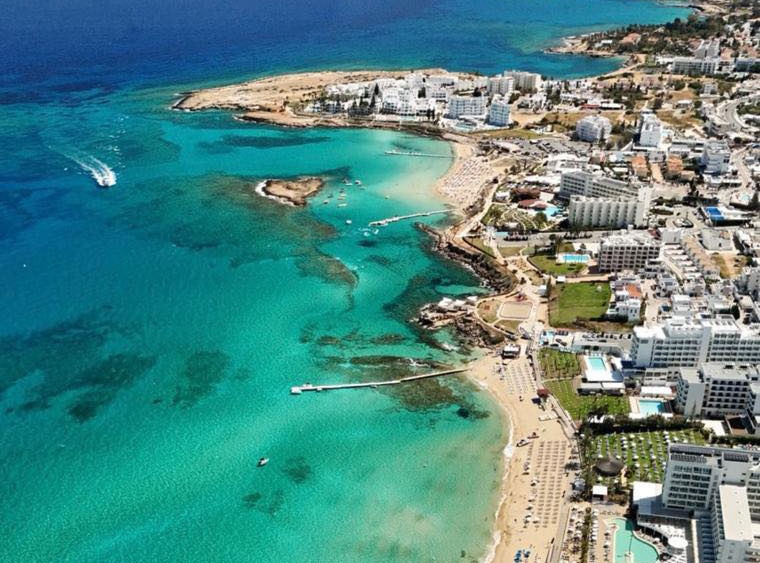
The Interior Ministry has ordered the immediate removal of unauthorised structures on a state-owned coastal plot in Protaras, giving the Famagusta District Administration a 24-hour deadline to complete demolition works and restore legality, while also moving to clarify enforcement responsibilities between state and local authorities.
The directive relates to a massage business, kiosk and associated structures operating within a beach protection zone on land leased to the Paralimni–Deryneia municipality for an annual rent of €5,000.
According to official correspondence, the lease permits only use as a public parking area and prohibits any permanent construction or commercial activity.
The minister’s instruction follows what ministry records describe as a prolonged administrative impasse spanning several years.
In the most recent letter, the Interior Minister instructed local authorities “to proceed without delay with the necessary actions for the immediate demolition and removal of the illegal structure, within 24 hours of receipt of this letter.”
The ministry said responsibility for enforcement lies with the district officer under the beach protection law, specifically in cases involving constructions within protected coastal zones.
It added that the structures fall within the legal interpretation of “construction”, triggering immediate removal powers without the need for a court order.
According to documentation published in earlier correspondence and cited in investigative reporting by Politis, the dispute over jurisdiction dates back to 2024.
Famagusta EOA initially stated in a letter dated May 13, 2024 that enforcement fell under the auspices of Paralimni municipality under the ‘streets and buildings regulation bill’.
In a later letter dated December 5,2024, it shifted position, stating that responsibility had indeed passed to the Famagusta EOA following reforms.
The municipality replied on October 27,2025 that it had no licensing authority over massage services and no executive powers within the beach protection zone, stating that any intervention would lack legal basis.
A subsequent legal opinion obtained by the municipality this March reiterated that enforcement within beach protection zones rests with the district officer, while building-related violations fall under the district EOA.
The Famagusta district EOA confirmed that inspections had identified unauthorised interventions on the coastal plot and concluded that responsibility for removal lies with the district officer.
Despite this, no enforcement action was taken until the ministry’s latest directive.
According to Politis reporting, the ministry had sent at least three letters in the past month urging immediate action before issuing the final 24-hour ultimatum.
The land in question is a state-owned coastal parcel of approximately 3,715 square metres leased for €5,000 per year.
It was originally approved in 2014 for parking use only, with no authorisation for construction or subleasing.
Ministry records confirm that no additional permits were issued for the erection of the structures currently operating on the site.
The premises include a pergola used for massage services, a kiosk and a storage unit.
According to ministerial statements, complaints from neighbouring businesses triggered inspections which confirmed that commercial activity was taking place in violation of lease conditions and planning restrictions.
The ministry has now announced it will issue a circular to district administrations, municipalities and EOAs to formally define enforcement responsibilities and prevent similar disputes over jurisdiction.
Officials said the aim is to eliminate what they described in internal correspondence as “confusion of competence” between authorities.
Speaking to Alpha TV, interior ministry press officer, Margarita Kyriacou, said legislative amendments are also under consideration to ensure faster intervention in cases of illegal occupation of state land.
She said the objective is to ensure that enforcement powers are exercised “without procedural delay where violations are confirmed”.
The case has also entered the criminal investigation framework following a complaint submitted last December by a private law firm alleging possible corruption and failure of duty in relation to the continued operation of the structures since at least 2022.
On the instructions of the attorney-general’s office, CID requested documentation from the ministry in March, with a ministry official providing a written statement earlier this month.
A parallel inspection by district land services concluded that the installations were entirely within a designated beach protection zone and that no cabinet approval had been issued for any change of use.
Authorities estimate the operation has been generating private income from public land without authorisation over an extended period.
The municipality of Paralimni–Deryneia has stated that it was first informed of a “small construction made of cheap materials” in 2025 and subsequently sought legal advice, which confirmed it did not hold enforcement powers following administrative restructuring.
In its latest position, the municipality said that the ministry’s directive “fully clarifies jurisdiction” and confirms that responsibility rests with the district officer, while also stating that delays in enforcement have created unnecessary administrative and public confusion.





Click here to change your cookie preferences