
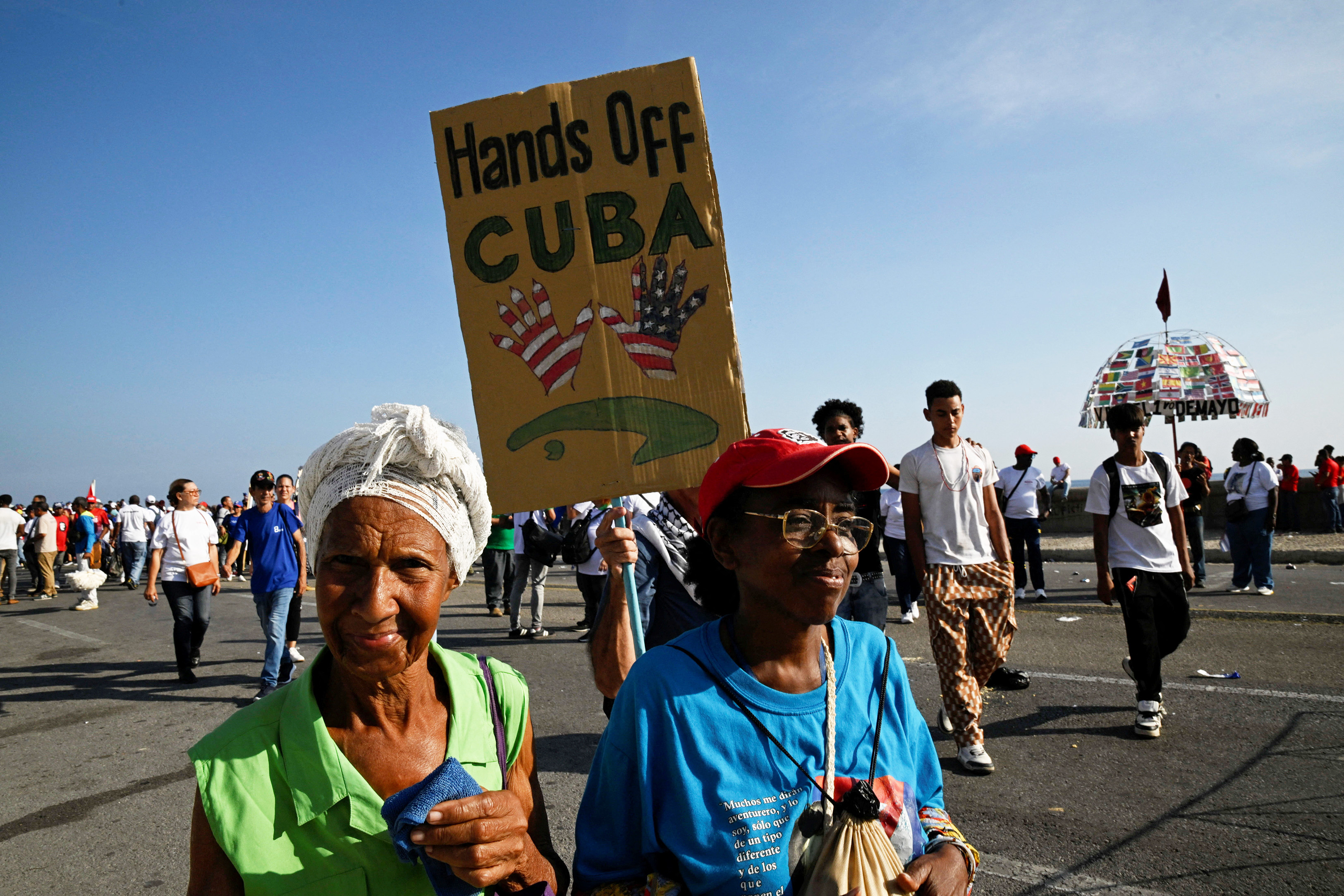
US Secretary of State Marco Rubio should be careful what he wishes for. Donald Trump has speculated that Rubio could be “the next president of Cuba” after the US overthrows the Communist regime that has ruled the island for the past 67 years, and this week he suggested that this takeover might be done by the US Navy “on its way home” from the Persian Gulf.
“We will be taking over Cuba almost immediately,” Trump said. “On the way back from Iran, we’ll have one of our aircraft carriers – maybe the USS Abraham Lincoln, the biggest in the world – we’ll have that come in, stop maybe 100 yards offshore, and they’ll say ‘Thank you very much, we give up’.” Then he made the hands-up gesture,
Typical Trump stuff: jokey, deniable, but also menacing – and Cuba has been on his hit list for a long time. As soon as he got control of Venezuela in January, Trump cut off the oil shipments from there that kept the Cuban economy afloat. A US takeover may really be coming – and Marco Rubio would be the ideal Gauleiter of a conquered Cuba.
His Cuban parents moved to the United States just before Fidel Castro seized power, so Rubio is American-born, but his home has always been the Cuban émigré-refugee society of South Florida. He has never actually been to Cuba (except for one brief trip to the US Naval Station at Guantanamo in 2012), but like most exiles he thinks he knows the place.
Maybe he’s right, in which case he may have a splendid career ahead of him as ‘president of Cuba’ and then, perhaps, as President of the United States. (Post-Trump, we are told, it’s either him or JD Vance.) But his personal knowledge of Cuba is as fragmentary and distorted as Maximilian’s personal knowledge of Mexico before he became Emperor of the country.
Maximilian I of Mexico began life as a humble Austrian archduke, younger brother to Emperor Franz Joseph I. Such people have no real jobs (ask Prince Harry of Britain), so he was open to offers. His best offer came from some Mexican conservatives who had just lost a civil war and were looking for a European royal as figurehead for a comeback attempt.
He was game, the American Civil War was on so the US wasn’t enforcing the Monroe Doctrine, and Emperor Napoleon III of France was willing to lend a French army for the enterprise. So off they all went, and for a while it went well.
Then the US Civil War ended, Washington secretly helped Benito Juárez drive out the French army in 1867 – and Maximilian ended up in front of a Mexican firing squad. (He had the grace to say his final words in Spanish.)
It’s just a cautionary tale, not a prediction, but Mexico and Cuba are the two most fiercely nationalist places in the Spanish-speaking world.
After several generations of dogmatic and incompetent Communist rule, worsened by the effects of the crippling 60-year US trade embargo and now by an outright blockade, Cubans are desperately tired and ready for change. However, ‘liberation’ at the hands of the perennial yanqui enemy would still be seen as humiliation by at least half the population.
This is where Rubio’s private calculations about the ease of an American takeover of Cuba (and the very public ruminations by Trump on the same topic) may run aground. The opinions of people actually living in Cuba are pretty unanimous about the failures of the regime, but they are much more various in their views on the future than Trump and Rubio imagine.
One should add that the hardest-line enemies of the Communist regime have taken advantage of the easier exit rules of recent years to leave the country. Cuba’s population has dropped by at least 1.5 million since 2013 (to below 10 million now), but those who left are all people who hate the regime. The ones who would fight are staying.
We cannot know how many Cubans would actually resist an American invasion by force until Trump actually tries one, but it could certainly be enough to make a real war. They would quickly lose the open warfare part, obviously, but they are pretty good at the guerilla war part.
There’s no guarantee that this will happen again, but there’s no guarantee it won’t either. The Clausewitz of our time already has two wars on his plate in two different continents, a big one in Iran temporarily stalled by a ceasefire and a smaller one waiting to start if and when he moves against the thugs who still rule Venezuela. He really should not start another one now.
Gwynne Dyer’s new book is ‘Intervention Earth: Life-Saving Ideas from the World’s Climate Engineers’. The previous book, ‘The Shortest History of War’, is also still available.





Click here to change your cookie preferences