
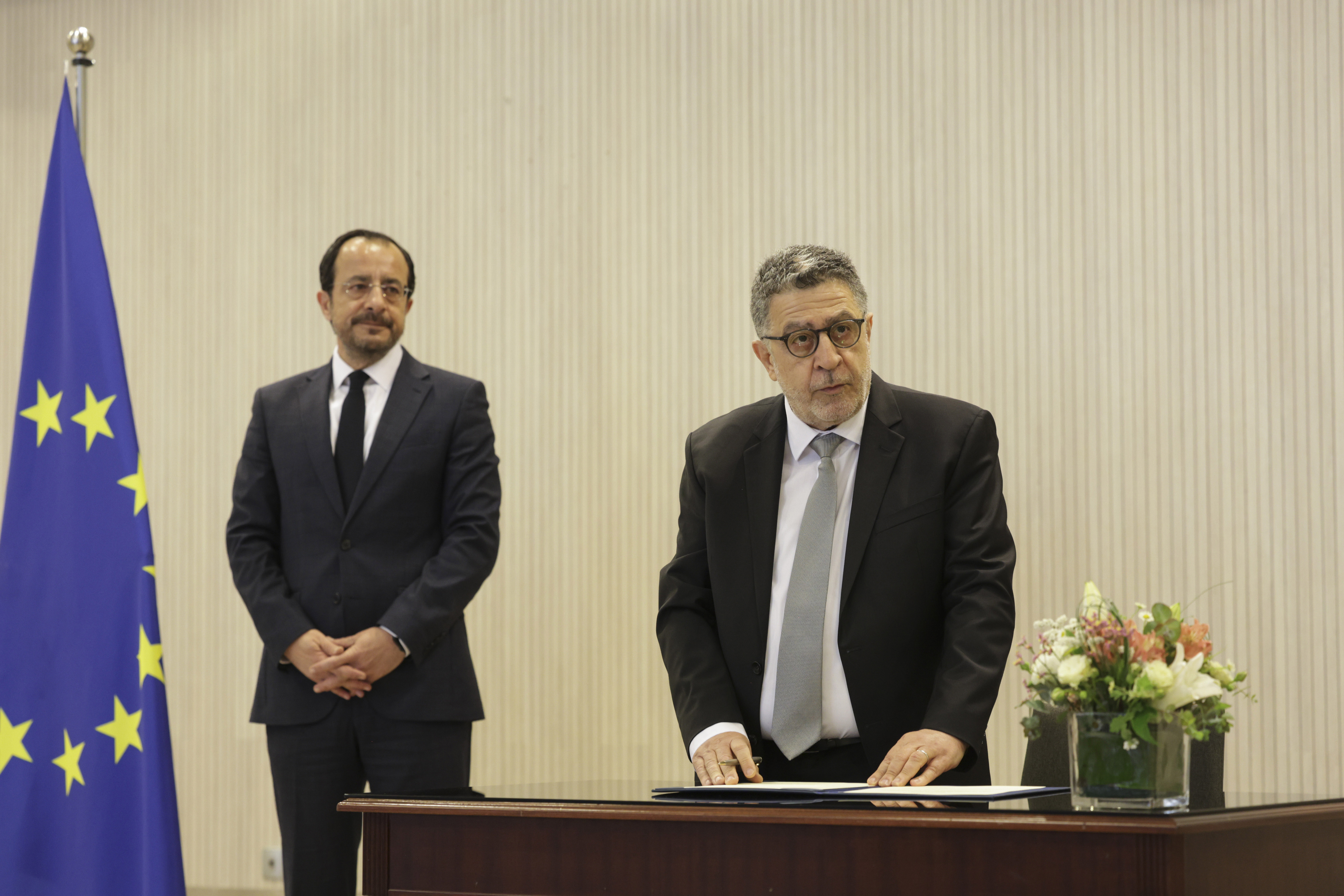
Alexandros Panayiotou was sworn in as a Supreme Court judge on Monday, and spoke at his swearing-in ceremony of the difficult times ahead for the rule of law, both domestically and internationally.
“In the difficult times in which we are living today, where a dangerous environment of questioning international law is taking shape at the global level, as well as a continuous crisis of institutions and the rule of law at home, it is important to emphasise that the courts constitute the last bastion of protection of democratic institutions,” he said.
He added that “in times of crisis, where the cohesion of society is affected and institutions are questioned, the courts will be called upon to protect the application of the law and restore public trust in the institutions”.
On this matter, he moved to defend the Cypriot judiciary at large, saying that “Cypriot judges respond adequately and with dedication to this duty, reverently observing the principle of judicial independence, without responding to criticism, which, while always welcome, is unfortunately sometimes unjustifiably unfair and devastating to the entire judiciary”.
“The Cypriot judge must be, for an additional reason, particularly sensitive to people’s human rights, since he operates and dispenses justice in a semi-occupied homeland where the Cypriot people suffer daily violations of their human rights,” he said.
He then spoke on the matter of perceived delays in the administration of justice, saying that this “rightly results” in people feeling disappointment and disillusionment, and said that those who work in the justice system are “trying under adverse circumstances to perform their duty and to cope with the effort to reduce delays”.
Meanwhile, President Nikos Christodoulides elected to praise the “consistency and responsibility” which he said Panayiotou has shown in the three decades of his career so far.
“His career in the judiciary is characterised by seriousness, scientific competence and commitment to the principles of impartiality,” he said, before outlining Panayiotou’s career so far, which has seen him serve as chief justice of the criminal courts of both Nicosia and Larnaca, and most recently as chief justice of the court of appeal.
He added that during his term as chief justice of the court of appeal, Panayiotou “confirmed his commitment to the principles which should govern a senior judicial officer”.
“Of particular importance is the perception that he himself has expressed regarding the role of the judge: that the judge must be a model of ethics and behaviour and that the exercise of judicial power is not consistent with arrogance or irony, but with modesty and a sense of responsibility,” he said.
As such, he said, “it is precisely this approach which strengthens the credibility of justice, because people’s trust is not built only through decisions, but also through the attitude and behaviour of those who make them”.
“In every period, and especially in moments during which people’s trust in institutions is tested, the responsibility of justice becomes even greater. Adherence, therefore, to the principles of integrity, equality, and accountability is not an option for any of us, but a minimum obligation,” he said.
He went on to say that “in a democratic state, much more so in a member state of the European Union, justice is delivered in courtrooms and nowhere else”, and that “anything else which undermines the values on which the rule of law is founded undermines our very democracy”.
Later, he addressed Panayiotou directly, saying that “the additional responsibility you are assuming today is great”.
“The state’s trust in you is a given and I am certain that with your work, you will continue to serve justice with dedication, selflessness and integrity,” he said.





Click here to change your cookie preferences