
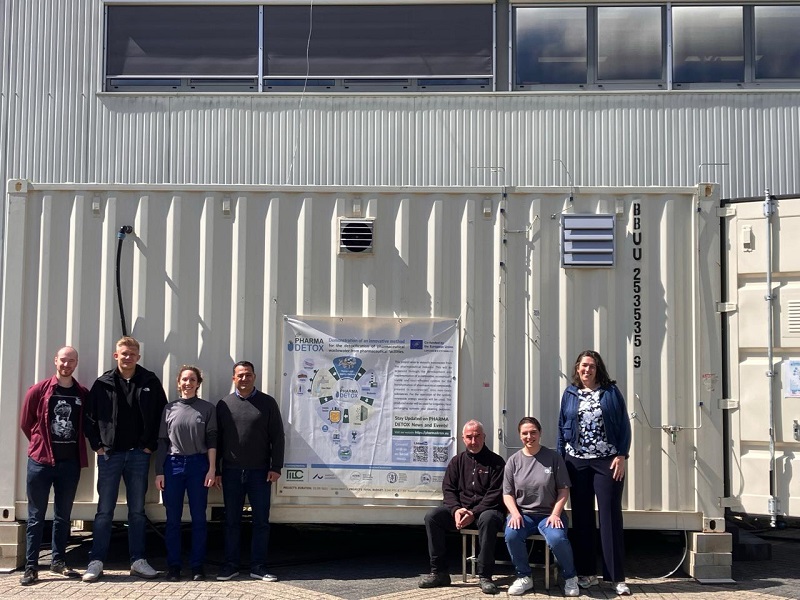
The pilot unit of the European LIFE Pharma-Detox project has been successfully transported to the Medochemie plant in the Netherlands, marking the start of the second phase of the project’s pilot stage.
The transfer of the unit to Medochemie’s FAL facilities marks a significant milestone in the project’s progress, as the system will now operate under actual industrial conditions in a different pharmaceutical manufacturing environment. The objective of this new phase is to further evaluate the technology’s performance, verify its effectiveness in treating wastewater containing active pharmaceutical ingredients and enhance its potential for broader application on a European scale.
LIFE Pharma-Detox is a four-year European collaboration coordinated by Medochemie and co-funded by the European Union’s LIFE programme. It brings together five partners from four EU countries, combining industrial experience with scientific expertise and specialisation in sustainable environmental technologies.
The consortium includes Medochemie from Cyprus as the coordinating partner, Aarhus University from Denmark, which specialises in sustainable technologies, the company NEVIS, Novel Environmental Solutions S.A. from Greece, with experience in environmental pilot projects, the National Technical University of Athens through its Environmental Science and Technology Unit, and the University of Catania from Italy, with expertise in chemical engineering and industrial sustainability.
At the heart of the project lies the development and implementation of an innovative system for treating pharmaceutical wastewater, with the aim of safely removing active pharmaceutical ingredients before they are discharged into the environment. The presence of such substances in aquatic ecosystems is one of the modern environmental challenges associated with pharmaceutical production and requires advanced, reliable and practical solutions.
During the second phase of the pilot stage, the unit will treat production wastewater containing active pharmaceutical ingredients, allowing project partners to evaluate the system’s performance in a real-world operating environment. Testing the technology at a different production facility is an essential step for the technical validation of the system and for assessing its adaptability and scalability to other pharmaceutical plants in Europe.
Once the operational phase in the Netherlands is complete, the pilot plant will return to Cyprus to continue operations at the Medochemie facility.





Click here to change your cookie preferences