
Artificial intelligence is no longer only changing the tools people use at work, but it is also reshaping what companies, universities and training centres understand by talent.
Indeed, speakers at a Cyprus Seeds panel discussion that took place at the Doers Summit in Limassol this week argued that deep expertise must now be matched with adaptability, curiosity and the ability to keep learning.
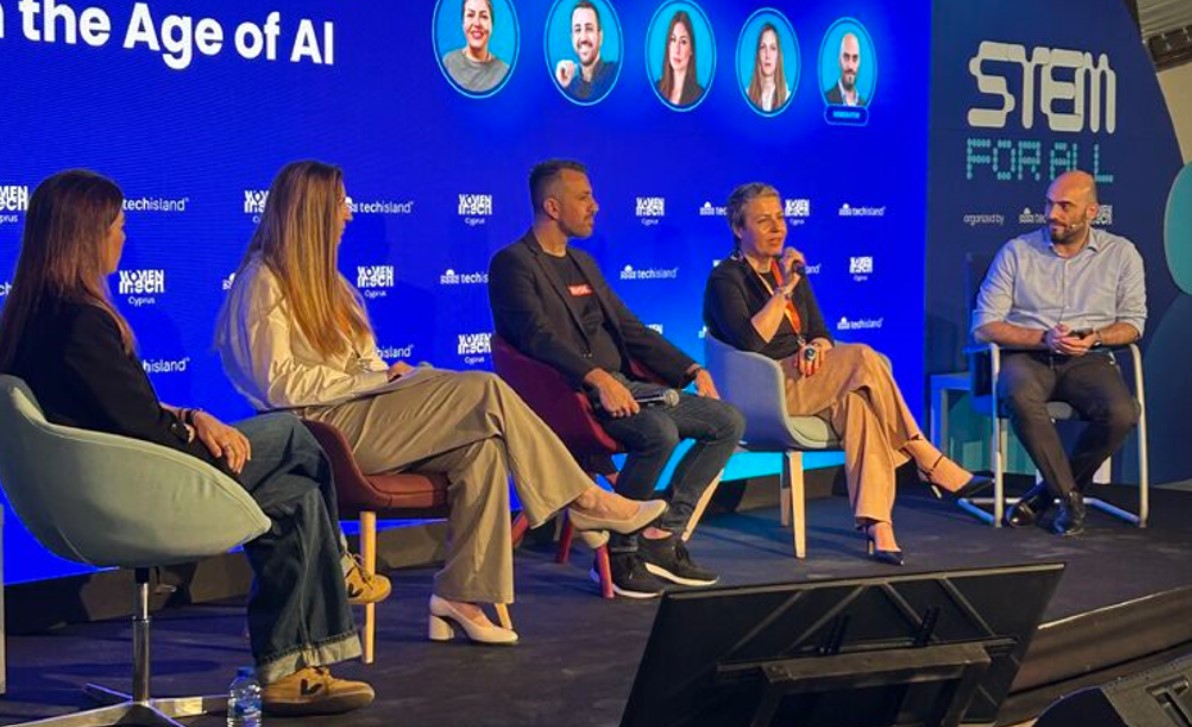
The panel, titled ‘Spot the Skillset: Defining Talent in the Age of AI’ and moderated by Andreas Papadopoulos, manager at PwC Cyprus, brought together voices from technology, entrepreneurship, research and education.
The panel featured Vera Solomatina, SVP People and Culture at inDrive, Michael Economou, founder of Exyde, Chrysanthia Leontiou, head of graduate school at The Cyprus Institute, and Ourania Miliou, education and training manager at CYENS CoE.
Opening the discussion, Papadopoulos said the aim was to explore what skills truly matter in the age of AI and how these are evolving as technology increasingly cuts across disciplines, industries and job functions.
Solomatina, speaking from the perspective of a global technology company, said AI adoption should not be treated as a simple training exercise. Instead, she said, it is a change-management challenge, requiring companies to create the right culture around learning, experimentation and trust.
Once a new technology is introduced, she explained, companies cannot simply tell employees to take a course and expect transformation to follow. “You need to build this change management around this at the same time,” she said, adding that employees need to understand why the skill matters and why there is now a sense of urgency around it.
She said this also means building communities of internal ambassadors; people who are willing to experiment, raise their hands, speak up and show others that the new tools are not only important, but also useful. At the same time, Solomatina said companies are already seeing a visible divide between employees who actively use AI and those who remain hesitant or resistant.
Some employees, she said, already use both personal and corporate AI tools, while others still do not use AI at all, either in their private or professional lives. This, she warned, will matter more as AI becomes increasingly connected to productivity and career development.
“Once it will be crucial for your career, once it will be crucial for your productivity,” she said, noting that the speed of change is now much faster than in previous waves of digital transformation.
However, she also stressed that leadership must be part of the process. Senior managers, she said, cannot simply listen to AI discussions from a distance. They need to use the tools themselves and treat them as part of normal daily work. She noted that many top managers are already using AI tools, including corporate tools, but some still feel uneasy about fully owning AI-supported work.
“They are still a little bit shy to use these instruments,” she said, explaining that some executives still feel that an AI-assisted document is somehow not fully their own. For Solomatina, that mindset also needs to change. AI, she said, should be seen as a normal workplace instrument, not as something separate from the employee’s own output.
Still, she added that the human side remains central. When asked about the soft skills that matter most in the AI era, she pointed first to curiosity. “Curiosity allows person to be on top of the technological race,” she said, adding that the ability to test, explore and remain open to new tools is becoming a defining skill.
She also pointed to critical thinking and the ability to learn, saying traditional education still plays an important role because it teaches people how to sit down, focus and gain knowledge systematically. “I would keep it very simple: curiosity, critical thinking, and ability to learn,” she said. “These are three main things that will keep you on the top of everything.”
Economou, meanwhile, brought the discussion into the world of startups and AI-native companies, saying AI is already changing what it means to build a business. Referring to his experience with atYourService, Foody and now Exyde, he said the idea of having a smaller human team supported by AI systems was something he had imagined even before it became technically possible.
For a young startup, he said, this was not only attractive but necessary, because small teams need to move quickly, work efficiently and produce at a level that can compete with larger organisations. An “AI squad”, as he described it, became a way to do things faster, at scale and at a quality that could match strong human personnel.
Economou was cautious about making firm predictions. “If I tell you something about AI today, if I make an assumption, most probably I’m going to be wrong in three months,” he said, pointing to the overwhelming pace of change.
Nevertheless, he said he already sees three broad categories forming in the workforce. The first are those who are AI-averse, or afraid of using AI in the same way people were once afraid of email or software platforms. The second are those who use AI tools in a more basic way, to support existing tasks. The third, and much smaller group, are what he called AI natives.
These AI natives, he said, represent perhaps 3 per cent of workers but are already able to use AI to build systems, teams and companies at scale.
In his view, this small group could have an outsized impact on the future of work.
For people who feel overwhelmed, Economou’s advice was practical. Rather than trying every tool and every model, he said, people should start with one problem and one tool. “Pick one tool and be obsessive with it,” he said, urging people to be deliberate in building their AI skills while costs remain low and access is still relatively easy.
At the same time, he argued that people also need to protect what he called their “anti-AI skills”. Because as AI becomes more present, he warned, people may gradually lose the habit of writing, thinking, strategising and communicating with other people.
For that reason, he said, people must also create time for human relationships, real-life activities and the skills that keep the mind active. “Keep thinking, keep writing,” he said, adding that some things do not make sense for AI to take over.
This point linked naturally with Miliou’s intervention on education and upskilling. Speaking from CYENS’ experience in training programmes, she said the mismatch between formal education and labour-market needs has always existed, but AI is making that gap more visible and much harder to close.
Formal curricula, she said, will probably never be updated quickly enough to fully match the speed of technological change. As a result, education providers need to become more open, collaborative and connected to industry.
Microcredentials, lifelong learning courses and continuous upskilling will therefore become increasingly important, she said, because the future workforce will need to keep refreshing its skills throughout people’s careers. The pace of change, she added, is already clear. Only a few years ago, generative AI was not part of everyday workplace discussion. Now, it is central to conversations about skills, competitiveness and employability.
Miliou said younger generations must also be inspired to engage with science, technology and emerging fields, rather than seeing them as distant or inaccessible.
She also stressed that technical skills alone are not enough. Drawing on CYENS’ work through digital transformation projects, she said more than 105,000 individuals have been trained, mainly in technical skills. However, she said the real lesson from this experience is that successful use of AI depends on much more than knowing how the system works.
When people hear the words artificial intelligence, she said, they often think of systems, devices, robots or drones. Yet behind every strong AI output, there is also a strong thinking process. A good result, she said, comes from “a high quality prompt, a high quality design” and, behind both of these, “a high quality thinking process”.
In other words, AI literacy must be combined with problem-solving, creativity, judgement and the ability to assess whether an output is actually useful. She said people also need hands-on and experiential learning, because many still do not understand what AI has to do with their own work or how it can support them.
“We need to help people see the value,” she said, adding that this value may be different from one person to another.
For Leontiou, the question is not whether traditional education or AI literacy matters more. Both, she said, are now essential. Traditional higher education, she explained, remains important because it gives people a strong scientific foundation and promotes critical thinking. Without that base, people may find themselves lost later on.
However, she was equally clear that AI literacy can no longer be treated as optional. “Today it is not a luxury anymore to be AI-illiterate. It’s a must,” she said.
Universities, she added, have a responsibility to prepare students not only as experts in their own fields, but also as people who understand AI, its uses and its ethics.
This means AI should be treated as a horizontal skill across all disciplines, not as something confined to computer science. Programmes in every field, she said, should integrate AI tools into teaching and research, while students should also be exposed to real datasets and practical applications.
At the same time, Leontiou said universities need stronger links with industry, because talent cannot be created within institutional boundaries alone.
It has to be built, she said, at the intersection between where knowledge is produced and where real-world applications take place. Joint projects, internships, joint PhDs, joint master’s degrees and industry collaboration can all help make education more relevant.
She later extended the same argument to researchers, saying they, like other professionals, need strong domain knowledge, AI fluency, critical thinking and interdisciplinarity. “This is not negotiable,” she said of domain expertise, adding that people still need to be very good at what they have studied.
However, because skills become outdated so quickly, she said education can no longer be seen as one phase in a person’s life. It must become a continuous process. “Learning is a mindset,” she said, adding that society as a whole must do more to value lifelong learning and link career progression with skills development.
Leontiou also said employers need to invest in training staff and should not see it as a waste of time. This, in turn, brought the discussion back to the broader question of how people and companies can keep the human element alive while using AI more effectively.
From an HR perspective, Solomatina said companies must create psychological safety and help employees understand that AI is not there to replace them. “AI is not a competitor, AI is a helper,” she said.
She added that equal access is also important. Companies should not give better tools to some employees and fewer tools to others, because that would create an uneven playing field.
Leontiou agreed that training is essential, saying people need to understand both the potential and the limitations of AI.
“We always hear that AI will replace humans,” she said. “In my opinion, AI will not replace humans, but humans that know how to properly use AI will replace those who don’t.”
Miliou added that awareness is also necessary, because many people still do not know what AI means for their own job. They need to be brought closer to the technology through practical, hands-on learning, she said, otherwise uptake will remain difficult.
Taken together, the panel pointed to a clear shift in the way talent is being defined. Deep specialisation still matters, but it is no longer enough on its own.
In the AI era, workers will also need adaptability, curiosity, critical thinking, communication, AI fluency and the ability to keep learning as technology changes.
As the speakers suggested, the question is no longer simply whether people know their subject well. It is whether they can combine that knowledge with the judgement, flexibility and confidence needed to work alongside AI rather than be overtaken by it.





Click here to change your cookie preferences