
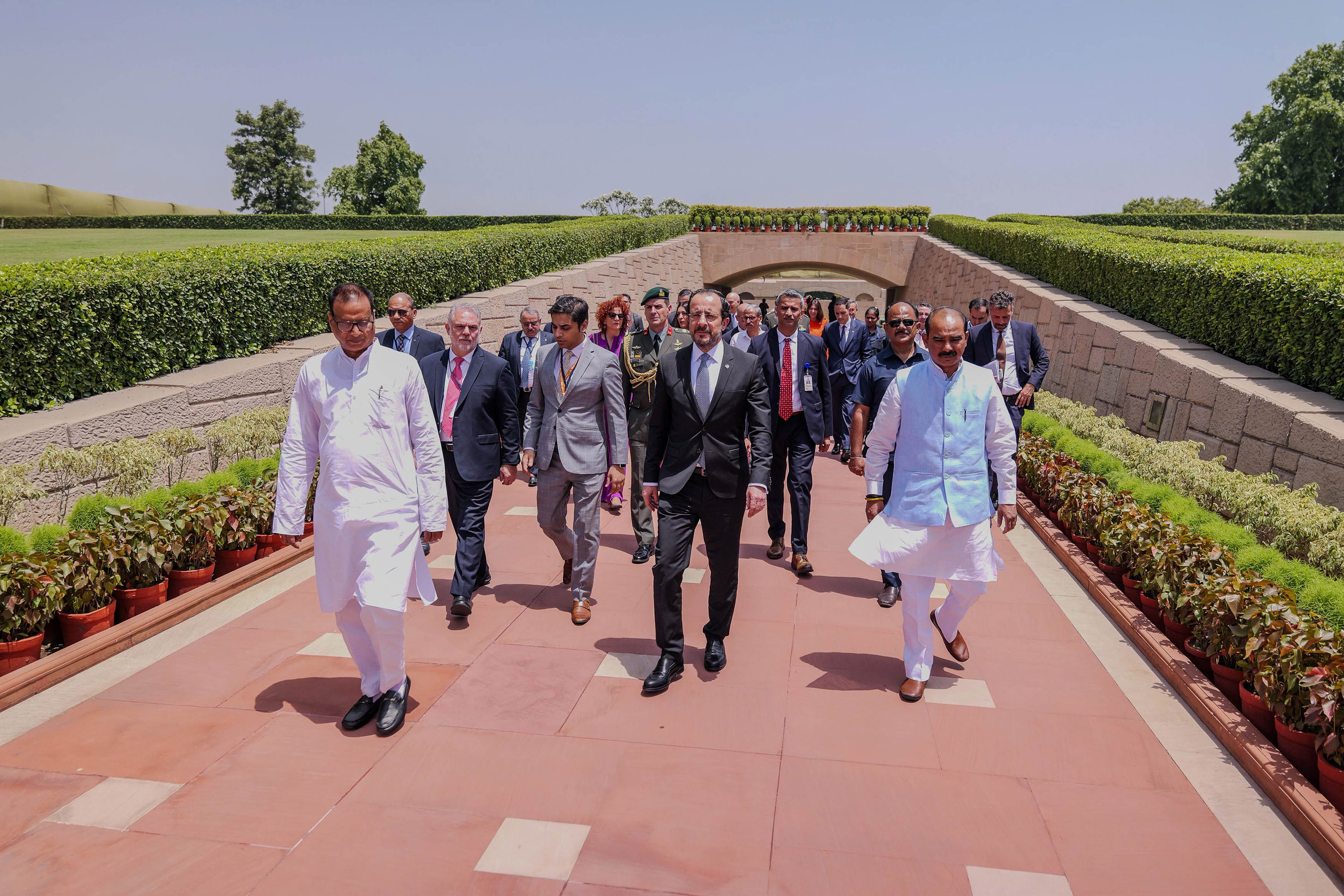
President Nikos Christodoulides on Friday called for India to become a permanent member of the United Nations security council, following a meeting with Indian Prime Minister Narendra Modi the latter’s official residence, the Hyderabad House in New Delhi.
“I wish to take this opportunity to reiterate that Cyprus also supports India’s growing global role, including its rightful place in a reformed United Nations security council, because global governance must reflect today’s realities,” he said during a joint press conference.
He added that during their discussions, he and Modi had “discussed broader regional and international developments, reaffirming our shared commitment to international law, the United Nations charter, and effective multilateralism – principles that matter today more than ever before”.
“It is in this context that I wish to sincerely thank you, prime minister. Cyprus and the Cypriot people deeply value India’s longstanding efforts to reunify Cyprus, and for your steadfast support for the independence, sovereignty, and territorial integrity of the Republic of Cyprus,” he said.
The call was also made in a joint declaration which was released following the day’s meeting, and said that “Cyprus reiterated its firm support for India’s permanent membership of a reformed United Nations Security Council”.
“The two leaders stressed the urgent need for the reform of the United Nations security council, including ways to make it more effective, efficient, and representative of the contemporary geopolitical challenges,” the joint declaration said.
It added that both leaders had “agreed to coordinate closely in multilateral fora”, including with relation to the UN security council, “and to continue supporting efforts to include intergovernmental negotiations on the reform of the UN security council”.
Since its creation in 1948, the UN security council has had five permanent members – China, France, Russia, the United Kingdom, and the United States – while ten non-permanent members take seats at the security council for two-year terms. This number rose from an initial six in 1966.
India has served eight separate terms as a non-permanent member, first doing so between 1951 and 1952, and most recently serving in 2021 and 2022.
Calls for the security council’s constitution to be altered have been made from various parts of the world in recent years, with Turkish President Recep Tayyip Erdogan having said during his address to the UN general assembly in 2013 that “the world is bigger than five”, and having repeatedly used the phrase in reference to the security council ever since.
India, meanwhile, is one of the “G4 nations”, a group which also comprises Brazil, Germany, and Japan, all of which support each other’s attempts to gain permanent seats.
For India or any country to gain a permanent seat at the security council, it would require a two-thirds majority vote at both the general assembly, including positive votes from all five current permanent members of the security council.
Regarding other UN-related matters, the joint declaration stated that both Christodoulides and Modi had “underscored their shared commitment to peace, democracy, the rule of law, effective multilateralism, and sustainable development”.
The declaration stated that both had also “reaffirmed their support for a rules-based international order, grounded in the UN Charter and international law”, and placed “particular emphasis” on the UN convention on the law of the sea (Unclos).
The reference to Unclos in particular is topical for Cyprus, given that Turkey’s parliament appears likely to pass its planned “maritime jurisdiction law”, which will codify its claims in the Aegean and Mediterranean seas in line with the “Blue Homeland” doctrine.
Additionally, both Christodoulides and Modi “reiterated their call for addressing pressing global challenges and to prepare the world for emerging developments through reformed and effective multilateralism”.
To this end, they agreed to “strengthen coordination within international organisations”, including within the UN and the Commonwealth.
Reference was also made to the Cyprus problem, with the joint declaration stating that both leaders “expressed their strong commitment to the resumption of negotiations to achieve a comprehensive, just, and lasting settlement … on the basis of a bizonal, bicommunal federation with political equality”.
They also “underlined the important role” of the UN peacekeeping force in Cyprus (Unficyp) and offered their “full support for its mandate”, while Christodoulides offered “appreciation” for “India’s valuable contribution to Unficyp”, with the country sending peacekeepers to the island to serve.
Additionally, Modi offered India’s “unwavering and consistent support for the independence, sovereignty, territorial integrity, and unity of the Republic of Cyprus”.




Click here to change your cookie preferences