
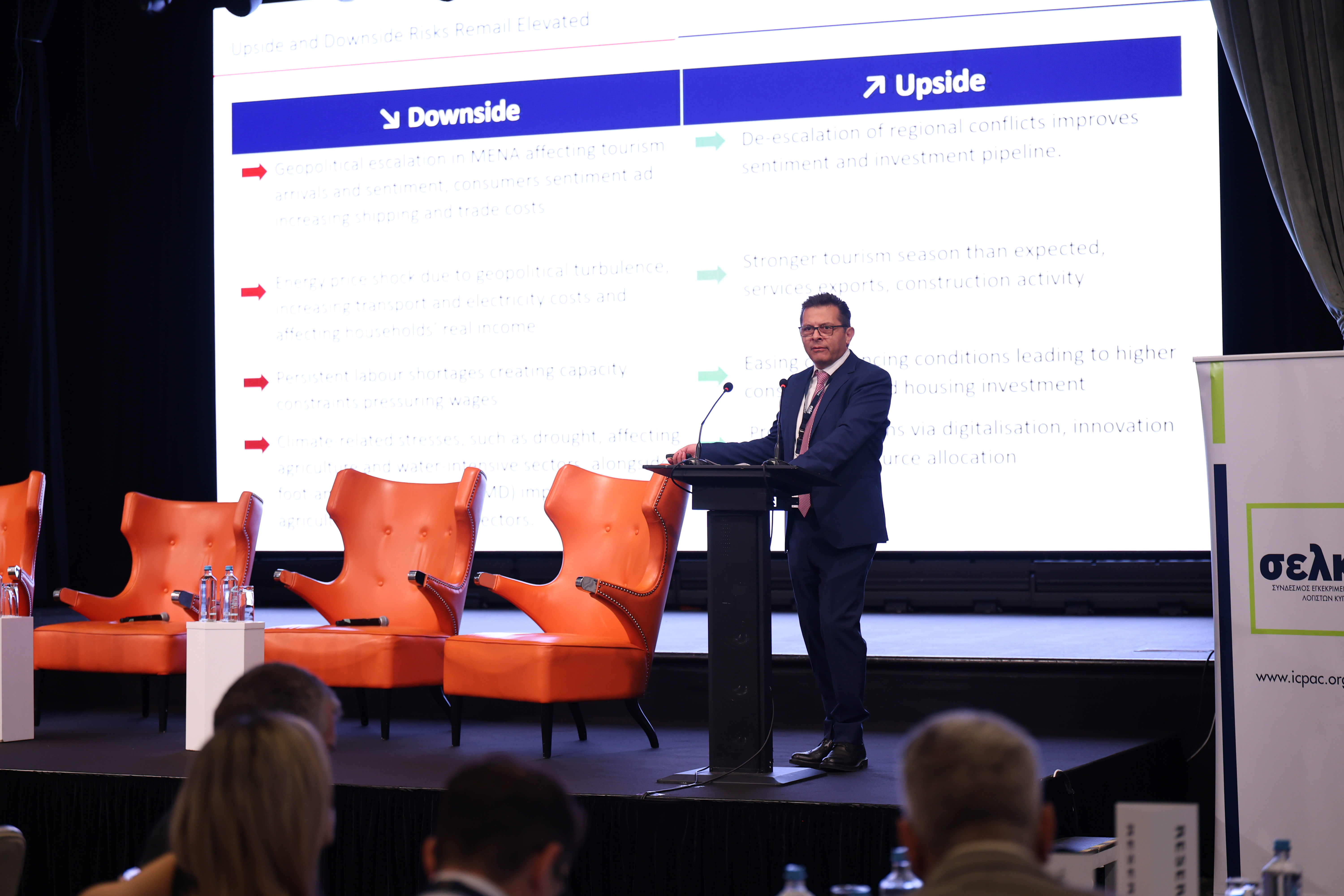
Geopolitical challenges and sectoral transformation mean that adaptability will determine the leading players in the new era of banking, according to Eurobank.
This was the key message highlighted by the bank at the recently-held ICPAC Mediterranean Finance Summit 2026.
The summit brought together senior figures from the financial sector, institutional stakeholders and business executives from Cyprus and abroad, with the event held under the support of the bank.
Eurobank Deputy Chief Executive Officer Haris Hambakis said that Cyprus started the year on solid economic footing, marked by renewed market trust in its state finances and a highly stable banking system
At the same time, he stressed that maintaining this positive trajectory is not guaranteed and will increasingly depend on productivity gains, targeted investments, consistent policymaking and the effective management of geopolitical and climate-related risks.
“Cyprus enters 2026 with strong macroeconomic foundations, restored fiscal credibility and a resilient banking sector,” he said.
He added that the evolving global environment, including changes in trade and financing costs, is not only affecting short-term economic performance but also reshaping the operating model of banks.
Within this context, Eurobank underlined that the sector is gradually transitioning towards a more customer-centric and data-driven model, where flexibility, rapid response and the use of technology are becoming key differentiating factors.
“To respond to new conditions, banks must evolve into simpler and more flexible organisations, accelerating their digital transformation,” the bank said in a statement.
This transformation, it explaned, includes modernising core infrastructure, strengthening digital service channels and leveraging data and automation to improve efficiency and decision-making quality.
The bank also emphasised the importance of internal transformation, highlighting accountability, collaboration, faster decision-making and a stronger organisational culture as critical elements.
“Flexibility, speed of response and the use of technology are decisive elements of differentiation,” the bank said.
Hambakis further explained that the combination of diversified growth, fiscal discipline and a strong banking system places Cyprus in a favourable position within the European landscape.
However, he warned that in a period marked by structural change and uncertainty, resilience alone will not be sufficient.
“The banks that will stand out will be those that manage to adapt in time, aligning strategy, technology and culture, while continuing to support the real economy with consistency and reliability,” he added.
What is more, he emphasised that the real challenge is no longer about the necessity of bank transformation, but rather the speed and success with which they execute it.
“The question is no longer whether banks will change, but how effectively they will do so,” he said.





Click here to change your cookie preferences