
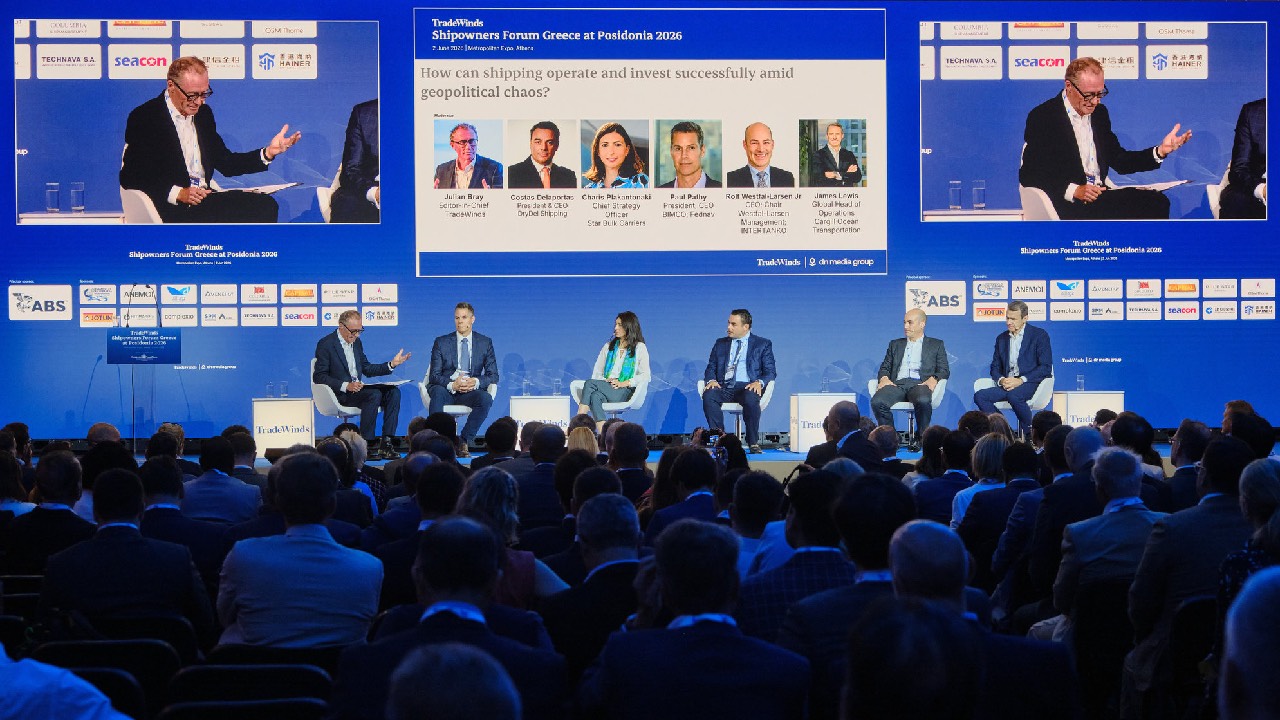
Global shipping entered Posidonia week facing a new maritime world order, as industry leaders warned that geopolitical fragmentation, dark fleet activity and uncertainty over decarbonisation are reshaping trade routes, investment decisions and long-term planning.
The warning came during the TradeWinds Shipowners Forum Greece, which opened Posidonia’s main week conference programme under the theme ‘Resilience in the Face of Disruption’.
In a keynote address that set the tone for the day’s debate, Steve Gordon, Managing Director of Clarksons Research, presented ten data points showing both the extraordinary pressure and resilience currently defining global shipping.
According to Gordon, the world fleet and its order book now stand at a combined value of $2.4 trillion, reflecting the scale of the industry at a time when capital is being deployed against a backdrop of deepening geopolitical stress.
He said transits through the Strait of Hormuz have fallen by 95 per cent, with an estimated 1.5 billion barrels of oil lost during the ongoing crisis.
Gordon also noted that some 7 million barrels per day and 2 per cent of the global fleet by tonnage remain trapped inside the Gulf, including 8 per cent of the world’s VLCC fleet and 3 per cent of its VLGC fleet.
Moreover, he said the domino effect of geopolitical conflicts, from Ukraine to Houthi and Iran war disruptions, has pushed the average distance of seaborne trade up by 10 per cent since 2019, a structural shift that continues to absorb tonnage and reshape trade geography.
Despite this, Gordon said the industry’s commercial indicators remain strong.
According to his presentation, the ClarkSea Index has recorded its strongest start to a year on record, with VLGC and crude tanker rates touching $40,000 per day, while container markets are also performing strongly.
Meanwhile, he said the global order book stands at 21 per cent of the existing fleet, with a record 60 million CGT in shipyard deliveries expected in 2027.
However, Gordon also pointed to the age profile of the fleet as a growing strategic concern, with 41 per cent of vessels now fifteen years or older.
Shipping’s contribution to global greenhouse gas emissions, at 2 per cent annually, also remains a contentious issue, particularly as the industry faces the scale of the decarbonisation challenge ahead.
For Greece, Gordon said the stakes are especially high, as Greek owners control 21 per cent of the global bulker, tanker and gas fleet, placing the country’s shipowners among the most influential actors in the decisions that will shape the sector’s next decade.
The forum brought together senior executives from major shipowning companies, financial institutions and industry bodies to discuss how operators are managing risk in an era of sanctions, dark fleet proliferation, superpower rivalry and regulatory pressure.
Paul Pathy, President of BIMCO and CEO of Fednav, said that “Shipowners are adaptable and flexible depending on market conditions and circumstances. Ultimately money talks and shipping doesn’t need to take sides on various differences between states, such as the US-China tariffs debacle.”
Charis Plakantonaki, Chief Strategy Officer at Star Bulk Carriers, said geopolitics have redefined the dry bulk market.
“For example the US-China situation shifted China’s focus from the US to Brazil. The ongoing Persian Gulf crisis has also hit us as hundreds of vessels are trapped either side of the Hormuz Strait,” she said.
“One of our nine vessels trapped in the region was recently damaged by an attack and the Red Sea instability is still a cause of concern,” she added.
“Overall however, supply and demand for bulker carriers continue to be strong and the market fundamentals are solid. However, if we end up having a prolonged crisis an economic downturn will be inevitable,” Plakantonaki said.
Costas Delaportas, president and CEO of DryDel Shipping, said a prolonged crisis would eventually weigh on the market.
“If the crisis lasts longer the market will suffer as cargo flows will be reduced due to lower demand,” he said.
“In the long term, we should be prepared to manage the challenge of fuel shortages for which the current waiting list for delivery is 10-12 days long, a challenge compounded by an estimated reduction in fuel availability of 60 per cent,” Delaportas added.
“Shipping is a very complex business and we simply need to wait and see how the crisis evolves,” he said.
James Lewis, vice president of Global Operations at Cargill Ocean Transportation, said the greatest challenge is the speed of change.
“We haven’t seen change of this scale for the last 20 years. While the world is witnessing tensions between West and East, uncertainty between the two superpowers is concerning,” he said.
“Risk management is the key to building the efficiencies and flexibility required to address the challenges across every facet of our business,” Lewis added.
Rolf Westfal-Larsen Jr, CEO and Chair of Westfal-Larsen Management and INTERTANKO, said the dark fleet poses a growing threat to global shipping.
“Shipping needs stronger enforcement and state control is required to fix this problem,” he said.
“Currently any corrective measures are ad hoc and follow no visible disciplined manner and if this doesn’t change, impunity for dark fleet operators will increase,” Westfal-Larsen added.
The forum’s second session then turned to the future of maritime decarbonisation, one of the industry’s most contested debates.
The discussion built on themes raised during the opening ceremony, where disagreement over alternative fuel availability and the readiness of enabling technologies set a candid tone for what followed.
Panellists examined what the continued delay of the IMO Net-Zero Framework means for long-term planning and investor confidence, whether sustainable shipping retains genuine urgency among owners, and how lenders and investors are incorporating sustainability criteria into financing decisions.
Baroness Charlotte Vere, group head market development at CORE POWER, said: “Shipowners have accepted that decarbonisation is coming.”
Claire Wright, managing director of Hanwha Ocean Europe, said the discussion is no longer about whether decarbonisation will happen, adding that the conversation has shifted from energy transition to resilience.
Bo Cerup-Simonsen, CEO of the Maersk Mc-Kinney Møller Center for Zero Carbon Shipping, said shipowners are willing to get going and try out new fuels and new technologies.
“As the IMO and the EU negotiations continue, I am confident that we’ll get regulation that is fair for all,” he said.
“The cost issue remains though and needs to be taken seriously. For owners it’s important to ask questions to get clarifications,” Cerup-Simonsen added.
“We are enabling now the technologies for when they are really needed in the future when regulations are in place,” he said.
Alexandra Ebbinghaus, general manager Decarbonisation, Marine Sector at Shell, said LNG is the best solution.
Representing the European shipowners’ voice, Sotiris Raptis, Secretary General of ECSA, called for clarity from Brussels.
“We want a clear commitment from the EU that if we have an agreement with the IMO, the points about ETS etc. will be dropped,” he said.
“European shipowners are paying Europe €9 billion annually. Where is this going,” Raptis added.
Evangelos Marinakis, founder and chairman of Capital Maritime & Trading Corp., also addressed the geopolitical situation during a fireside panel session towards the end of the TradeWinds conference.
He said none of his vessels would attempt crossing the Strait of Hormuz, citing crew safety as the overriding concern.
“Even if we had to pay a passage fee, it would be far better than having the Strait closed,” he said.
On European sanctions against Russian oil, Marinakis said partial sanctions are counterproductive.
“Indians and Chinese are buying drastically discounted Russian oil and we Europeans are paying sky-high prices,” he said.
In his view, if sanctions are to be effective, they must be total.
“They should blockade any shipment from Russia to the rest of the world, because if sanctions apply only partially, that’s bad for Europe and the rest of the world that does not trade Russian oil,” Marinakis added.
Posidonia 2026 continues until Friday with conferences, seminars, MoU signings and networking events.
According to the organisers, Lloyd’s Register is expected to launch its new ESG Advisory Service and ESG Index, presenting what they described as the maritime industry’s first ESG benchmarking report.
In addition, the Maritime Emissions Reduction Centre (MERC), established by Lloyd’s Register with five leading Greek shipowners, is expected to announce a major new industry programme combining research, pilot projects and data development to help reduce greenhouse gas emissions from the existing global shipping fleet.




Click here to change your cookie preferences