
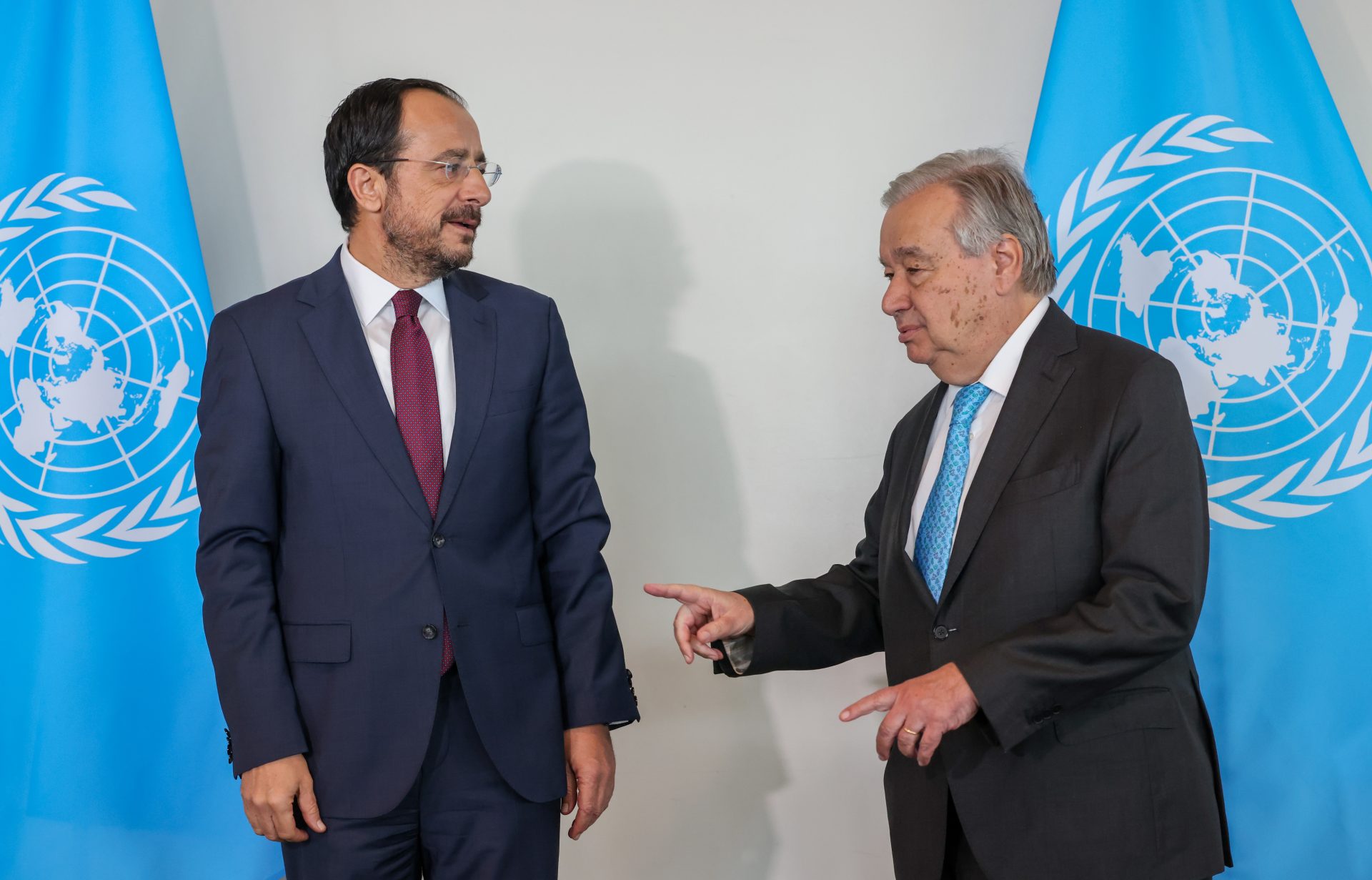
United Nations Secretary-General Antonio Guterres has a “very specific plan” for the next steps to be taken in efforts to resume talks geared towards a solution to the Cyprus problem, President Nikos Christodoulides said on Sunday.
He told journalists during a visit to the Paphos district village of Emba that Guterres had informed him in March of his intentions.
“He has a very specific plan, a specific design, and I share his approaches and views. The effort that is underway is this, with [Guterres’] reasoning to be transformed into something very specific which will lead to the convening of an enlarged meeting, essentially to restart talks,” he said.
UN envoy Maria Angela Holguin is set to arrive on the island and hold meetings with both Christodoulides and Turkish Cypriot leader Tufan Erhurman on Monday, and Christodoulides described his planned meeting with Holguin as “very important”.
“[It is] a meeting which is a continuation of many other meetings which have been taking place for a long time, and which started with [Guterres’] visit to Turkey, the discussion he had with the Turkish president [Recep Tayyip Erdogan], and then our meeting, and what we discussed in Brussels in March,” he said.
He added that during Holguin’s visit, she will “see where we are, how to give further impetus, so that we can achieve the goal of convening an enlarged meeting, during which the resumption of talks will be announced”.
“So, I look forward to tomorrow’s meeting and hope that there will be results,” he said.
Holguin’s visit comes with sources having informed the Cyprus Mail that Erdogan has green-lit the “new initiative” being undertaken by the UN with the aim of bringing about a resumption of formal negotiations on the Cyprus problem.
Erdogan is said to be of the view that the lack of a solution to the Cyprus problem has “unduly cost Turkey through no fault of its own” in recent decades, particularly in light of the fact that Turkish governments led by Erdogan supported both the 2004 Annan plan referendum and the failed negotiations in 2017 at the Swiss ski resort of Crans-Montana.
The sources said that Turkey’s support of both the 2004 referendum and the 2017 negotiations, both of which were rejected by the Greek Cypriot side, constitute evidence of Erdogan’s “pragmatic and constructive stance” and “will to engage in the hope of securing a solution to the Cyprus problem”.
The question of when a “new initiative” on the Cyprus problem may be undertaken has been ongoing for weeks, with Erhurman having said a month ago that such an initiative will begin in July, following the conclusion of Cyprus’ six-month term as the holder of the Council of the European Union’s rotating presidency.
However, the Greek Cypriot side has insisted that such an initiative is “already underway”, with government spokesman Konstantinos Letymbiotis having said that Christodoulides had “made public this initiative” after he met Guterres in Brussels in March.
Holguin most recently visited Cyprus in January, holding a tripartite meeting with both leaders, and saying thereafter that no enlarged meeting on the Cyprus problem could be held until more before “results on the confidence-building measures” between the island’s two sides are achieved.
Some have suggested that the next enlarged meeting may take place as early as next month, exactly a year after the most recent enlarged meeting was held on July 16 and 17 last year, though it appears thus far that this timeline is likely to be extended.

Click here to change your cookie preferences