
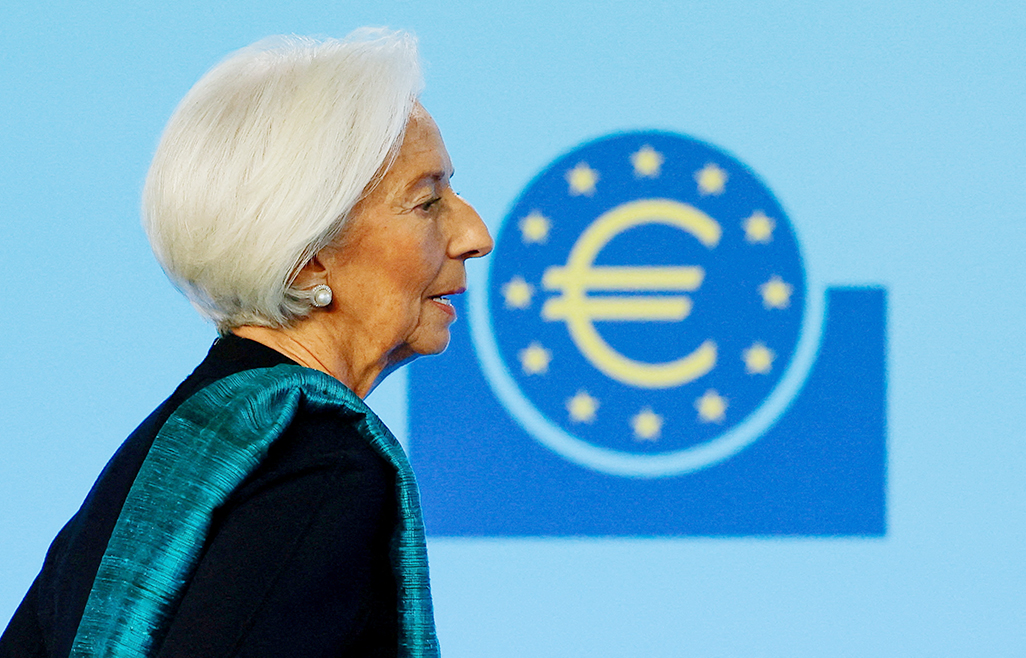
European Central Bank (ECB) policymakers raised interest rates by 25 basis points on Thursday, citing mounting inflation pressures linked to the war in the Middle East and warning that the conflict poses growing risks to both prices and economic growth across the euro area.
The ECB Governing Council said it remains committed to ensuring inflation returns to its 2 per cent target over the medium term and described the latest increase in borrowing costs as robust under a range of scenarios regarding the evolution of the conflict.
With the move, the deposit facility rate will rise to 2.25 per cent, the rate on main refinancing operations to 2.40 per cent, and the marginal lending facility to 2.65 per cent, with the changes taking effect on June 17, 2026.
The central bank said the war in the Middle East is generating inflationary pressures and has forced it to revise its outlook for prices and economic activity.
According to the latest Eurosystem staff projections, headline inflation is expected to average 3.0 per cent in 2026, before easing to 2.3 per cent in 2027 and returning to the ECB’s target at 2.0 per cent in 2028.
Inflation excluding energy and food is projected to average 2.5 per cent in both 2026 and 2027, before declining to 2.2 per cent in 2028.
Compared with projections published in March, the ECB revised inflation forecasts higher for 2026 and 2027 because of rising energy prices, which are expected to spill over into food, goods and services prices.
At the same time, the central bank cut its growth expectations, with euro area output now forecast to expand by 0.8 per cent in 2026, 1.2 per cent in 2027, and 1.5 per cent in 2028.
The ECB said the downward revisions reflected the stronger impact of the conflict on commodity markets, confidence and household incomes.
The Governing Council warned that uncertainty remains exceptionally high, with upside risks to inflation and downside risks to growth depending on the intensity and duration of the energy shock and its wider effects on the economy.
It said updated scenarios prepared by Eurosystem staff illustrate a broad range of possible outcomes and will be published alongside the latest projections.
The ECB stressed that it will continue to follow a data-dependent and meeting-by-meeting approach, adding that it is not pre-committing to a particular rate path.
During a press conference in Frankfurt, ECB President Christine Lagarde said “the war in the Middle East is generating inflation pressures, and the decision to raise rates is robust across a range of scenarios mapping out how the shock might evolve and affect the medium-term outlook for the euro area,” according to remarks released by the ECB.
Lagarde said the euro area economy expanded in the first quarter, supported by domestic demand and exports, although surveys now point to a slowdown, especially in services.
She said manufacturing has held up partly because firms have been building inventories to cope with supply chain pressures and because of higher defence spending.
The labour market has remained resilient, with unemployment standing at 6.3 per cent in April, close to historical lows, although labour demand has continued to cool and both companies and households expect weaker employment conditions ahead.
Lagarde said household balance sheets remain generally strong and consumption should continue to underpin growth, although higher energy prices and weaker confidence are expected to weigh on private investment in the near term.
She argued that reforms aimed at increasing productivity and completing the Savings and Investments Union are essential for Europe’s long-term competitiveness.
Lagarde also underlined the importance of the digital euro, saying “the digital euro and tokenised wholesale central bank money will enhance Europe’s strategic autonomy, competitiveness and financial integration, and will boost innovation in payments,” according to the ECB transcript.
She added that “it is thus essential to swiftly adopt the Regulation on the establishment of the digital euro,” according to the ECB.
Inflation accelerated to 3.2 per cent in May from 3.0 per cent in April, driven by a rise in energy inflation to 10.9 per cent, while food inflation slowed to 2.0 per cent.
Services inflation increased to 3.5 per cent, while goods inflation edged up to 0.9 per cent, reflecting the impact of higher input costs.
The ECB said energy prices are expected to push inflation higher during the summer and keep it above target through the first half of 2027, before price pressures gradually ease.
Financial conditions have remained tighter than before the outbreak of the conflict, with the cost of issuing market debt rising to 4.0 per cent in April, while lending rates for businesses stood at 3.6 per cent and mortgage rates at 3.4 per cent.
The central bank said euro area banks remain resilient thanks to strong capital and liquidity positions, although prolonged geopolitical conflicts and a sharp decline in asset prices could threaten financial stability.
The ECB also confirmed that the asset purchase programme (APP) and pandemic emergency purchase programme (PEPP) portfolios will continue shrinking steadily, as the Eurosystem no longer reinvests proceeds from maturing securities.
It added that the Transmission Protection Instrument remains available to counter disorderly market developments that could interfere with the transmission of monetary policy across the euro area.





Click here to change your cookie preferences