
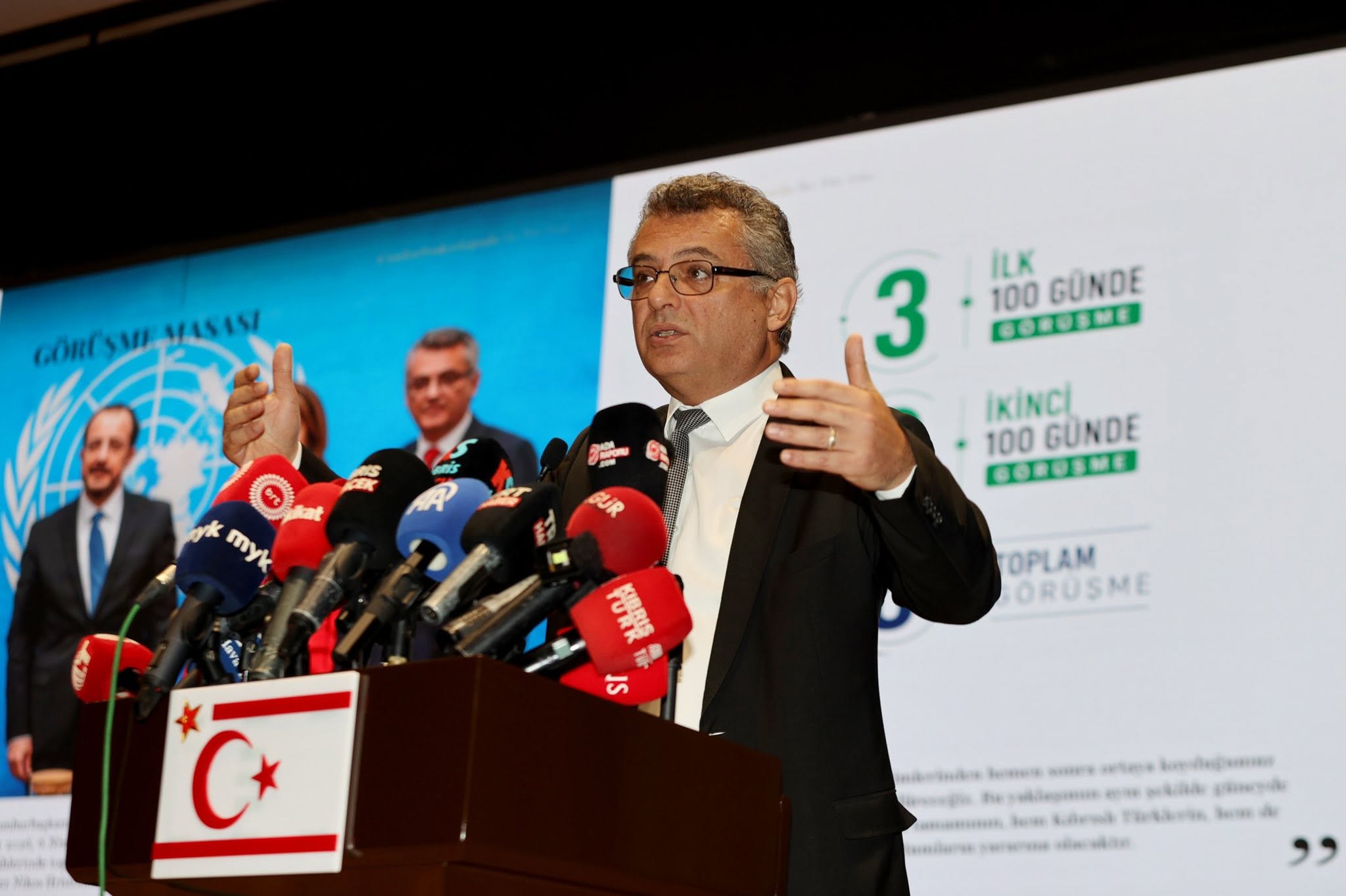
Turkish Cypriot leader Tufan Erhurman on Thursday said that significant progress has been made since he was elected to the role in October last year, saying that “we are much further ahead than where we started on the Cyprus issue”.
“The Turkish Cypriot people have a will for a solution, and the president is obliged to work in line with this will … The will of the Turkish Cypriot people for a solution, as shown in the polls and as I have seen on the streets, is greater even than the 63 per cent of the vote I received,” he said at a presentation of his first 200 days in the role.
He said that he has “remained faithful” to his “four-point methodology” which he says must be met for negotiations on the Cyprus problem to recommence in earnest, and that he will “continue” to do so.
“The framework of the methodology is negotiation for the sake of a solution, not negotiation for the sake of negotiation, and the four points were prepared in good faith and in line with the will for a solution,” he said.
He then passed comment on United Nations Secretary-General Antonio Guterres, who will retire at the end of the year, saying that while his term is “nearing its end”, he “has not lost interest in the Cyprus problem”.
Instead, he said, Guterres “wants to evaluate the situation by giving it a special position and setting an agenda” before he retires.
“The most fundamental thing Guterres said was the emphasis on the point that ‘this time it must be different’, and we proceeded from this point,” he said, adding that with this in mind, Guterres “spoke of a phased approach and time constraints” in efforts to bring about a solution.
In response to this, he said, “we developed ideas to achieve a different outcome in response to the failure to reach a conclusion after the Annan plan referendum and the Crans-Montana talks”, both of which resulted in no solution being reached.
On the matter of confidence-building measures and practical steps to be taken on the island in advance of a solution, he said he has engaged in talks with the European Union on matters including Cyprus’ potential accession to Europe’s border-free Schengen zone, and the export of Turkish Cypriot halloumi to the continent.
“We want to take steps on confidence-building measures in parallel with negotiations. Although we are not at the point we desire on confidence-building measures, positive steps have been taken,” he said.
He also pointed out that he has “undertaken initiatives without severing our ties with the world outside the negotiating table”, drawing attention to the fact that he met Azerbaijan’s President Ilham Aliyev in Antalya in April and attended the Organisation of Turkic States’ summit in Kazakhstan last month.
He then touched on President Nikos Christodoulides’ own visit to Kazakhstan last week, and said that “there is no point in observing international relations from Sarayonu”, in reference to northern Nicosia’s central square.
“We need to look at international relations from a broader perspective. We need to make assessments with the understanding that all countries will act in accordance with their own international relations needs,” he said.
With this in mind, he said that “we are trying to use and leverage our own position in the Organisation of Islamic Cooperation, the Economic Cooperation Organisation, and the Organisation of Turkic States in favour of the Turkish Cypriot people”.
Closer to home, he said that “establishing good relations with the Republic of Turkey on the right footing is crucial”, and that he has “made significant progress in this area”.
Erhurman’s next engagement on the Cyprus problem will come on Saturday, when he will meet UN envoy Maria Angela Holguin, as preparations continue in the hope of convening an enlarged meeting, involving the island’s two sides, its three guarantor powers, Greece, Turkey, and the United Kingdom, and the UN, later this summer.




Click here to change your cookie preferences