
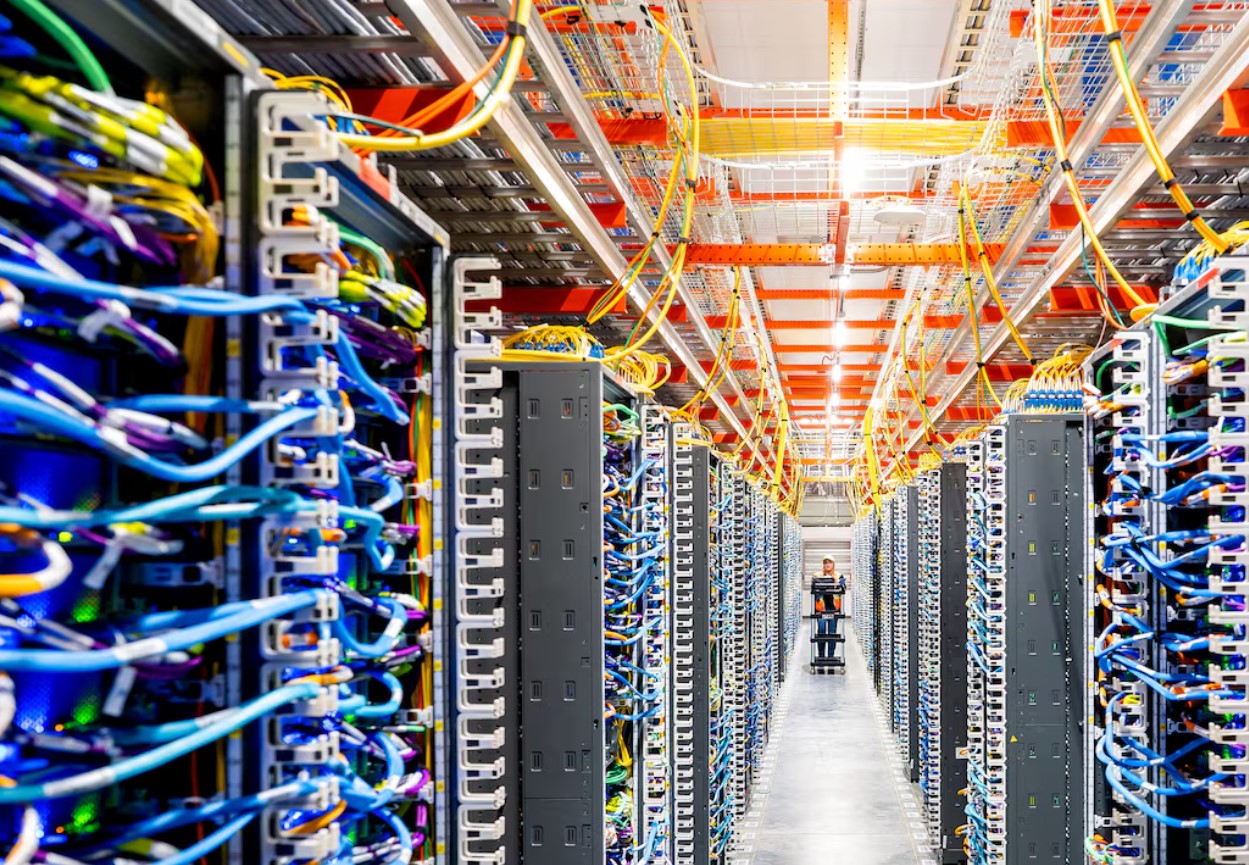
Global investment in data centre infrastructure is projected to reach $1.6 trillion by 2030, with major technology firms set to deploy more than $600 billion in artificial intelligence capital expenditure during 2026 alone, according to research firm Omdia.
This massive surge in funding confirms that the AI Factory market has moved past a critical turning point, transitioning into an industrialised model defined by intense capital requirements, geopolitical influence, and complex engineering challenges.
Omdia characterises the AI Factory as a specialised industrial facility designed primarily to produce intelligence, with the token serving as the fundamental unit of output.
Data centres are undergoing a fundamental transformation, moving away from being simple business support hubs to becoming digital manufacturing centres that produce high-value intelligence.
These facilities are now structured around a four-layer architecture, which includes physical and energy infrastructure, network fabrics and hardware, virtualisation orchestration, and a Model as a Service ecosystem.
The current market spans four distinct solution paradigms, ranging from public cloud hyperscalers and compute-native specialists to private foundation providers and regional infrastructure operators.
A recent survey of more than 200 businesses revealed that the most pressing industry hurdles include lengthy time-to-market, digital sovereignty, talent shortages, and systemic engineering complexity.
The industry is currently moving away from compute hoarding as businesses combat the Zombie GPU effect, where expensive processors remain idle during input and output wait times.
Evaluation benchmarks are being redefined to prioritise Time-to-First-Token and vector retrieval speed, with recent studies showing a 12 times improvement in indexing speed and up to a 75 per cent reduction in compute costs.
Major hyperscalers are managing the balance between agility and sovereignty by offering full-stack integrated physical units alongside options for hardware and software decoupling.
Rack power density has increased sharply, rising from between 10 and 15 kW in 2024 to as much as 250 kW by June 12, 2026, as workloads shift from initial proof-of-concept stages to production-grade deployment.
Companies such as Nebius and Sensetime are altering their business models, shifting from basic hardware leasing toward a Model as a Service framework.
Sensetime is now implementing an integrated strategy that combines infrastructure, software, and energy management to ensure greater control over computing resources.
Value is increasingly being captured by vertical integrators and domain operators through long-term data governance and legacy system integration.
Inspur Cloud is pursuing a strategy that combines heavy-asset infrastructure with specialised industrial operations to accelerate the path to full AI industrialisation.
New regulatory frameworks such as the EU AI Act are compelling organisations to keep sensitive information within physically isolated facilities.
This shift has elevated regional operators like G42 from traditional infrastructure landlords to becoming the physical gatekeepers of national data.
“Future competition will no longer be defined by model parameters or GPU counts, but by a comprehensive contest of energy, liquid cooling, chips, autonomous software stacks, sovereign compliance, and long-term capital endurance,” according to Senior Principal Analyst for Cloud and AI at Omdia, Raymond Zhan.
“For enterprise clients, the provider landscape for AI factory is not a one-size-fits-all game; choices should be tailored to actual business scale and the balance between steady-state and innovative workloads,” Zhan added.
Omdia anticipates that 2026 and 2027 will represent a critical window for the expansion of these facilities, with regional and industrial operations poised to become the most reliable growth sectors over the next five years.





Click here to change your cookie preferences