
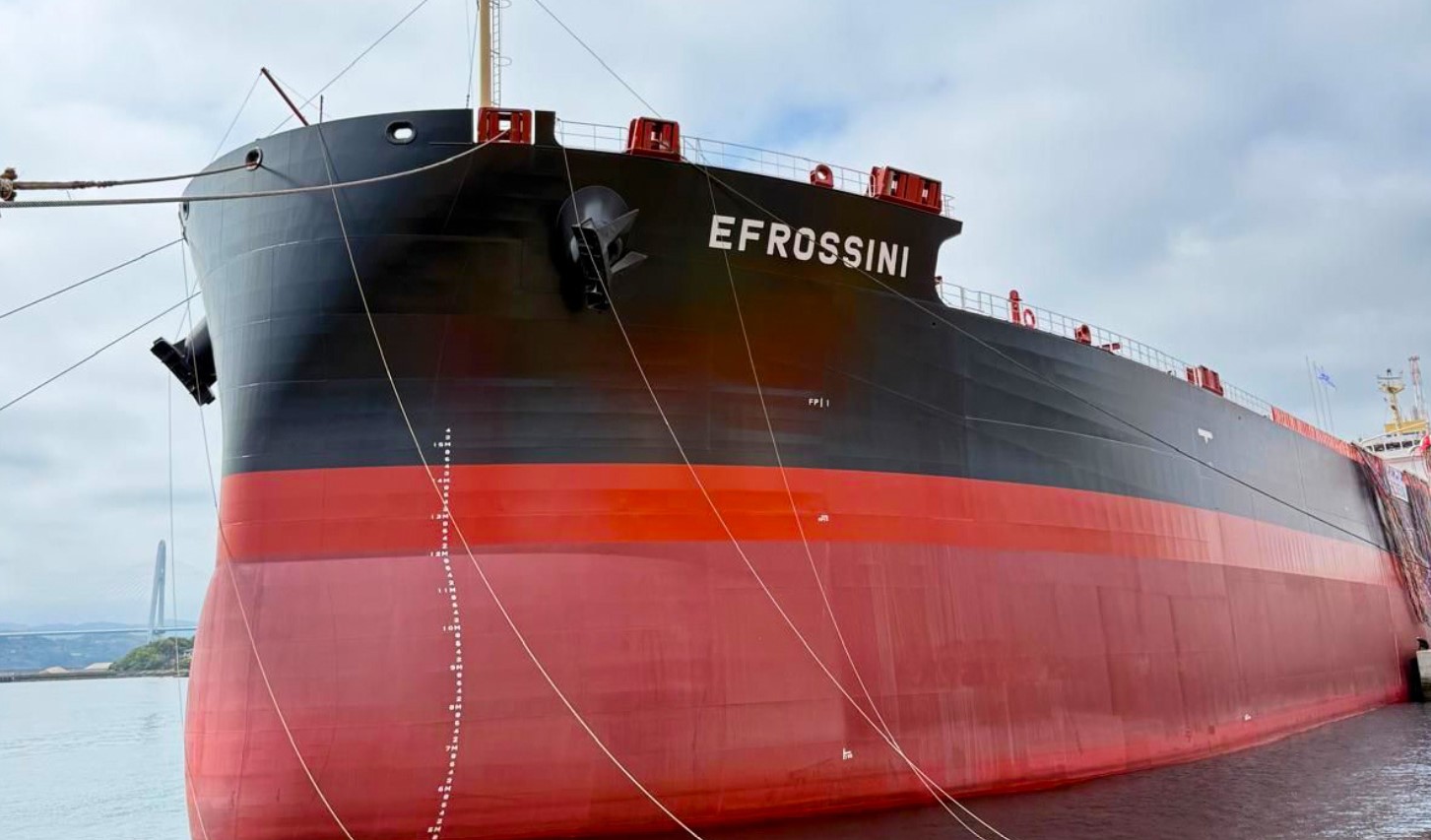
Safe Bulkers reported a sharp rise in first-quarter profit, supported by stronger dry bulk market conditions, higher charter revenues and lower vessel operating costs, while the company also raised its dividend to shareholders.
The company, controlled by the family of Poly V. Hajioannou and listed on the New York Stock Exchange, said net income rose to $22.2 million in the first quarter of 2026, compared with $7.2 million in the same period last year, according to its official earnings announcement.
Net revenue increased by 16 per cent to $74.4m, from $64.3m a year earlier, mainly due to higher charter revenues and the contribution of vessels fitted with exhaust gas cleaning systems, known as scrubbers.
Earnings per share rose to $0.20, from $0.05 in the first quarter of 2025, while EBITDA increased to $42.2m, compared with $28.8m a year earlier.
On an adjusted basis, net income stood at $20.7m, while adjusted EBITDA reached $40.7m.
The improvement was also reflected in the company’s operating performance. Its average daily time charter equivalent rate rose to $17,095 per day, from $14,655 in the first quarter of 2025.
At the same time, daily vessel operating expenses fell to $5,223, from $5,765 a year earlier, further supporting profitability.
Following the stronger results, Safe Bulkers’ board of directors approved an increase in the common stock dividend to $0.06 per share, from $0.05 in the previous quarter.
The dividend is expected to be paid on July 16, 2026, to shareholders of record as of June 30, 2026.
Safe Bulkers president Loukas Barmparis said the two most important developments of the period were the higher dividend and the company’s parallel listing on Euronext Athens.
The company’s move to Euronext Athens followed the publication of its prospectus relating to the admission to trading and listing, after its board approved the admission of its common shares to trading on the market.
The listing, completed in June 2026, made Safe Bulkers the first shipping company whose common shares are traded both on the New York Stock Exchange and Euronext Athens, according to the company’s commencement of trading announcement.
Through Euronext, the company gains access to a wider European investor base, including markets such as Paris, Milan, Brussels, Amsterdam, Dublin, Lisbon, Oslo and Athens.
Meanwhile, Safe Bulkers maintained a strong liquidity position, with cash and cash equivalents rising to $181.2m at the end of March, compared with $127.7m a year earlier.
Unused credit facilities stood at $193.2m, while operating cash flow rose to $35.2m, from $29.9m in the first quarter of 2025.
The company is also pressing ahead with its fleet renewal strategy.
As of mid-June, Safe Bulkers operated a fleet of 45 vessels, with total capacity of 4.5m deadweight tonnes and an average age of 10.5 years.
Its order book includes 11 new-generation vessels designed to meet IMO GHG Phase 3 and NOx Tier III requirements. These include ten Kamsarmax vessels, two of which are dual-fuel methanol ships, as well as one Capesize vessel.
At the same time, the company is selling older vessels selectively as part of its wider fleet renewal and environmental upgrade strategy.
During the first half of the year, it agreed to sell a 2012-built Capesize, a 2006-built Post-Panamax and a 2008-built Kamsarmax.
Looking ahead, Safe Bulkers said it had already secured approximately $161m in revenue from existing charter contracts, with 56 per cent of its fleet employment days for 2026 covered by contracts.
However, the company continues to operate in a market shaped by geopolitical uncertainty, including tensions in the Middle East, the Black Sea and the Strait of Hormuz.




Click here to change your cookie preferences