
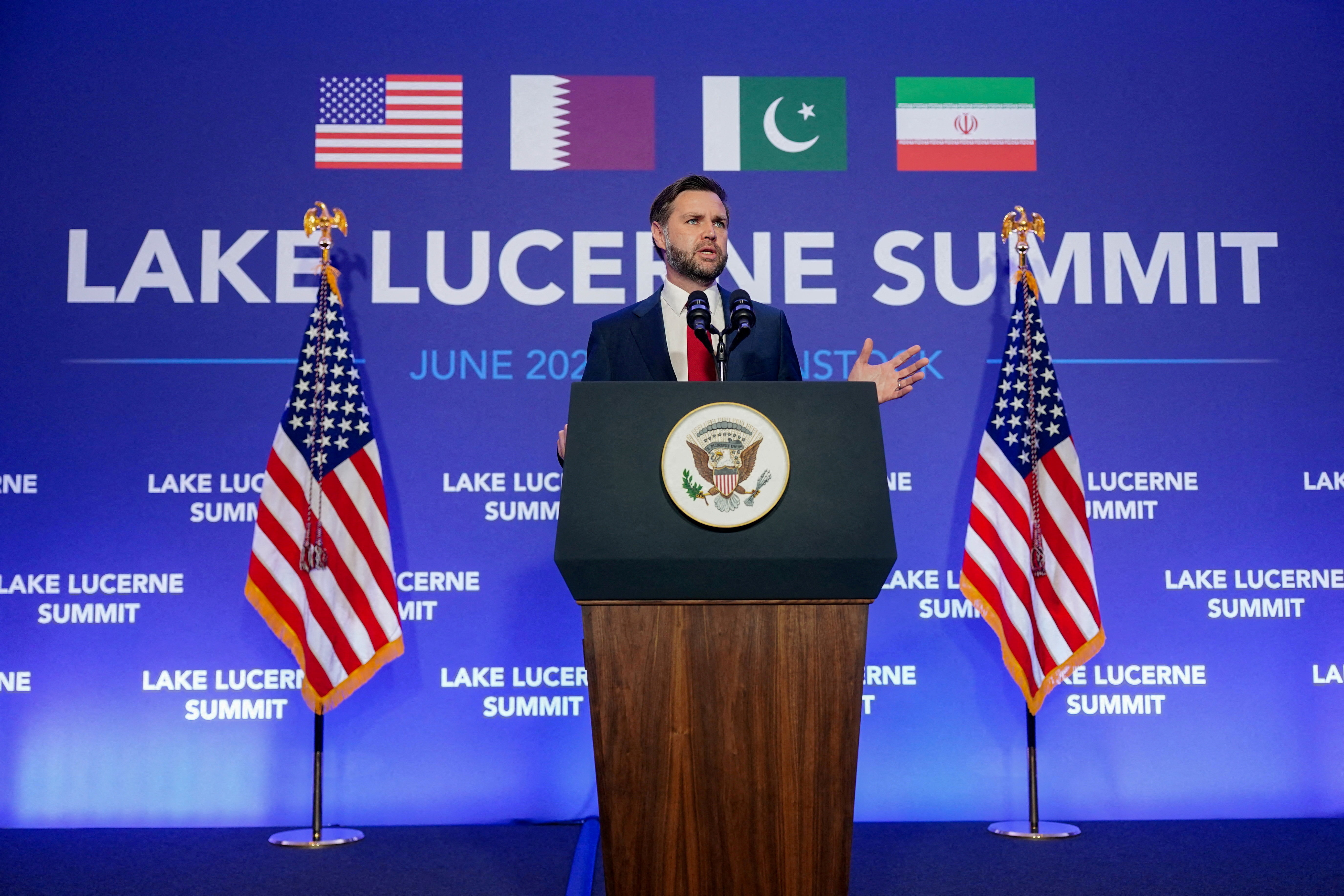
The United States and Iran made “encouraging progress” at the first round of talks aimed at reaching a final peace deal, mediators said on Monday, although tension persisted over Lebanon and the Strait of Hormuz.
The two sides agreed to a roadmap towards a lasting deal to end their war within 60 days at the talks in the Qatari-owned Swiss mountain resort of Buergenstock, which concluded early on Monday, mediators Pakistan and Qatar said.
They also agreed on a mechanism to end fighting in Lebanon between U.S. ally Israel and Iran-aligned Hezbollah, and opened a communications line to help ensure safe passage for commercial ships through the strait, a vital global oil supply route.
Sunday’s meeting followed an interim deal signed last week and stretched into the early hours of Monday, despite Tehran again shutting the waterway on Saturday and U.S. President Donald Trump threatening to resume attacks on Iran.
‘CONSTRUCTIVE ATMOSPHERE’
“The discussions were held in a positive and constructive atmosphere and yielded encouraging progress,” Pakistani Prime Minister Shehbaz Sharif wrote on X, adding that the first round of talks had “concluded successfully”.
Vice President JD Vance, who led Washington’s delegation, told reporters Trump had “asked us to turn over a new leaf to transform our relationship with the people of Iran” and said progress had been made towards ending hostilities in Lebanon.
“These things are always a little bit messy,” he said.
The main Iranian negotiating team, including senior diplomat Mohammad Baqer Qalibaf, left Switzerland for Tehran, Iranian student news agency ISNA reported, but technical talks were due to continue for the rest of this week.
In a post on social media, Iranian Foreign Minister Abbas Araqchi said Tehran had secured waivers for oil and petrochemical exports, the release of some frozen assets and the launch of a reconstruction and development plan for Iran.
Oil prices had risen sharply when Tehran started blockading the Strait of Hormuz, prompting a U.S. blockade of Iranian ports, but after the interim deal fell to their lowest since before the war began on February 28 with U.S.-Israeli attacks on Iran.
Oil prices fell further after Monday’s joint statement, with worries about a supply shortage in global markets easing and global benchmark Brent crude trading below $80 per barrel.
TALKS AIM TO REACH LASTING DEAL
The talks began under the terms of the memorandum of understanding reached last week to extend a tenuous ceasefire from April for at least another 60 days.
Before the talks officially began, Fox News quoted Trump as saying he had told Iranian officials “you won’t have a country” if they tried to close the strait again. Trump also reiterated an earlier threat that the U.S. would take over the waterway and possibly charge a toll of its own, Fox News said.
Iran’s semi-official Tasnim news agency, citing an informed source, said that after Trump’s threats became public, the Iranian delegation refused to return to the room where talks were held, though messages were traded via the mediators.
According to Tasnim’s source, the Iranians said the start of negotiations on nuclear matters required the delivery of other parts of the MOU, including the release of frozen assets and U.S. waivers authorizing Iranian oil exports.
The interim agreement calls for reopening the Strait of Hormuz and ending all hostilities, including in Lebanon, where violence continued after a ceasefire was declared on Friday.
Accusing the U.S. of failing to meet its commitment to halt fighting in Lebanon, Iran said at the weekend that it had again stopped maritime traffic through the strait.
Five vessels passed through the strait on Sunday, a sharp drop from the 26 ships spotted a day earlier, data from analytics firm Kpler showed. The data may exclude vessels that switch off their transponders while travelling in the Gulf.
VIOLENCE IN LEBANON ABATES
The violence between Hezbollah and Israel has abated since late on Saturday.
Security sources in Lebanon said Israel’s last airstrike was on Saturday evening, and that the lull in violence was the longest since Hezbollah opened fire in support of Iran on March 2 although an Israeli drone could be heard over Beirut.
Reflecting reduced tensions, the Israeli military lifted safety restrictions in eight communities near the Lebanese border beginning at 6 a.m. (0300 GMT) on Monday.
Lebanese President Joseph Aoun discussed efforts to maintain the ceasefire and halt Israeli military escalation during a phone call with Vance, Qatar’s prime minister and White House envoy Jared Kushner, the Lebanese presidency said.
Israeli President Isaac Herzog said Israel was not opposed to a diplomatic end to the Iran war, but any agreement must ensure Tehran cannot use funds it receives as part of the deal for military purposes or to support regional proxies.


Click here to change your cookie preferences