
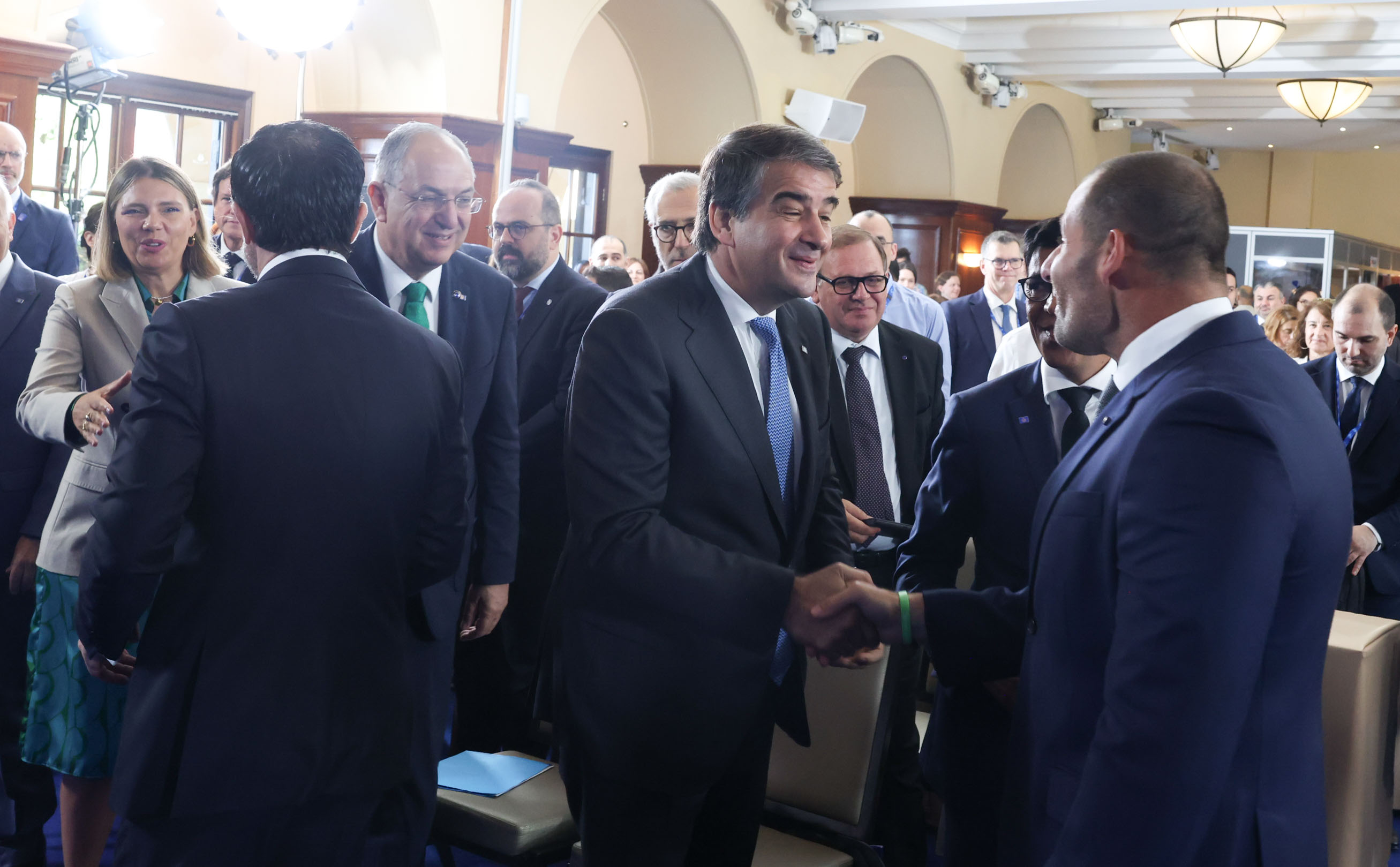
The European Union’s new strategy for islands is only a starting point and must now be turned into practical policies that respond to the daily realities of island communities, European Commission Executive Vice-President Raffaele Fitto said on Friday.
Speaking at the high-level conference on islands and coastal communities in Paphos, Fitto said more than 17 million people live across over 4,000 inhabited islands in Europe, while three EU member states are islands themselves.
“Insularity is not simply a geographic fact. It has real economic and social consequences,” he said.
Fitto said islands contribute to Europe’s economic development, maritime identity, environmental diversity, cultural heritage, security and resilience. They are also places of innovation, entrepreneurship and strong local identity, he added.
However, he said islands face structural challenges linked to distance from mainland markets, dependence on maritime and air connections, higher transport costs and limited economies of scale.
“These affect almost every aspect of daily life and economic activity,” he said.
He described the “cost of insularity” as a daily burden carried by island residents and businesses, affecting access to jobs, education, healthcare, public services and economic opportunities.
“For island residents and businesses, this is not an occasional experience. It is a daily reality,” he said.
The EU Strategy for Islands, adopted by the European Commission earlier this month, aims to establish a coordinated framework for EU action and support member states in designing policies and investments that respond to island realities.
Fitto said the strategy is structured around four pillars: economic development and connectivity; energy, climate and the environment; people and demographic challenges; and security and crisis preparedness.
Connectivity, he said, remains the central challenge for islands. Under the strategy, the Commission will support better transport and digital infrastructure, assess the particular situation of islands in relevant state aid frameworks, the upcoming review of the emissions trading system and transport legislation, and launch an in-depth analysis of the cost of insularity.
Fitto said islands are often energy isolated, while many also face population decline, ageing, brain drain and severe housing pressure.
He also highlighted their strategic role, saying islands are on the frontline of geopolitical challenges “from the Baltic to the Mediterranean”.
Fitto said his visit to remote areas of Cyprus during his trip had reinforced the need for policies shaped by the real experience of communities. “A strategy is a starting point, not an endpoint,” Fitto said. “Now it’s time to move from vision to action.” He thanked Cyprus, the presidency, local authorities and the communities he visited, saying people had opened their doors to him “as if I were an old friend”.
Speaking to the Cyprus Mail on the sidelines of the conference, Fitto said the European Commission’s broader objective was to modernise cohesion policy and strengthen the link between competitiveness and territorial cohesion, ensuring that no region is left behind.
“We are working first of all to modernise cohesion policy, because this policy is very crucial for the future of Europe,” he said. “The most important goal of cohesion policy is to reduce disparities on the ground.”
Fitto said the process had already begun through the mid-term review of the current EU budget, under which member states have redirected funding towards five new priorities: defence, water, housing, energy and competitiveness.
He explained that the new islands strategy formed part of a wider package of five territorial strategies being developed by the Commission, alongside the European Agenda for Cities, a strategy for eastern border regions bordering Russia, Belarus and Ukraine, a forthcoming strategy for outermost regions and the planned “right to stay” strategy.
Describing the latter as particularly important, Fitto said it aimed to address the growing challenge of depopulation in rural and remote areas across Europe.
“We launched the call for evidence in May and received more than 700 contributions,” he said. “Now we are working to prepare this strategy, and it is important to visit the territories for this reason.”
Asked by the Cyprus Mail about his visit to remote communities in the Troodos region on Wednesday, Fitto said the experience had reinforced his conviction that European policies must be shaped through direct engagement with citizens.
“I think that the best way to prepare this strategy is to visit the territories and to speak with the people, to understand directly the real situation and to show that the European Commission is close to the citizens, not too far,” he said.
Asked how residents had responded, Fitto described the visit as “very positive”, saying he had heard firsthand about concerns over public services, infrastructure and employment opportunities, particularly for younger generations.
“I listened to the needs that they have for public services, for infrastructure, for the opportunity that they want to have to work, for the right to stay, for the young people in particular, because this is the challenge that we have,” he said.
Fitto added that he intended to spend the next six months visiting remote areas, rural communities and small islands across the European Union ahead of the presentation of the “right to stay” strategy in January.
“The problem we have in villages in Cyprus is different from the problem that we have in the north of Europe,” he said. “We have to work on the same strategies at the general level, but following the specificities that we have.”
He said these place-based strategies would play a key role in shaping the next EU long-term budget framework, which the Commission plans to simplify through the introduction of national and regional partnership plans developed in close cooperation with national governments, regional authorities and local communities.
According to Fitto, 25 member states have used the voluntary opportunity offered under the mid-term review of cohesion policy to redirect more than €34 billion, around 10 per cent of cohesion funding, towards five priorities: competitiveness, affordable housing, energy, water resilience and defence.
Of that amount, more than €1.5 billion has been redirected to support strategic priorities in island areas.
Asked by a journalist about possible projects, Fitto said connectivity and water infrastructure could be included, adding that desalination plants were possible as water is one of the EU’s priorities.
The commissioner said the strategies were not designed in Brussels in isolation, but were shaped through dialogue with communities. More than 350 stakeholders from 18 member states contributed to the islands strategy, including citizens, public authorities, businesses, universities, NGOs and island networks.

Click here to change your cookie preferences