
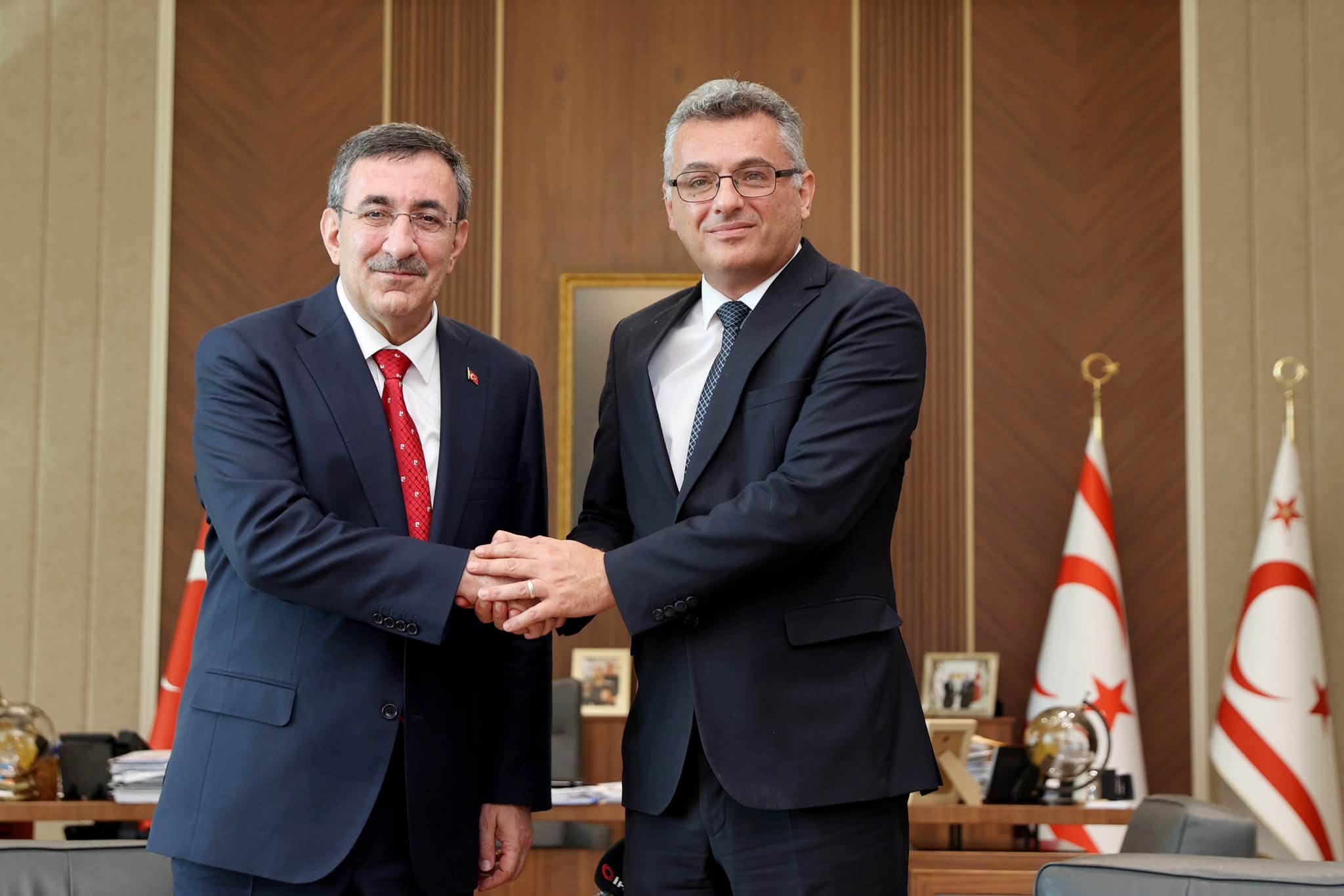
Turkish Cypriot leader Tufan Erhurman on Friday evening extolled the “harmony” of his cooperation with the Turkish government, as he met Turkish Vice President Cevdet Yilmaz at his official residence in Nicosia, with efforts both on the island and abroad ramping up with the aim of bringing about a resumption of negotiations in earnest on the Cyprus problem.
“I am extremely pleased that our harmony regarding the process we are conducting has been confirmed once again, as emerged from our meeting with the president of the Republic of Turkey, Recep Tayyip Erdogan, before the Antalya Diplomacy Forum,” he said of the pair’s meeting in April.
He added that “we have always said that we will conduct this process in consultation” with Turkey, and that “we are continuing this process in intensive consultation”.
“We have the opportunity to maintain constant contact, and these contacts will continue uninterrupted,” he said.
Yilmaz, meanwhile, said that “mutual visits are an indication of the unbreakable ties between our two states, our shared history, and our common future”.
“This is a clear manifestation of the strong support given by the motherland and guarantor Turkey to the Turkish Cypriot people,” he said.
He said that he and Erhurman had “naturally also discussed the latest developments regarding the Cyprus issue”, and that they had “reaffirmed once again that we are in complete agreement and harmony on this matter”.
“The freedom, rights, and security of the Turkish Cypriots are not merely an ordinary foreign policy issue for Turkey, but the defining characteristic of our national cause,” he said.
As such, he added, “Turkey, with the responsibility bestowed unto it as a guarantor state, will always stand by the Turkish Cypriot people, defend their just cause on every platform, and mobilise all its resources to establish a just, lasting, and sustainable solution based on sovereign equality”.
Friday’s meeting comes two days after the conclusion of this week’s Nato leader’s summit, which took place in Ankara, with Erhurman describing Turkey’s hosting of the summit as an “extremely great achievement”.
On the sidelines of that summit, European Council President Antonio Costa and European Commission President Ursula von der Leyen called on Erdogan to “seize the renewed momentum” to bring about a solution to the Cyprus problem.
They said that “we must also seize the renewed momentum to advance a settlement of the Cyprus issue through the UN-led process”, with the United Nations having undertaken a “new initiative” in recent weeks and months with the aim of bringing about a resumption of negotiations in earnest to resolve the Cyprus problem.
Nato continues to form part of the ongoing discussions regarding security guarantees in a post-solution Cyprus, with it having been suggested that those guarantees may come in the form of the new Cypriot republic’s accession to Nato, alongside the presence of Nato troops from Turkey, Greece, France, the United Kingdom, and the United States on the island.
In light of this, UN envoy Maria Angela Holguin postponed her latest round of contacts until after this week’s summit. Her next meeting of note will be with Antonio Costa on Monday.
She is then expected to return to Cyprus with a view to holding more meetings with both Erhurman and President Nikos Christodoulides with a view to convening an enlarged meeting on the Cyprus problem.
That meeting will involve the island’s two sides, its three guarantor powers, Greece, Turkey, and the UK, and the UN, and will likely take place next month.
In advance of that, the EU’s foreign policy chief Kaja Kallas, Enlargement Commissioner Marta Kos, and Internal Affairs Commissioner Magnus Brunner all visited Turkey and signed a joint declaration with Hakan Fidan offering their support for UN Secretary-General Antonio Guterres’ efforts in Cyprus.
Holguin, meanwhile, called on Cypriots to “seize this historic opportunity to negotiate a lasting solution” and saying that Guterres is “evaluating which could be the next phases that will convince both parties to take concrete steps towards a final solution”.
The way forward is not yet completely clear, however, with Akel leader Stefanos Stefanou having offered vehement pushback to the idea of Nato involvement in a solution to the Cyprus problem during a meeting with diplomats on Wednesday.
“Those who think about Nato involvement in [a solution to] the Cyprus problem should do their calculations without Akel. Those who know the situation in Cyprus well can easily understand that a solution without Akel’s support cannot be supported by the people,” he said.
This assertion is not without precedent, too, given that the party had withdrawn its support for the Annan plan to reunify Cyprus prior to the 2004 referendum, officially because the UN security council did not provide adequate guarantees regarding post-reunification security.
At the time, the party had said it was “saying ‘no’ now to cement the next ‘yes’”. This hypothesis has not yet been tested at a public vote.




Click here to change your cookie preferences