
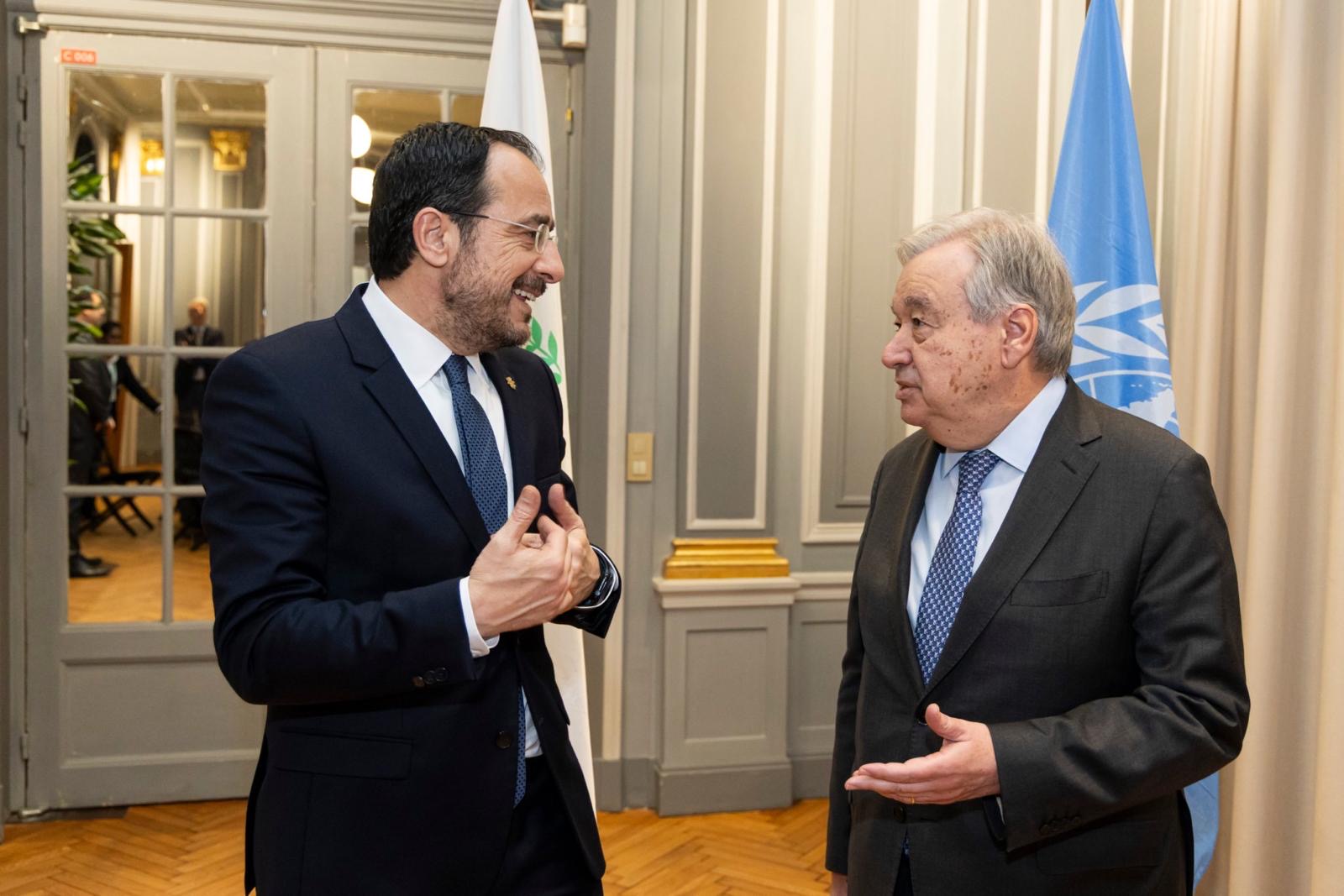
Both President Nikos Christodoulides and Turkish Cypriot leader Tufan Erhurman have demonstrated their “commitment to building a relationship based on trust” in recent months, United Nations Secretary-General Antonio Guterres wrote in an advance copy of his latest report on the status of the UN’s good offices in Cyprus seen by the Cyprus Mail on Saturday.
“The intensification of dialogue between the Greek Cypriot and Turkish Cypriot leaders over the reporting period remains positive. It demonstrates their commitment to building a relationship based on trust and to finding a path forward on the Cyprus issue,” he said.
He did, however, note that there are “several trust building initiatives” which were agreed upon at enlarged meetings on the Cyprus problem in March and July last year which “remain unimplemented”.
“Implementation of these initiatives would improve the daily lives of Cypriots and demonstrate concretely that the sides possess the political will to make progress,” he said, before warning that “in the absence of progress on these initiatives … a lasting solution may continue to be elusive”.
He said that he encourages both leaders to “continue their constructive engagement” with one another and with UN envoy Maria Angela Holguin.
“I urge the leaders to avail themselves of the current window of opportunity for making progress, which should not be taken for granted, and encourage both sides to engage with determination to construct a future together by reaching an agreement that takes into account the interests and rights of all Cypriots,” he said.
On this front, he made reference to UN security council resolution 2723, which called on both sides of Cyprus to demonstrate the required “openness, flexibility, and compromise” to bring about a solution.
He then praised the ongoing work of the bicommunal technical committees, and urged both leaders to “support progress in the areas of education, crisis management, and the environment”.
“I once again stress the importance of education to instil reconciliation, forgiveness, and cooperation among school-aged children,” he said, while saying that likewise, “sports have shown a unique capacity to bring together individuals who might not otherwise interact”, and urging the leaders to “work in this area”.
In less positive news, he said that he is “deeply concerned by unilateral actions [undertaken] by both sides in and around the buffer zone”, and by “the lack of progress in taking de-escalatory steps”.
He also called on both leaders to “consider ways to move past the impasses around the opening of new crossings on the island”, and said that he urges “the full implementation” of the European Union’s Green Line regulation “to help increase the volume of intra-island trade and cooperation”.
Additionally, he said he welcomes the agreement reached in May regarding a plan for the conduct of religious services.
“Religious leaders have, in the past, been a powerful joint voice towards peace and in support of dialogue,” he said.
He added that he is “grateful for the support” of the island’s three guarantor powers, Greece, Turkey and the United Kingdom, “to finding a mutually acceptable way forward in Cyprus, including in view of the volatile regional environment”.
Christodoulides and Erhurman both also wrote updates in the report, with Christodoulides writing that he holds “the steadfast conviction that a solution to the Cyprus problem on the mutually agreed federal basis … constitutes the only viable and sustainable path forward”.
He also wrote in his updates that “I represented the Republic of Cyprus through my capacity as president … while also representing the Greek Cypriot community” – an assertion which Erhurman has described as a “provocation”, and one which he has promised not to “fall for”.
On the matter of Green Line trade, Christodoulides said that it “continues to maintain the strong trend of recent years”, and that “the unobstructed trade of products from the government-controlled to the non-government-controlled area is further required to enhance confidence between the two communities”.
However, he said that “the creation of an appropriate environment, conducive to the resumption of negotiations, continues to be undermined by Turkey’s policies”, including the “illegal exploitation of properties in the occupied part of Cyprus belonging to displaced persons”.
In addition, he decried “the continuation of the upgrading of Turkey’s military capabilities and infrastructure in the occupied part of Cyprus” and “the continuation of ‘moves forward’ violations in the buffer zone, south of the ceasefire line”.
He also made reference to a “move forward” on the plateau near the buffer zone village of Pyla, near Larnaca, saying that there is now a “static presence and patrols of the occupation forces in a big part of the buffer zone” since April.
This, he said, has “expanded the occupation over four square kilometres of Cyprus’ territory”.
Nonetheless, he said that he is prepared to discuss “the establishment of a mechanism for military contacts between the opposing forces in Cyprus”, as had been suggested by Erhurman in January.
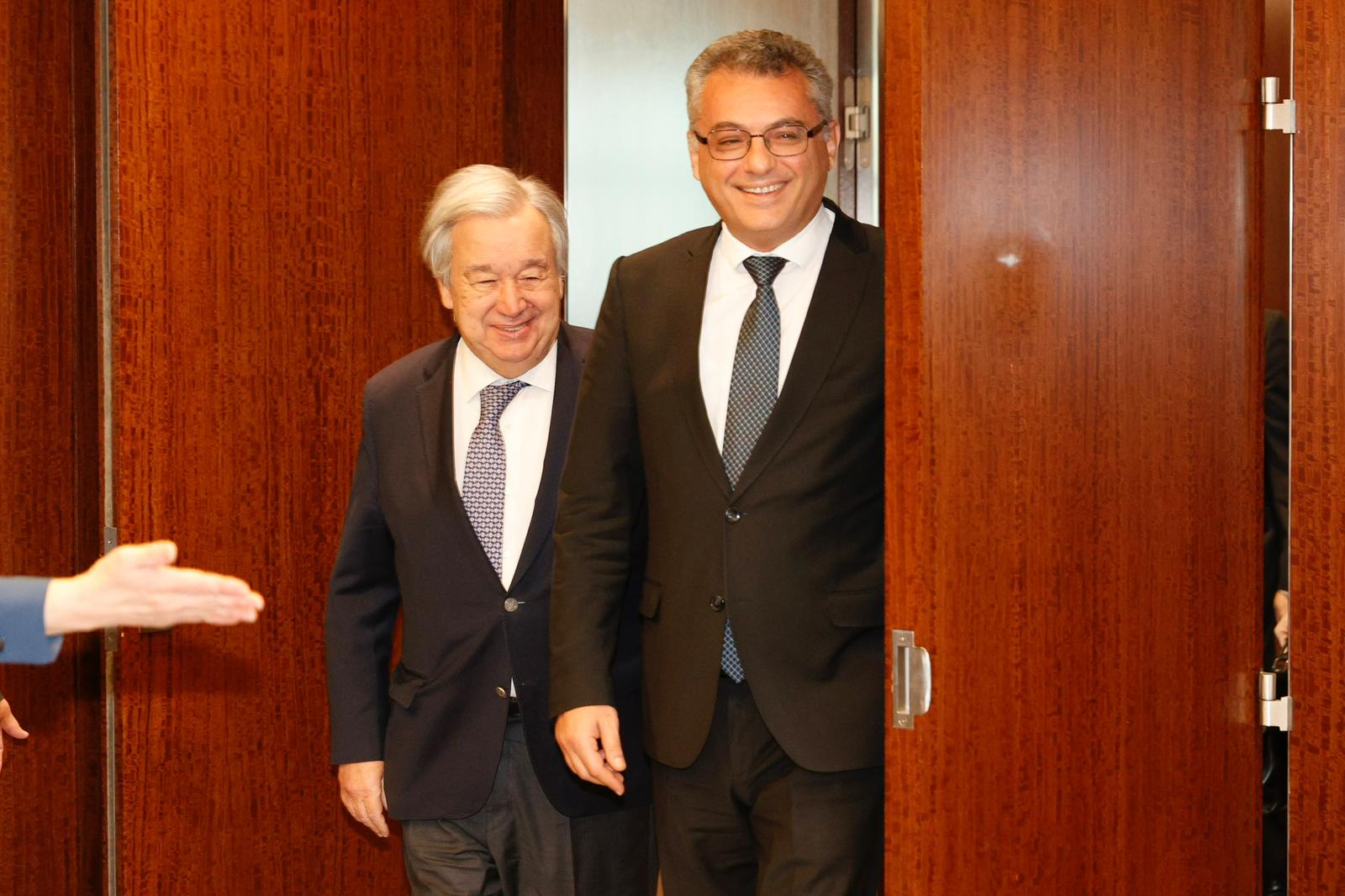
Erhurman, meanwhile, wrote that “when I assumed my duties as president, I was convinced that we, as the two sides, had the responsibility, first and foremost, to reverse [the] negative dynamic [following the collapse of talks at Crans-Montana in 2017] and begin building trust in order to create new momentum that could lead to a new process”.
He also made reference to his four-point collection of ideas which he said must be met for negotiations to resume, and said that it was “devised with a view to ensuring meaningful negotiations, rather than negotiations for the sake of negotiations”.
“It represents the culmination of lessons learned from past experiences and is fully in line with the expectation that ‘this time must be different’, a point emphasised by [Guterres] numerous times following the collapse of the Crans-Montana conference in 2017,” he said.
He said that he had “availed myself to meet as much as possible with my Greek Cypriot counterpart”, and that his undersecretary Mehmet Dana has been holding “weekly meetings” with Greek Cypriot chief negotiator Menelaos Menelaou.
Later, he expressed regret that the Greek Cypriot side had rejected a proposal for a bicommunal children’s football match to be played, and warned that in the absence of direct contact between the two communities, “the gap between the two sides continues to widen across many aspects of life”.
“Indeed, both [Guterres] and the security council have repeatedly drawn attention to the widening socio-economic disparity between Turkish Cypriots and Greek Cypriots, warning of the risk of further estrangement on the island and underscoring the importance of addressing this challenge through meaningful contacts,” he said.
He also decried “politically motivated property-related arrests [conducted] by the Greek Cypriot side”, saying that the issue “undoubtedly poisons the relations between the Turkish Cypriots and the Greek Cypriots”.
On the matter of property, he wrote that “yet another example of the Greek Cypriot side’s efforts to undermine the Turkish Cypriots’ economy and their wellbeing was witnessed” following last month’s ruling made by the Council of Europe’s committee of ministers.
The committee had chosen not to close its monitoring of certain property-related cases in Cyprus, with Erhurman saying that “the outcome reflected the politicisation of the European convention system through the increasing pressure exerted by the Greek Cypriot side on Council of Europe member states”.
“My Greek Cypriot counterpart subsequently went so far as to declare on social media that the results of the said voting at Strasbourg ‘contribute decisively to the Greek Cypriots’ negotiating power on the Cyprus issue’,” he said.
He added that “such unabashed attempts to impose on the Turkish Cypriot side its terms for a solution raise serious doubts about the Greek Cypriot side’s sincerity as regards a settlement and further erode trust”.



Click here to change your cookie preferences