
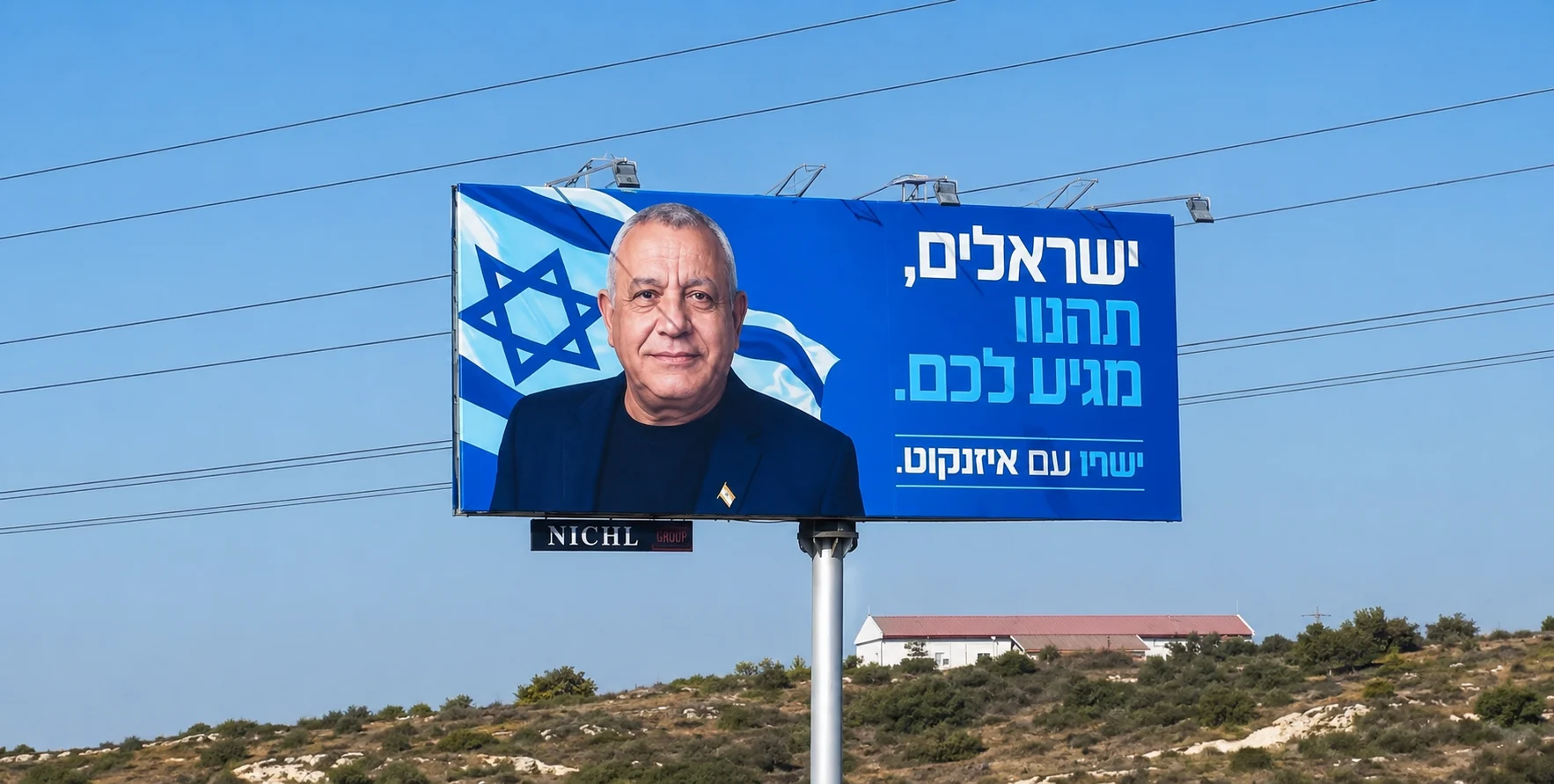
An election billboard promoting Israeli prime ministerial candidate and former IDF chief-of-staff Gadi Eisenkot has led independent MEP Fidias Panayiotou to call for an outright ban on third countries conducting campaigns in Cyprus.
The billboard, erected near Larnaca airport, forms part of the campaign of Eisenkot, leader of Israel’s Yashar party and a candidate for prime minister in Israel’s October 27 elections.
One sign reads ‘Israelis, enjoy! You deserve it,’ while a second, positioned on the return route to the airport, urges travellers to ‘Come back and win!’
The campaign was confirmed by Eisenkot’s headquarters, which said the billboards are an official part of its election strategy and are intended to reach the significant number of Israelis holidaying in Cyprus.
The signs caused an outcry on social media, leading to public debate over whether political advertising by a foreign country should be permitted in Cyprus.

Panayiotou described the development as “particularly concerning” in a video posted on social media, arguing that the advertisements demonstrated there were enough Israeli nationals in Cyprus for campaign organisers to consider such advertising worthwhile.
He questioned whether countries outside the EU should be allowed to conduct election campaigns in Cyprus and called for legislative changes to prevent the practice.
“This is unacceptable,” he stressed, proposing a law that would prohibit election campaigns by third countries within the government-controlled areas.
Electoral legislation and official guidance does not identify any provision prohibiting a foreign political party from purchasing billboard advertising in Cyprus outside a local election period.
Existing electoral rules regulate campaigning for elections held in Cyprus, while commercial billboards are generally governed by advertising and planning regulations.
The interior ministry told the Cyprus Mail that responsibility for billboard content does not fall within its remit, with “no legal framework under its competence to regulate advertising for elections or advertising in general”.
The ministry pointed instead to the advertising regulation organisation (Caro), the country’s self-regulatory advertising body.
Caro likewise told the Cyprus Mail there is currently “no framework governing the content displayed on commercial billboards”, with decisions resting at the discretion of billboard owners, provided advertisements comply with the relevant advertising codes.
No previous example of a foreign political party campaigning within Cyprus has been publicly identified, making the Israeli campaign an unprecedent case.
Niche Advertising, the company responsible for the billboard, said it did not politically endorse Eisenkot or his party and said that the advertising space had been purchased as a commercial booking.
The company questioned the reaction to the billboard, asking, “Do you not see this in Germany with Turkish elections?”
It further remarked that “the Israelis are investing greatly in Cyprus” and maintained there was “nothing in the law prohibiting this.”
Panayiotou also called for greater attention to Cyprus’ relations with Israel and with other non-EU countries, saying safeguards were needed to ensure circumstances did not emerge that could place Cyprus at a future “political or geostrategic disadvantage”.
The appearance of the billboards comes amid a broader public discussion over the increasing presence of Israeli nationals, businesses and investment in Cyprus, particularly in Limassol and Larnaca.
According to Israeli media, the overseas campaign is designed specifically to encourage Israelis visiting Cyprus to return home to vote in October’s election.





Click here to change your cookie preferences