
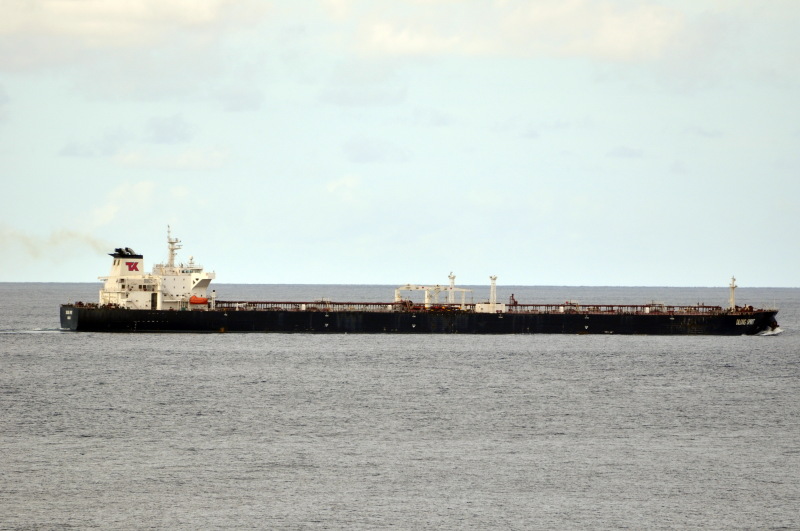
Merchant ships are now taking fire at both maritime gateways to the Middle East and in the Black Sea, leaving crews exposed across three of the world’s most important trade routes.
The latest incident came early on Tuesday, when an unnamed vessel was struck while sailing out of the Strait of Hormuz.
According to an official warning, an unknown projectile hit the ship’s engine room and caused a crew casualty. The remaining crew were being assisted by the Omani Coast Guard, while no pollution had been reported.
UK Maritime Trade Operations did not identify the ship, the type of projectile or the party responsible. Crucially, it described a “crew casualty” but did not confirm whether the person was injured or killed.
The attack came as commercial traffic through Hormuz remained close to a standstill. Just six commodity vessels crossed on Monday, compared with a ten-day average of 11, according to shipping data. Only two passed on Sunday and three on Saturday.
No very large crude carriers or liquefied natural gas tankers were recorded on Monday, although vessels travelling with their tracking equipment switched off would not appear in the figures. Before the war, daily traffic was estimated at about 130 to 140 ships.
The risks have increased further following the failure of Washington and Tehran to turn their temporary agreement into a lasting settlement. The memorandum, signed on June 17, gave the two sides 60 days to agree on Iran’s nuclear programme, sanctions and navigation through Hormuz.
That deadline passed on Monday. Iran has since warned that it could move to a “fully offensive” posture, while US President Donald Trump has ruled out extending the interim agreement.
The tension pushed oil prices higher for a third session, with Brent crude reaching $91.76 a barrel on Tuesday and US crude rising to $85.55.
However, Hormuz is only one side of the problem.
At Bab el-Mandeb, the other major sea entrance to the Middle East, the August 11 attack on the Egyptian-owned cargo ship Tihamah killed four sailors and two Yemeni rescuers.
Three Pakistani crew members and one Indonesian were killed in the initial strike, while seven other seafarers were injured. The Yemeni Coast Guard said the ship was struck again after rescue teams arrived, killing two members of the National Resistance Forces and injuring three rescuers.
The Houthis claimed they had attacked a vessel carrying Saudi military equipment, although they did not identify it and the allegation has not been independently verified. Yemen’s internationally recognised government said the ship was instead transporting food supplies.
The fatal attack was especially disturbing because it showed that the danger did not end once a ship had been hit. The people attempting to evacuate the crew also became targets.
International Maritime Organisation (IMO) Secretary-General Arsenio Dominguez said “innocent seafarers have lost their lives in an indefensible attack on international shipping”, urging operators to assess risks before entering the Red Sea and Gulf of Aden.
Traffic through Bab el-Mandeb has already fallen by more than 50 per cent compared with levels before the earlier wave of Houthi attacks. On Monday, 19 commodity ships crossed the strait, below the ten-day average of 26.
Military action against merchant shipping has not come only from Iran and the Houthis. On the same day as the Tihamah attack, a US Navy helicopter fired two Hellfire missiles into the engine room of the Panama-flagged container ship Vela Nova in the Gulf of Oman.
US Central Command said the vessel had ignored repeated warnings and was heading towards an Iranian port in breach of Washington’s naval blockade. The strike disabled its steering gear.
Meanwhile, the threat has also spread to the Black Sea, where the Liberia-flagged, Greek-managed tanker Skiros was struck near Novorossiysk after loading crude.
The 2009-built Suezmax can carry roughly one million barrels of oil and has a deadweight capacity of 159,021 tonnes, according to vessel data.
Reports differ over whether it was still loading or had already left the terminal when it was hit. Its Athens-based manager said there were no injuries or pollution, although the vessel suffered material damage.
Sources said the cargo was Russian crude, even though the Caspian Pipeline Consortium terminal primarily handles Kazakh oil. No party has claimed responsibility, and reports describing the incident as a Ukrainian drone strike remain unconfirmed.
The attack came shortly after port operations resumed following another drone alert. Novorossiysk can handle about 700,000 barrels of oil a day and remains vital to both Russian exports and landlocked Kazakhstan.
The cost is already showing. Repeated strikes have pushed some Black Sea tanker rates to around $400,000 a day, while war-risk cover for a port call has risen as high as 2 per cent of a vessel’s value.





Click here to change your cookie preferences