
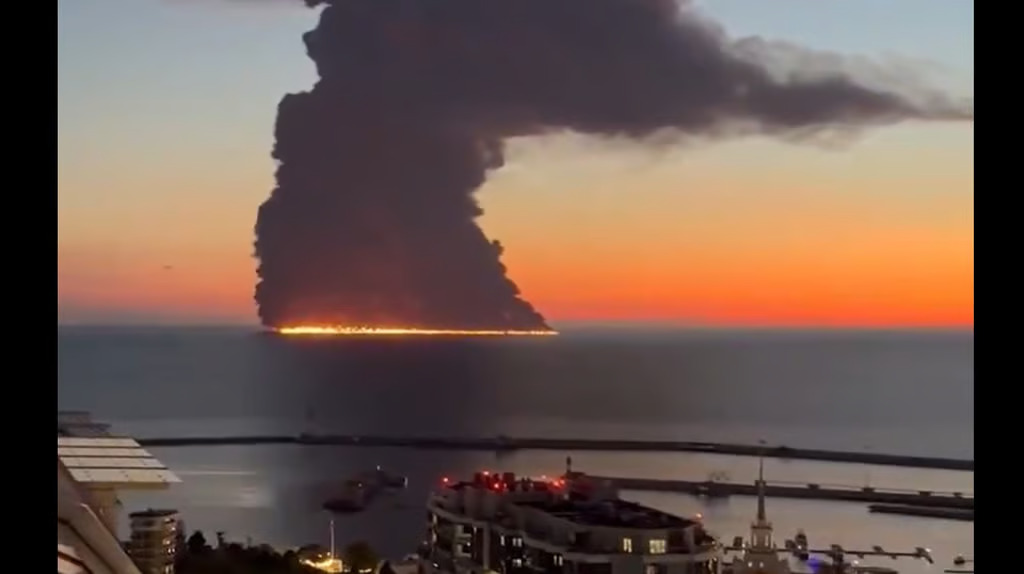
A Cyprus-linked crude oil tanker caught fire off Russia’s Black Sea coast near Sochi after being struck by unmanned vessels, with all 23 crew members rescued as attacks on commercial shipping in the region intensify.
The Liberian-flagged Aframax Rio, linked to Cypriot shipowner Andreas Hadjiyiannis, was attacked on Tuesday, according to Russia’s Transport Ministry.
The ministry said the vessel was struck by unmanned surface vessels, causing a major fire.
All 23 crew members, who are Indian nationals, were rescued, with no injuries reported, according to Reuters.
By Wednesday afternoon, local authorities said all crew members had been taken ashore and had declined hospital treatment.
The blaze initially prevented emergency crews from approaching the tanker, while authorities in the nearby Sirius federal territory temporarily closed beaches and advised residents to remain indoors.
By Wednesday, however, Russia’s Transport Ministry said “the open fire had been extinguished.”
Rescue vessels remained on standby, while a joint response team involving the Transport Ministry, Emergencies Ministry, Defence Ministry and Krasnodar regional authorities began dealing with the aftermath.
The tanker was meanwhile drifting along the coastline of Sochi’s Lazarevsky district under the influence of the Black Sea current, according to an afternoon update from local authorities.
The Transport Ministry also said no contamination of the Black Sea from the tanker’s oil cargo had been recorded, according to Interfax.
Russia’s environmental watchdog Rosprirodnadzor said it was continuing to monitor the coastline and surrounding waters, with no signs of pollution detected.
Sochi authorities also said “air monitoring carried out overnight and on Wednesday morning found no excessive concentrations of pollutants.”
Additional samples taken in the city’s Central and Khostinsky districts were also within permitted levels, while Russia’s consumer protection watchdog Rospotrebnadzor was taking sea-water samples across all four districts of Sochi.
Access to beaches nevertheless remained restricted on Wednesday afternoon, with swimming still prohibited while monitoring continued.
The Aframax Rio, IMO 9273844, was built in 2004 and has a deadweight capacity of 107,113 tonnes.
The crude oil tanker is 247 metres long and 42 metres wide, with a gross tonnage of 57,948 tonnes.
Shipping records identify Rio Enterprises SA as the registered owner, while Hellenic Tankers Co Ltd is listed as manager.
Hellenic Tankers was founded by Andreas Hadjiyiannis, who has served as its chairman from the start.
Hadjiyiannis also founded Cyprus Sea Lines and Cyprus Maritime, with the three companies privately owned, according to the Shipping Deputy Ministry’s Maritime Cyprus profile.
He served as president of the Cyprus Union of Shipowners (CUS) before Polys Hajioannou took over the position in 2025.
Hadjiyiannis currently serves as vice-president, according to the union’s executive committee.
The tanker has also been targeted by Ukrainian sanctions over its involvement in Russian oil trade.
Ukraine added the Rio to its sanctions list in February 2026, together with another 90 vessels Kyiv considers part of Russia’s so-called shadow fleet.
The wider package targeted vessels Kyiv says were involved in transporting Russian oil and petroleum products to third countries, according to the Ukrainian presidency.
The Rio had continued trading from Russian ports during 2026.
A May voyage record shows the tanker leaving Novorossiysk on May 10 for Rabigh, Saudi Arabia, where it arrived in early June.
The vessel was also included in BlackSeaNews data covering Russian crude oil exports from Black Sea ports in May.
However, the origin and intended destination of the cargo on board at the time of Tuesday’s attack have not been officially confirmed.
Vessel-tracking data cited by Russian media show the Rio’s last AIS report was recorded on October 5 at 17.24 UTC, before the attack.
At the time, the tanker was travelling at about 7.3 knots, while no destination was displayed.
Its reported draught was 8.4 metres, compared with a maximum of about 14.8 metres, while Samsun in Turkey was listed as its last recorded port call.
The draught data alone, however, do not establish the amount of oil on board at the time of the attack.
The incident comes amid a sharp rise in attacks on commercial shipping in the Black Sea.
Also on Tuesday, drones struck two commercial vessels in Bulgaria’s exclusive economic zone, with one vessel sinking and another catching fire, according to Reuters.
The attacks prompted rescue operations involving crews from several nationalities and added to concerns over the safety of commercial shipping across the Black Sea.
A day earlier, another merchant vessel was struck in Romania’s exclusive economic zone, prompting a separate rescue operation.
The incidents have increased concern over the extension of the Russia-Ukraine conflict into commercial shipping routes used by tankers and bulk carriers.
European Commission President Ursula von der Leyen subsequently condemned attacks against civilian shipping in the Black Sea, calling them unacceptable.
Ukraine had not explicitly claimed responsibility for the attack on the Rio by Wednesday afternoon.
However, Ukrainian President Volodymyr Zelenskiy said Ukrainian forces had carried out strikes on four targets over the previous 24 hours, including two oil facilities and a military training ground in Russia.
He also referred to a “counter-strike action in the Black Sea”.
Zelenskiy did not identify the Aframax Rio or say explicitly that Ukrainian forces had attacked the tanker.


Click here to change your cookie preferences