

Students in Cyprus lag behind their European peers in basic, civic and digital skills, with a recent European Union report pointing to a “general problem related to the quality of education” which could affect their future career prospects.
According to the EU’s Education and Training Monitor, Cyprus records an overall low level of basic skills among students, which the report warns could also affect the country’s competitiveness.
Citing findings from the Programme for International Student Assessment (PISA), the report found that more than half of students in Cyprus, 53.2 per cent, underperformed in mathematics, compared with an EU average of 29.5 per cent.
The report also found significant disparities according to socioeconomic background, with 69.8 per cent of students in the lowest socioeconomic quartile lacking basic proficiency in mathematics, compared with an EU average of 48 per cent.
A similar picture emerged at the other end of the scale, with relatively few Cypriot students demonstrating advanced levels of basic skills.
Only 1.4 per cent demonstrated advanced reading skills, well below the EU average of 6.5 per cent.
In mathematics, 3.9 per cent of Cypriot students achieved an advanced level, four percentage points below the EU average of 7.9 per cent, while 2 per cent demonstrated advanced science skills, compared with 6.9 per cent across the EU.
“Further efforts are therefore needed to improve educational outcomes, including by strengthening an evaluation culture, to enhance the effectiveness of policy measures,” the report said.
Cyprus also lags behind regarding student’s digital skills. According to the report, 59 per cent of eight-graders do currently not reach basic digital skills. This compares to 43 per cent in the EU and ranks the island far from the EU 2030 goal of 15 per cent.
Cypriot students also performed below the EU average in civic skills, achieving an average civic knowledge score of 459 compared with 511 across the EU, with girls generally outperforming boys.
Cyprus also has one of the lowest shares of students enrolled in science, technology, engineering and mathematics (STEM) subjects in the EU, at just 14.9 per cent compared with an EU average of 26.9 per cent.
The figure is well below the proposed EU-level target of 32 per cent by 2030 and represents a decline of 3.4 percentage points since 2015.
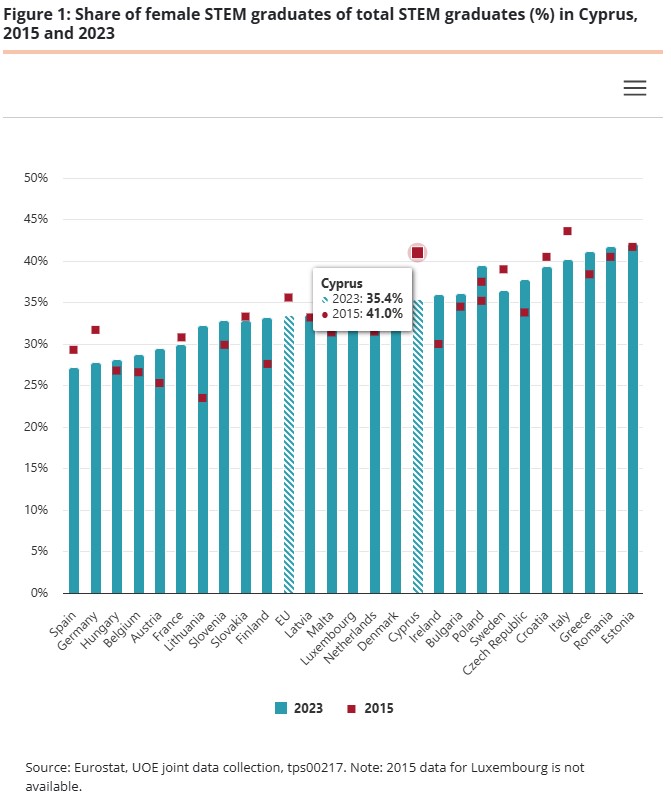
At the same time, Cyprus ranked above the EU average in terms of women’s participation in STEM, at 33.9 per cent compared with 32.2 per cent across the bloc.
Despite the challenges highlighted by the report, Cyprus continues to have one of the highest rates of tertiary educational attainment in the EU.
In 2024, 60.1 per cent of 25-34 year-olds held a tertiary degree, which was well above both the EU average of 44.2 per cent and the EU’s 2030 target of 45 per cent.
Overall, the number of students enrolled in tertiary education grew by 42 per cent in the period from 2015 to 2023, while the number of tertiary graduates increased by 125 per cent during the last decade.
According to the report, this is partly due to the establishment of private tertiary education institutions and universities since 2007.
Cyprus also records particularly high levels of outward degree mobility, at 26.9 per cent compared with an EU average of just 4.4 per cent.
Meanwhile, inward degree mobility ranged at the same levels as the EU-average, with students having obtained their degree at one of the twelve universities operating in the country standing at 9.2 per cent.
Overall, 27.8 per cent of Cypriot students studied abroad.
The EU’s Education and Training Monitor reviews member states’ progress towards the bloc’s education and training targets and provides an overview of recent policy developments in the sector.




Click here to change your cookie preferences