
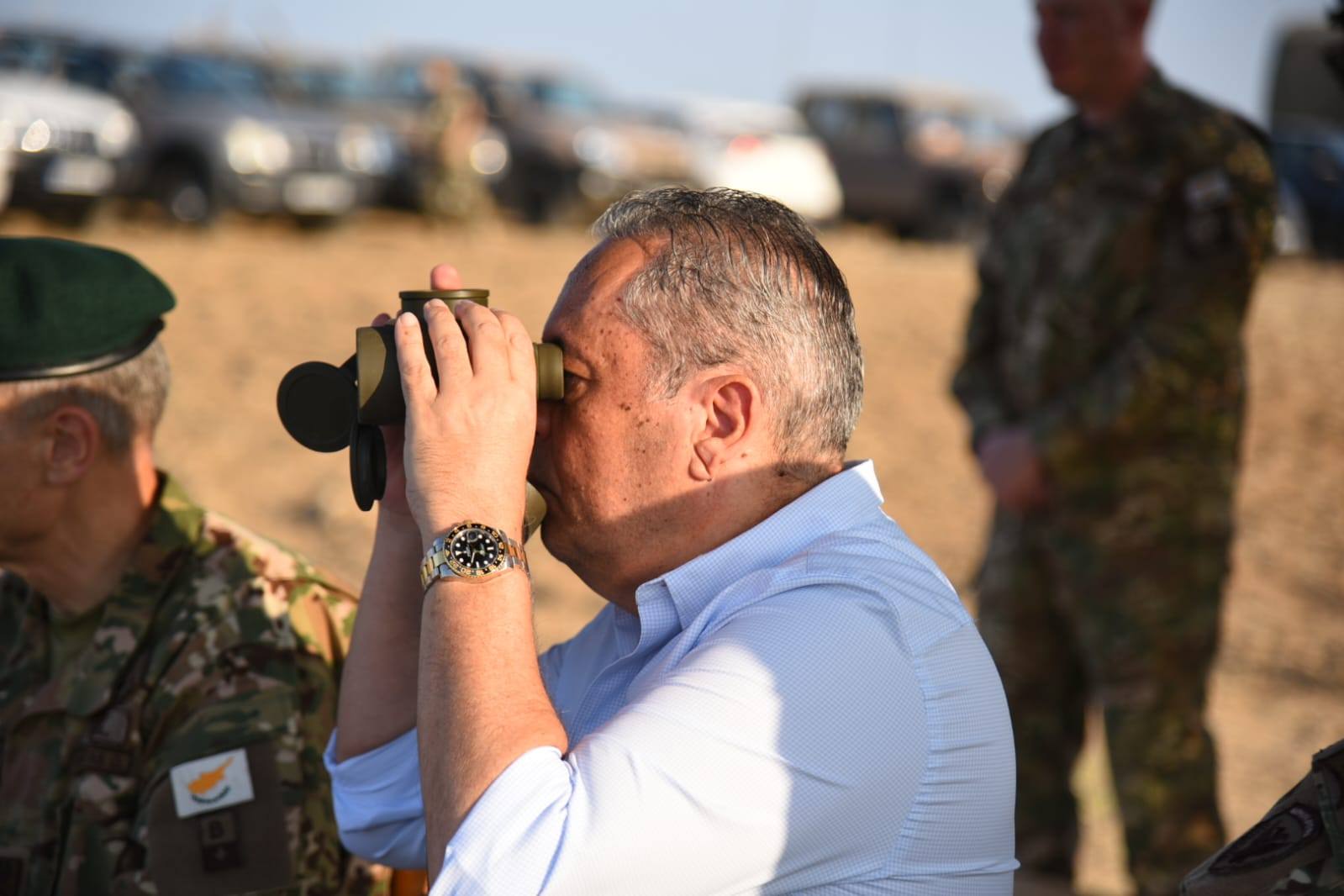
The Tseri firing range is set to close, Defence Minister Vasilis Palmas said on Friday, although he did not specify when operations would cease.
Speaking to CyBC, Palmas said the “countdown” towards the closure of the firing range had begun.
Turning to the Kalo Chorio firing range, Palmas acknowledged that the main demand of residents in the surrounding area was for the facility to be relocated, but said this was not currently possible.
Communities affected by the wildfire have renewed calls for the facility to be relocated. The defence ministry also pledged to cover all damage caused by the wildfire.
Asked about the discovery of two shells at the Kalo Chorio firing range during efforts to extinguish a fire in Ayia Anna, Palmas said it was understandable for residents to be concerned.
However, he said there had been some exaggeration in the reaction, noting that it was not unusual for unexploded shells to be found at firing ranges.
The objective, he said, was to eliminate such incidents as far as possible and ensure that unexploded ordnance was destroyed following each exercise.
Palmas also stressed that entry into firing ranges is prohibited and recalled that a decision had been taken to establish a 24-hour guard post at the Kalo Chorio firing range.
The Kalo Chorio range came under scrutiny after a fire broke out during the destruction of munitions in late July, forcing the evacuation of nearby Ayia Anna and Psevdas. The fire spread rapidly in the dry conditions, burning around 120 hectares.
The exercise involved US military personnel alongside members of the National Guard’s Explosive Ordnance Disposal unit. During the joint training activity, warheads from RPG anti-tank rounds were destroyed through controlled explosions.
Palmas was also asked about the appointment of the National Guard’s new deputy chief, saying the matter would be brought before the cabinet on Saturday. He said ministers would decide whether current deputy chief Lieutenant General Neophytos Pachoulides would remain in the post or whether one of two Greek Cypriot major generals, Charis Georgiou or Andreas Charalambous, would be appointed.
Meanwhile the defence ministry later said it was moving ahead with a series of additional measures at the Kalo Chorio firing range aimed at preventing similar incidents involving unexploded ordnance and fires and improving public safety.
Ministry spokesman Sofianos Philippides said that work was already underway to widen firebreaks around the range.
Plans are also being made for round-the-clock security, initially through vehicle patrols which are expected to begin immediately, while infrastructure will be created for a permanent 24-hour guard post.
The ministry is also studying the installation of a surveillance system using fixed cameras.
Asked about the unexploded shell recently found at the range, Philippides said it was an old illumination round dating back several years. He said current procedure following military exercises was to locate any unexploded ordnance and deal with it on site.
Specialised units enter the firing range to search for shells whenever it is established that ammunition has failed to explode, he said.
Such searches are also carried out after exercises and live firing, as well as periodically to locate older unexploded ordnance.
“The aim is to eliminate these incidents,” Philippides said.
He added that members of the public are prohibited from entering certain parts of the firing range, with warning signs in place informing them of the restrictions.





Click here to change your cookie preferences