
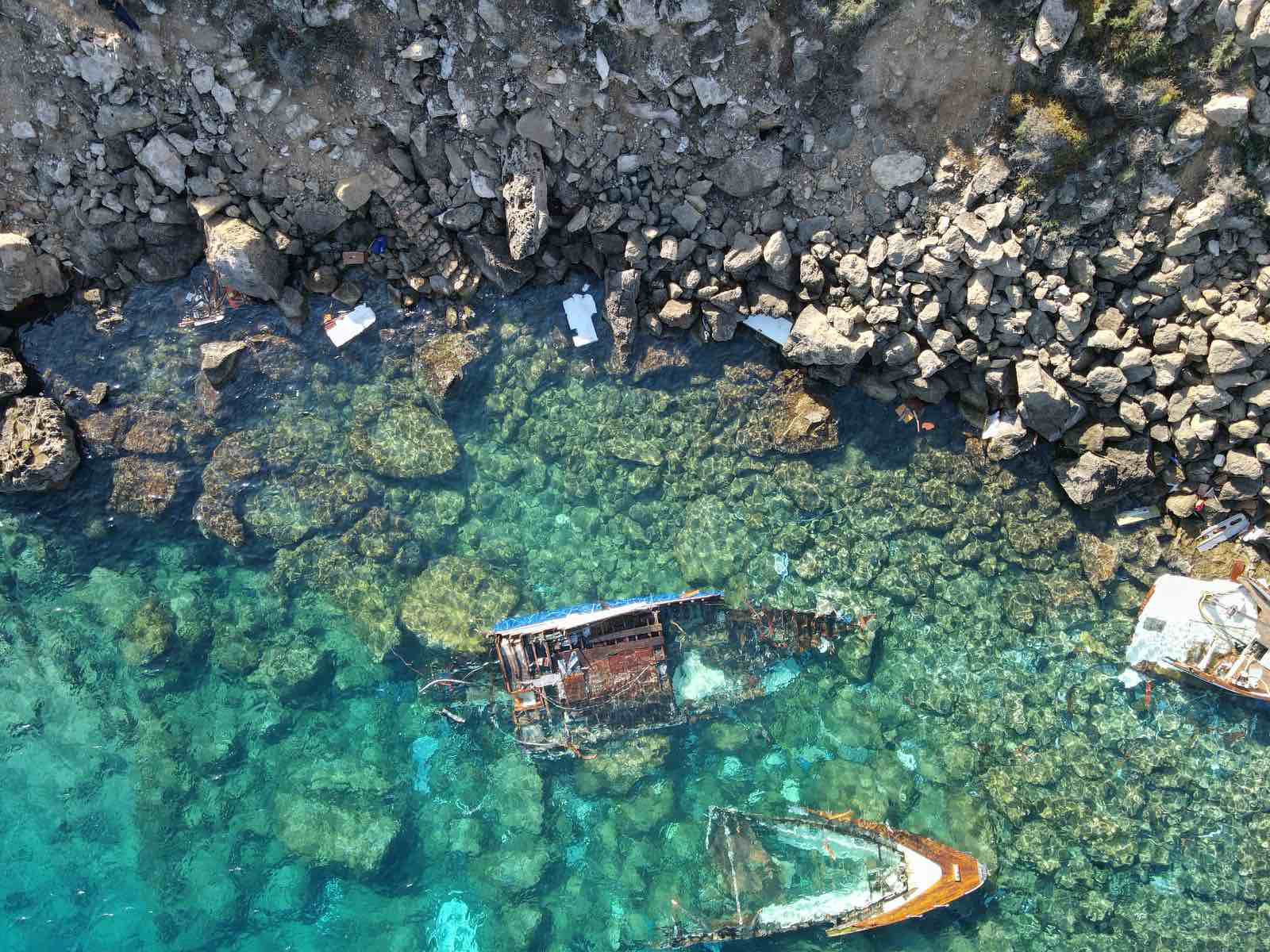
The cabinet on Wednesday approved amendments to existing legislation allowing authorities to prohibit vessels from leaving the Republic and require them to move to a safe shelter or port, Shipping Deputy Minister Marina Hadjimanoli said.
The measures are intended to serve as an interim step pending the establishment of a coastguard. At present Cyprus has a marine police force, but no coastguard.
Justice Minister Costas Fitiris had previously said that the sinking of two vessels during rough seas off Cape Greco at the weekend had prompted the relevant ministers to examine what could be done during the transitional period before the coastguard becomes fully operational.
Police and the deputy shipping ministry are jointly investigating the death of 76-year-old Dimis Mavropoulos, who was on one of the ships that sank, the Perla Bianca. His daughter and 57-year-old partner were rescued from the vessel during a JRCC operation.
Hadjimanoli said the cabinet had also approved the creation of an anchorage committee, to be chaired by the shipping deputy ministry and include all relevant state and other services.
The committee will examine issues concerning safety at anchorages, conditions governing the presence of vessels and the collection and proper management of waste.
Its aim, Hadjimanoli said, is to establish unified coordination between state services operating at sea, with clearly defined responsibilities.
According to information, the committee will include representatives of the Cyprus Ports Authority, the environment department, fisheries department, port and marine police and local authorities.
The process for establishing the committee is expected to move forward immediately.
Hadjimanoli said the issue would ultimately be addressed through legislation currently being prepared for the establishment of the Republic’s coastguard, which was approved in principle by the cabinet on March 16 . Proposed by Fitiris, it aims to bring together six state agencies that currently handle maritime affairs across separate ministries. The coast guard’s headquarters will be at the Evangelos Florakis naval base at Mari
Until then, however, the shipping deputy ministry will prepare amendments to existing legislation or regulations allowing authorities both to prohibit vessels from setting sail and to order vessels already at sea to return to a safe shelter or port when weather conditions deteriorate.
Hadjimanoli said this route should be considerably faster than introducing entirely new legislation. One option being considered is the adoption of regulations under legislation implementing the International Convention for the Safety of Life at Sea (SOLAS).
Similar provisions already exist for coastal passenger vessels of 300 units or more, she said, while legislation adopted in 2026 also addressed the issue for rental craft, including jet skis.
The remaining gap concerns privately owned vessels.
“There was nothing prohibiting private vessels from sailing, but most importantly, as we saw from the incident on Saturday, [nothing requiring them] to return to any safe shelter or port,” she said.
Under the proposed system, sailing restrictions would be linked to the meteorological department’s official marine weather bulletin, following a model similar to that used in Greece.
The bulletin would specify factors including wind strength and sea conditions by area, with predetermined thresholds triggering the relevant restrictions automatically.
Until now, marine forecasts have been issued by the meteorological department and broadcast by Radio Cyprus through the Joint Rescue Coordination Centre, but responsibility for acting on the information rested with individual vessel operators.
Hadjimanoli said Saturday’s incident had also highlighted problems surrounding unofficial anchorages.
The location involved was not an officially designated anchorage of the Republic, she said, but an area where vessel owners had been mooring freely – a practice which she said had been growing in recent years.
She added that while anchoring is prohibited in Natura 2000 and other protected areas, there was no mechanism equivalent to a sailing ban to enforce such restrictions.
The new anchorage committee will therefore examine where vessels can safely anchor as well as the environmental consequences of uncontrolled mooring.
“At the end of the day, we need to see how we can protect people by having them anchor in specific areas, but also address the various environmental impacts, because vessels which moor there uncontrollably pollute the environment,” she said.
Existing maritime legislation already provides for administrative fines for breaches involving coastal and rental vessels.
Hadjimanoli said the government would also examine whether the future coastguard should have powers extending to criminal offences and potentially arrests.
“What we want to examine is how the coastguard will be able to act so that there is also a criminal offence, but perhaps also the right to make arrests. All of this will be discussed immediately,” she said.
The deputy ministry will now draft the regulations, which will undergo legal vetting by the Legal Service before being submitted to parliament. They will first be considered by the House transport committee before going to the plenum for a vote.
Hadjimanoli said the process would be faster than introducing a completely new bill and was intended to close the existing gaps while the broader legislation establishing the coastguard is being prepared.




Click here to change your cookie preferences