
By Alexey Gubarev
I started a hosting company in Cyprus in 2005, at a time when “the cloud” was not a market but a promise most businesses did not trust. We bet on something unfashionable: physical infrastructure done exceptionally well. Racks, power, network paths, response times. By the time we sold Servers.com in 2023, that bet had become a global bare-metal platform serving customers on several continents.
Eighteen years of that work leaves you with one stubborn habit. Whenever somebody describes a technological future, you ask what it has to be plugged into.
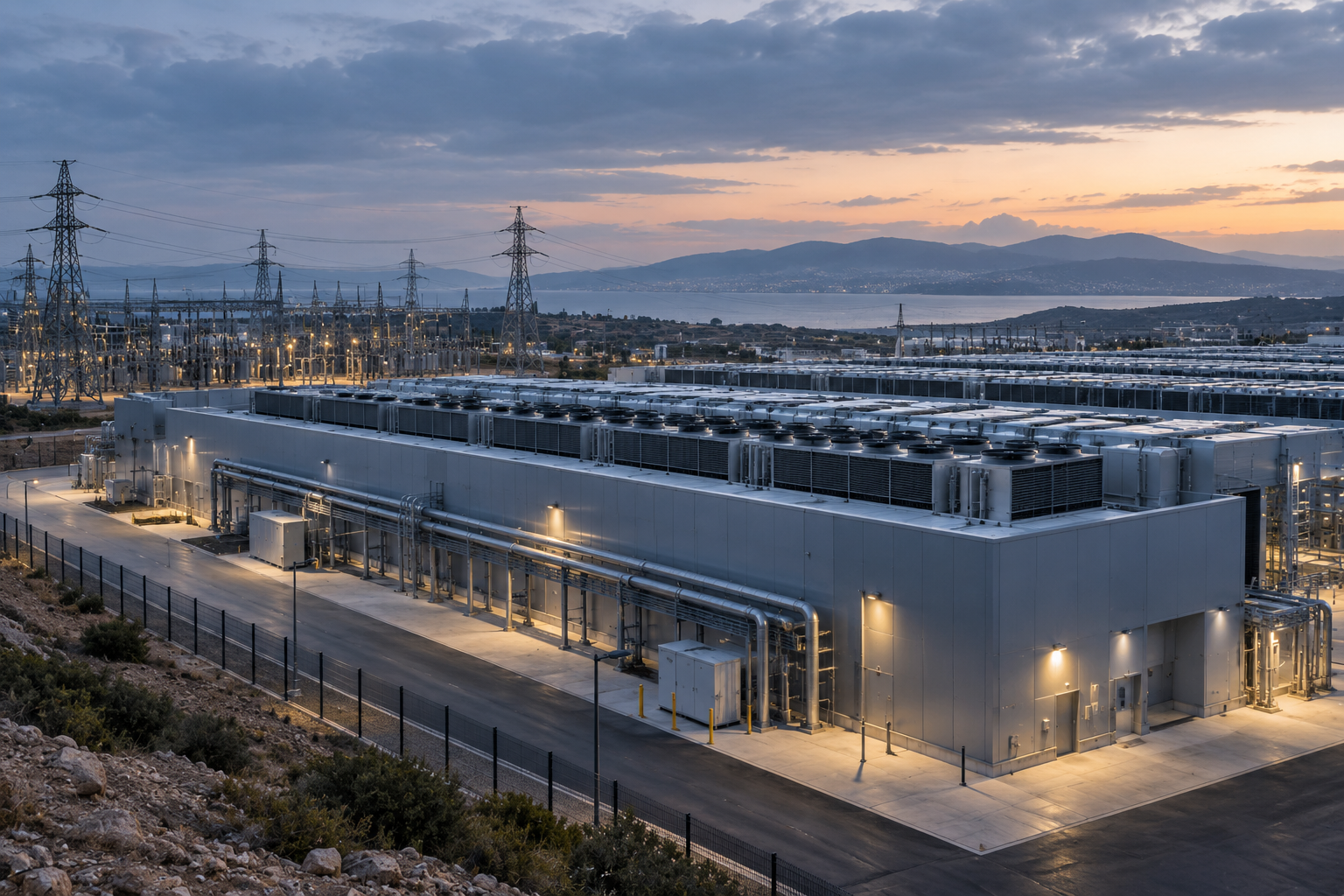
So while the current argument about artificial intelligence is a contest between clever people writing clever software, I would suggest the next ten years will be settled somewhere less glamorous: at the substation, in the cooling loop, in the queue for a grid connection. Four things follow from that.
The price of thinking becomes a quoted commodity
Not, as is often claimed, because tokens will start costing more — per-token prices have been falling steeply, by roughly 80 per cent over the past year alone. They fall because the constraint moves elsewhere. Total spend rises even as unit prices collapse, and the large buyers stop buying subscriptions and start signing multi-year capacity contracts that look remarkably like the power purchase agreements heavy industry signs for electricity. I have sat on the supplier side of exactly that conversation, and it is a different business from selling software: you are selling availability, and availability is bought in advance. By the early 2030s the price of a unit of reliable machine reasoning will sit on the business pages next to oil and gas.
The line between renting and owning moves
For a decade the answer was simple: rent everything. That answer is no longer automatic. Once a workload is steady and predictable — inference running around the clock rather than experiments — owning the hardware beats renting it past a break-even point companies can now calculate. I spent most of my career on the owning side of that question, so let me be honest about the other half: this is not a stampede out of the cloud, and anybody who tells you it is has something to sell. Owning GPUs carries brutal depreciation risk. It is a boundary shifting, not a reversal, and the organisations that know where their own break-even sits will spend a great deal less than those that do not.
Data centres stop being a problem for the grid and become part of it
Globally, data centres consume around 415 terawatt-hours a year — about 1.5 per cent of world electricity — heading for roughly 945 TWh by 2030, growing four times faster than demand from everything else. In aggregate that is not unmanageable. The difficulty is that it lands in a few places at once, where connection queues run for years. In Amsterdam, one of Europe’s most important digital hubs, a fully permitted new campus is reportedly limited to a fraction of its capacity until new substations arrive in the 2030s. What replaces the old model is compute that arrives with its own generation and storage, that can be turned down when the system is stressed and paid for the flexibility, and that is sited by grid capacity rather than by tax rate. Small nuclear reactors come up in every conversation about this. They will matter eventually; almost none are operating today, and the near-term answer is solar, gas and very large batteries.
Medicine moves from episodic to continuous
Today you are diagnosed when you notice something and see a doctor. Cheap sensors and efficient models make it possible for the signal to arrive before the symptom. Alongside the infrastructure business, I’ve spent years building in health, as co-founder of Palta, so let me be careful about what actually changes: the accuracy problem is largely solvable, and the hard problems that remain are consent, liability and who is responsible when the machine is wrong. Those are institutional problems, and institutions move slower than models do.
Which brings this home, to the island where I have lived for more than two decades and where, as a founding member of TechIsland, I have spent years arguing that we should build rather than merely host. Cyprus will not run frontier AI training campuses. That is a gigawatt game, and we currently curtail nearly half our own solar output because we can neither store it nor export it. But the physics argument cuts both ways for a small country: if the binding constraint is energised capacity rather than clever code, then storage, permitting and grid upgrades are AI policy — and unlike almost everything else in this field, they are entirely within our own hands.
Investors and ministers alike should stop looking only at software. The value in the next decade sits in hardware, energy and the unglamorous machinery that lets any of this exist.
The next decade of artificial intelligence will not be won by whoever writes the cleverest model. It will be won by whoever can plug it in.
Alexey Gubarev is a Cyprus-based technology entrepreneur and investor. He founded Servers.com, a global infrastructure company. He sold it in 2023. He also co-founded Palta, a health and wellbeing technology studio. Palta is behind Flo Health, the first women’s health app to reach unicorn status. Alexey is also a founding member of TechIsland, the nonprofit organisation driving Cyprus’s growth as a European tech hub.
More at gubarev.com.
You can contact Alexey Gubarev at gubarev.com or on LinkedIn.




Click here to change your cookie preferences