
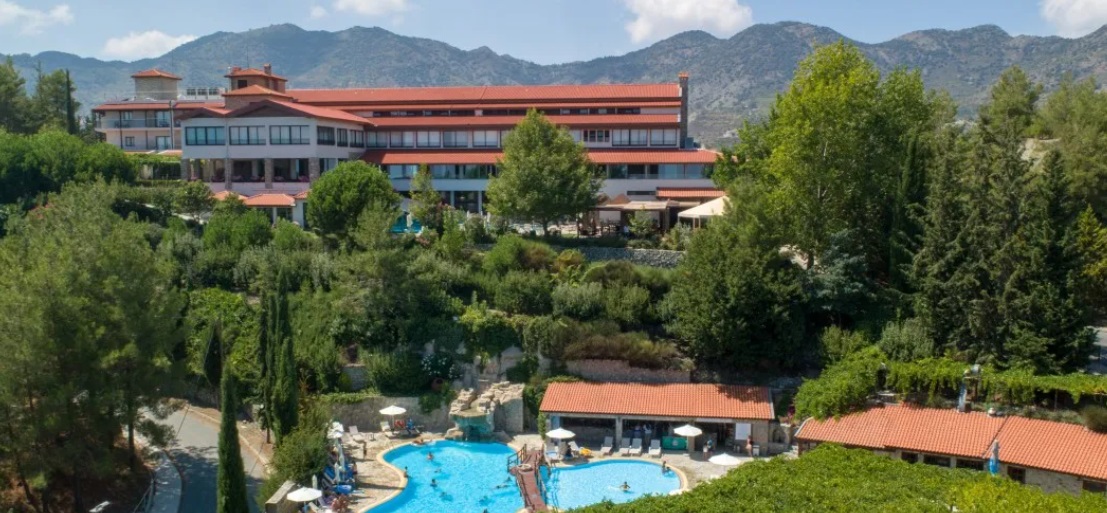
The Agros Development Company (Proodos), owner of the Rodon Hotel in Agros, reported a wider first-half loss of €173,843 this week, with the company expecting weaker financial results for the remainder of 2026 as the hotel faces lower revenue and higher costs.
The loss attributable to shareholders increased from €39,922 in the first half of 2025 to €173,843 in the six months to June 30, 2026.
The company said the deterioration was mainly linked to higher operating and administrative expenses associated with the Rodon Hotel, including a provision for a 13th salary, higher energy costs and increased maintenance and repair expenses.
Despite the weaker profitability, income remained broadly unchanged, falling marginally to €1,508,971 from €1,509,785 in the corresponding period of 2025.
The decline amounted to just €814, or 0.05 per cent, the financial report showed.
The Agros Development Company operates in the hotel sector and property development, with the Rodon Hotel described by the company as its main asset.
The loss per share increased to 4.84 cents in the first half of 2026, compared with 1.11 cents in the same period of 2025.
The company’s issued share capital stood at €6.14 million at June 30, divided into 3,590,215 ordinary shares with a nominal value of €1.71 each.
The company said there was no income, profit or loss from non-recurring activities or activities outside its main operations during either the first half of 2026 or the corresponding period of 2025.
Rodon outlook weighs on 2026
The Agros Development Company expects its financial performance in the second half of 2026 to be lower than in the corresponding period last year.
The company said the main reason was expected weaker revenue and higher costs at the Rodon Hotel, with the additional costs unable to be passed on to customers.
For the full year, the board also expects financial results to be lower than those recorded in 2025.
The company said this assessment took into account its first-half performance as well as the revenue and costs it expects from the Rodon Hotel during the second half of the year.
The company’s board approved the unaudited interim financial statements for the six months to June 30 at a meeting on September 21.
The first-half results had not been audited by the company’s external auditors.
Middle East conflict
The company also identified the geopolitical situation in the Middle East as a key short-term risk, particularly because of its potential indirect effects on Cyprus.
It referred to the escalation of the conflict on February 28, 2026, saying the situation had increased uncertainty in international relations and financial markets.
According to the company, the conflict could affect global trade, energy security and wider economic stability.
Although the conflict is taking place outside Cyprus and the company has no direct exposure to the Middle East, it said the island could experience indirect effects because of its dependence on international trade, tourism, shipping and financial services.
The company said visible effects included upward pressure on energy prices, while possible further consequences included volatility in commodity prices, disruption to global supply chains and fluctuations in foreign exchange and capital markets.
It also highlighted increased uncertainty for sectors including tourism and transport.
The company said the scale and duration of these effects remained uncertain and could not be reasonably estimated at this stage.
Inflation concerns
The Agros Development Company also raised concerns about rising inflation in Cyprus and its potential effect on demand for hospitality and catering services.
The company said Cyprus had recorded one of the highest inflation rates in the eurozone, with inflation rising from zero in August 2025 to 1.5 per cent in March 2026 and reaching 5.2 per cent in August 2026.
It attributed much of the increase to rising energy and fuel prices, which it linked in part to the continuing conflict in the Middle East.
The company said higher inflationary pressures and trends were expected to have a negative effect on consumer behaviour, including demand for hospitality and catering services.
It said management would continue to monitor developments closely and take appropriate action when and if necessary.
The company also said its annual general meeting on June 30 had not resulted in a recommendation by the board to pay a dividend from 2025 profits.




Click here to change your cookie preferences