
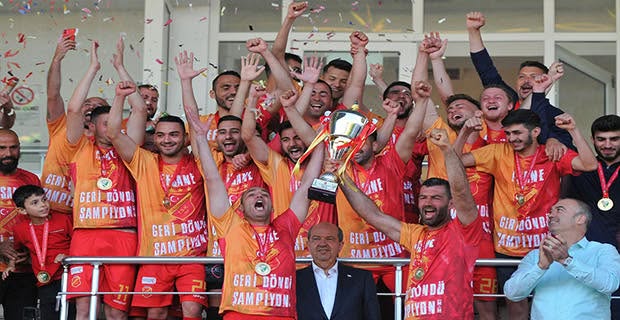
Nicosia-based Turkish Cypriot football club Cetinkaya on Wednesday vowed to return to the Cyprus Football Association, as it marked the 92nd anniversary of the association’s founding, at the end of a turbulent summer for intercommunal relations on the issue of football.
“Ninety-two years of history, 92 years of memories, and a history which cannot be erased. In 1934, Cetinkaya stood among the founder members of the Cyprus Football Association. We were not merely a participant in its history, we were a part of its foundation,” it said.
It added that “as the CFA marks its 92nd anniversary, we commemorate this occasion with mixed emotions”, saying that “there is pride in the history we helped build, but also deep and lasting sense of sorrow over what was taken away from us”.
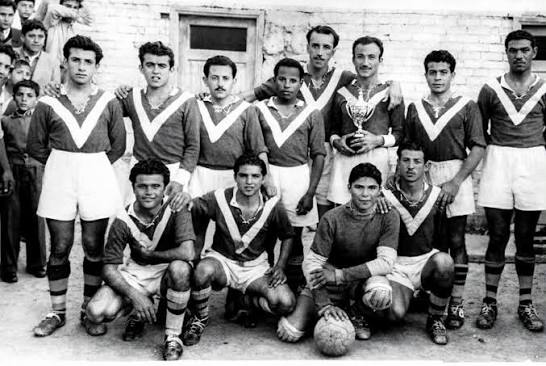
Cetinkaya in 1951
To this end, it described “the pain of seeing something which was built with our sweat, our signatures, our commitment, and our very spirit taken beyond our reach” in 1955, when the Cypriot Orthodox church forbade Turkish Cypriots from playing football on grounds it owned, thus effectively excluding Turkish Cypriots from CFA competition.
“Cetinkaya is not simply a football club. Cetinkaya is one of the roots of football on this island. Our history is woven into the very foundations of the game and into the story of the CFA itself,” it said.
Attached to the statement was an image bearing the words “we will be back where we belong” and a list of accolades won by the club before 1955, including the 1951 first division title and the Cyprus Cups of 1952 and 1954.
Football has been a source of intercommunal tension this summer
Football has been a source of tension between the island’s two sides over the summer, with Turkish Cypriot leader Tufan Erhurman having offered criticism for the Greek Cypriot side for undertaking political and diplomatic initiatives to bring about the cancellation of a children’s football camp organised by FC Barcelona.
He warned that this matter, and other, similar initiatives undertaken by the Greek Cypriot side serve only to “undermine trust” between the Turkish Cypriot and Greek Cypriot communities.
Government spokesman Konstantinos Letymbiotis reacted to this criticism by saying that “we are doing exactly what an internationally recognised state should do”.
“It is with diplomacy that we are operating, and what we are doing is to clearly present the real state of affairs,” he said in response to a question on the matter from the Cyprus Mail.
He also referred to an agreement reached in 2013 which foresaw that the Cyprus Turkish Football Association (CTFA), which was formed after the Turkish Cypriots’ 1955 expulsion, would join the Cyprus Football Association (CFA), thus allowing international recognition of Turkish Cypriot football.
That agreement was signed in Zurich in by the chairmen of both Cypriot associations, Costas Koutsokoumnis and Hasan Sertoglu, in the presence of then Fifa chairman Sepp Blatter and then Uefa chairman Michel Platini, with Turkish Cypriot football clubs unanimously approving it in 2015.
Bicommunal agreement of 2013 was never implemented
However, reports in 2016 stated that it was never implemented as negotiations to bring about the plan’s realisation stalled over a procedural disagreement.
The CFA had wished that the CTFA register in the Republic of Cyprus, but the CTFA insisted that given that its existence predates the republic, its existence should have automatically been recognised.
However, when documentation was requested to prove this, the CTFA did not produce any such documentation, and Koutsokoumnis said that “without it, the procedure cannot continue”.
In the absence of an agreement, the CTFA has continued to run its own competitions and field its own representative team, which this summer won the Conifa European football championship, a tournament organised for unrecognised countries and minority peoples across Europe.
Cetinkaya have since 1955 competed in CTFA competitions, winning the Turkish Cypriot top flight a joint-record 14 times.




Click here to change your cookie preferences