
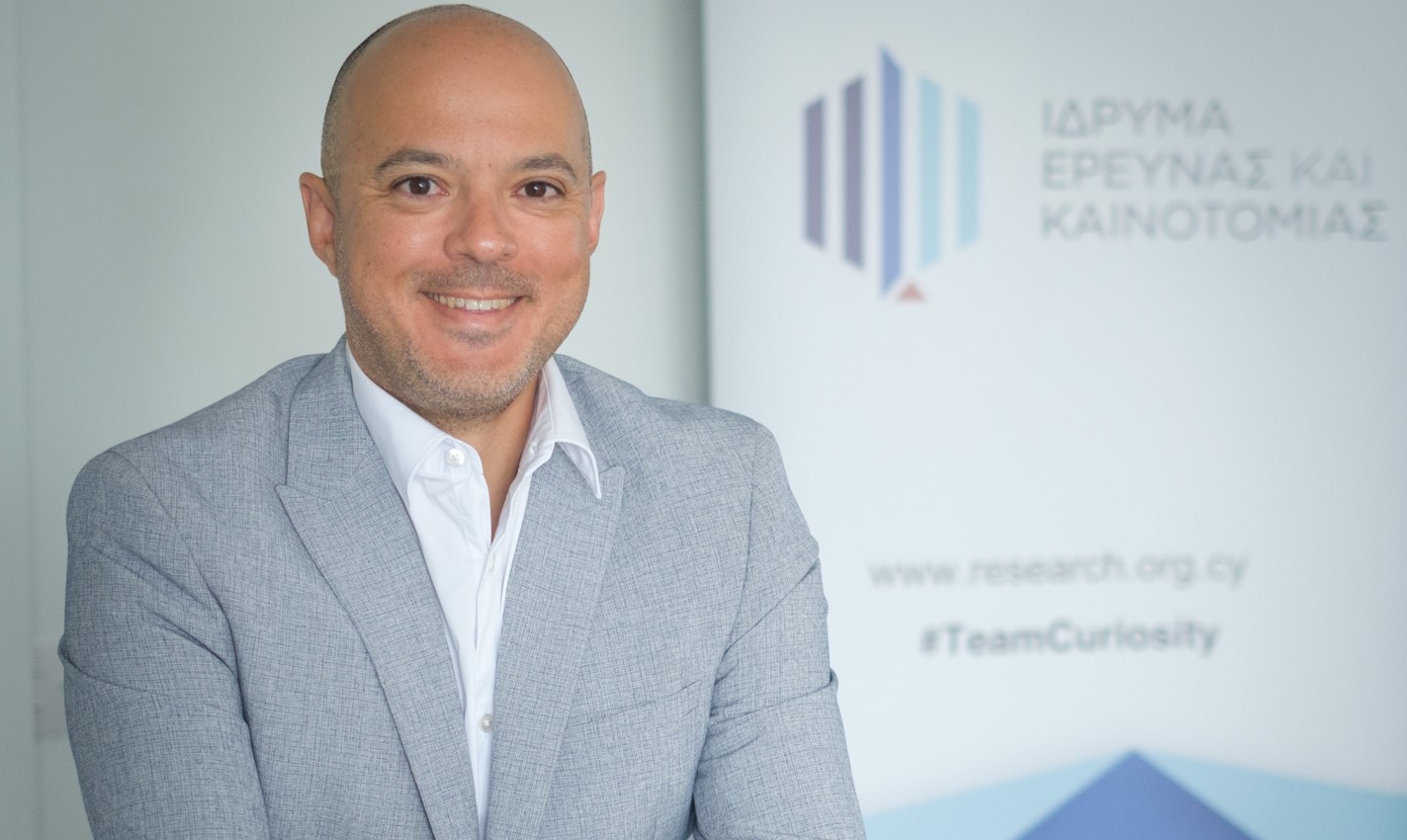
Cyprus’ research and innovation ecosystem has reached the point where it must build scale, attract more private investment and talent, and turn research into greater commercial value, according to Research and Innovation Foundation (RIF) director general Theodoros Loukaidis.
Speaking to Cyprus News Agency (CNA) as the foundation marks 30 years since its establishment, Loukaidis said Cyprus had come a long way in research and innovation, with more companies, investment and international links now forming part of the country’s economic landscape.
“It is no longer something that may perhaps be happening. It is something that is happening in Cyprus,” he said, pointing to what he described as a broader shift in attitudes towards research and innovation.
He mentioned that the next challenge is no longer simply to build an ecosystem, but to help it grow up.
For Loukaidis, that means bringing in more private capital, making better use of talent, widening Cyprus’ international reach and ensuring the country is not left merely adopting technologies developed elsewhere.
He pointed, in particular, to Cyprus’ position at 25th globally in the Global Innovation Index, among 139 economies, while its startup ecosystem ranks 34th worldwide according to StartupBlink.
“Today, 30 years later, we have an ecosystem which, with the long-standing support of RIF, has managed to improve its performance, rank highly internationally both in Europe and globally, and strengthen its international competitiveness,” he said.
The emphasis now, however, is firmly on scale.
“We are looking at the next 30 years so that what we have built can evolve, create scale and grow, and through that growth bring even more successes to Cyprus,” Loukaidis added.
Public funding and private capital
One sign of that shift is the demand for RIF funding. A recent call attracted 284 applications, compared with around 60 under the same programme five or six years ago.
At the same time, that surge in interest raises another question: how public money can be used to draw more private capital into the sector.
Loukaidis believes public investment in research and innovation needs to increase, but not in isolation. Rather, the aim should be to use it in ways that encourage substantially more private money to follow.
The ecosystem itself is already broadening. Universities, centres of excellence and businesses remain at its core, but investment funds are now taking a greater interest in Cypriot companies, while organisations such as Plug and Play have also entered the market.
In that sense, Loukaidis sees public funding less as a destination and more as a catalyst.
Under RIF’s DISRUPT programme, every €1 of public funding has mobilised €1.20 in private investment, while under BOOST, private investment has been twice the level of public support.
“This is the way we can use the programmes as force multipliers, to attract even more investment,” he said, linking that additional capital to productive activity and sustainable employment.
Talent and emerging sectors
Money, though, is only one side of the equation.
Equally important, in Loukaidis’ view, is talent, both attracting people from abroad and making better use of skills that already exist in Cyprus.
There are people, he noted, who studied in specialist fields but ended up working elsewhere simply because the local market could not offer them the right opportunities.
Biotechnology is one area where that is beginning to change.
Where there may once have been few companies able to employ people with relevant qualifications, Loukaidis now sees a small technology ecosystem taking shape. Some companies have attracted several million euros in private investment, built infrastructure and recruited staff, while businesses in the sector are employing teams of around 150 people.
Others, meanwhile, are exporting high-technology products and opening offices abroad.
From founders to venture capital
The financing journey for startups is also evolving.
At the earliest stage, Loukaidis explained, founders still often rely on their own money, family, friends or people willing to take a substantial risk.
As those businesses develop, however, RIF programmes can step in without taking equity and without requiring the money to be repaid as a loan.
At the same time, business angels are becoming more visible, offering not only capital but experience, contacts and advice.
Further down the line come investment funds and venture capital, with several RIF-backed companies already attracting investment from funds operating in Cyprus.
RIF, meanwhile, is trying to give the Cypriot ecosystem greater visibility abroad and bring local businesses into closer contact with international investors.
Loukaidis singled out Medochemie’s strategic investment in Theramir, a startup previously supported by RIF, as one example.
The value of such partnerships, he said, goes well beyond the money involved. Strategic investors can also bring product expertise, commercial knowledge and access to international markets.
Multinationals and international reach
Much the same applies to the multinational and international ICT companies already operating in Cyprus.
According to Loukaidis, their presence brings access to overseas markets, deeper commercial knowledge, experience in developing competitive products and the ability to mobilise larger sums for research and development.
Just as importantly, they create links with universities, research institutes, centres of excellence and domestic businesses.
Through those relationships, Cypriot companies can gain technical know-how, improve standards and methodologies and, in some cases, introduce new forms of organisational innovation.
The wider aim, he said, is for local businesses to become competitive enough to sell their expertise not only at home but internationally.
AI and Cyprus’ place in the value chain
That same logic runs through his approach to artificial intelligence.
AI, Loukaidis said, is a highly disruptive technology with enormous potential, but it also poses an obvious challenge for a small country competing with economies and companies able to spend on a very different scale.
Cyprus does not, in his view, need to compete everywhere. Instead, it needs to focus on areas where it already has something useful to offer.
He singled out shipping, financial services and professional services, where Cyprus has international expertise and access to data that could be converted into new knowledge and intellectual property.
“The big challenge is not to end up simply adopting and using technologies which are produced elsewhere,” Loukaidis said.
That, in turn, makes infrastructure crucial.
He referred to Pharos-CY, part of the AI Factory Pharos initiative, as well as the investment in a supercomputer in cooperation with Nvidia.
Researchers and innovative businesses need access to that infrastructure if they are to make proper use of their own data and develop models suited to local needs while still retaining international relevance, he said.
Skills, education and productivity
Beyond infrastructure, however, comes the question of skills.
Loukaidis stressed the importance of encouraging an interest in science and technology from a young age, alongside creativity, critical thinking, entrepreneurship and research skills.
Students and graduates, he added, also need a clearer understanding of the opportunities already available in Cyprus.
In that context, he referred to the Research & Innovation Summer Internships and the Accelerate Cyprus Talent (ACT) programme, under which students are placed with companies in the hope that those connections may eventually lead to permanent jobs.
At the same time, technology is widening the range of skills that companies need.
Loukaidis pointed to Cyprus’ video games industry, which according to a recent report he cited generates around €3.2 billion, as one example.
The sector does not need only technical specialists, he noted, but also people with backgrounds in the arts, marketing and other disciplines.
Nevertheless, shortages remain particularly evident in digital technologies and the green transition, making it important both to direct existing talent towards areas of demand and to continue upgrading skills.
Productivity also features prominently in Loukaidis’ thinking.
Artificial intelligence, he believes, can deliver considerable gains, provided businesses and workers learn how to use it properly.
Bringing talent back to Cyprus
However, attracting skilled Cypriots back from abroad will take more than favourable tax treatment.
Referring to the Minds in Cyprus initiative, Loukaidis said financial and tax incentives were useful but could not, on their own, create a strong innovation economy.
More broadly, people need reasons to build their careers here.
That means an environment where companies can establish themselves more easily, teams can grow, private finance is available and professionals have access to networks, international partnerships and genuine opportunities to progress.
“Talent goes where there is opportunity for development, advancement and the conditions for success,” Loukaidis said.
Cyprus’ quality of life is another advantage, in his assessment, although the ambition goes further than that. He wants the country to become a “connected hub” in the region.
From research to business growth
Some companies, he believes, already show what that can look like in practice.
Loukaidis pointed first to NIPD Genetics, which began as a spin-off from the Cyprus Institute of Neurology and Genetics and went on to receive RIF support and private investment from Cyprus and abroad.
The company developed diagnostic and prenatal tests for international markets before reaching a valuation of €65m and being acquired by a Swedish multinational.
Importantly, however, it remained in Cyprus, where it employs around 150 people and continues to invest in research and development.
Another example is Blue Analytics, which combines artificial intelligence with aquaculture.
The company received RIF support before raising around €6m from a specialist blue-economy investment fund. It already has a product on the market and continues to develop from Cyprus, Loukaidis said.
Then there is Silicon Dali, founded four years ago with €200,000 in RIF support.
Since then, it has moved beyond €1m in sales, employs 18 people, has opened an office in Spain and has customers as far away as South Africa.
Loukaidis also referred to Cleedee, an artificial intelligence company working on recruitment challenges in the hospitality and hotel sectors.
It has received €500,000 from RIF and around €300,000 in private investment, he said, and is now expanding into Greece and Austria.
In fintech, meanwhile, he highlighted Klidi, which recently raised €2.1m in private investment.
Research excellence brings European funding
The progress he described is not confined to companies.
Loukaidis also drew attention to two female researchers working on cancer-related projects who were selected from among 421 researchers under the highly competitive European Research Council programme.
Each first received €100,000 in national support before securing €1.5m in European funding, bringing a combined €3m to Cyprus.
One approaches the subject through the life sciences and the other through engineering, which Loukaidis used to underline a broader point: medical challenges increasingly require expertise well beyond medicine itself.
New RIF programmes
Meanwhile, RIF is already working on its next programming period, with a wider range of tools planned for different stages of the research and innovation cycle.
Among them is PhD MINT, aimed at attracting and supporting new doctoral researchers, alongside Accelerate Cyprus Talent, which connects students with businesses.
There is also Games Go Global, designed to help Cyprus’ video games industry expand into international markets.
At the same time, the foundation plans to strengthen research excellence through VISION ERC, while continuing BOOST and DISRUPT.
Twenty years of European Researchers’ Night
For now, however, attention turns to the foundation’s 30th anniversary, which coincides with the 20th European Researchers’ Night at the Cyprus International Fair.
Loukaidis said the event would begin on Friday morning with school visits and feature more than 75 stands, giving researchers, scientists and innovators the chance to present their work in a simple and interactive way.
For him, the event also reflects how far attitudes towards research and innovation have moved over the past two decades.
“It is no longer something that may perhaps be happening. It is something that is happening in Cyprus,” he said, adding that the next step is to make research and innovation a genuine career choice for younger people.
RIF’s work with schools continues throughout the year through researcher visits, student competitions and other activities, while Friday’s event is free to attend, giving families and the wider public the chance to see Cyprus’ research and innovation community at close range.





Click here to change your cookie preferences