
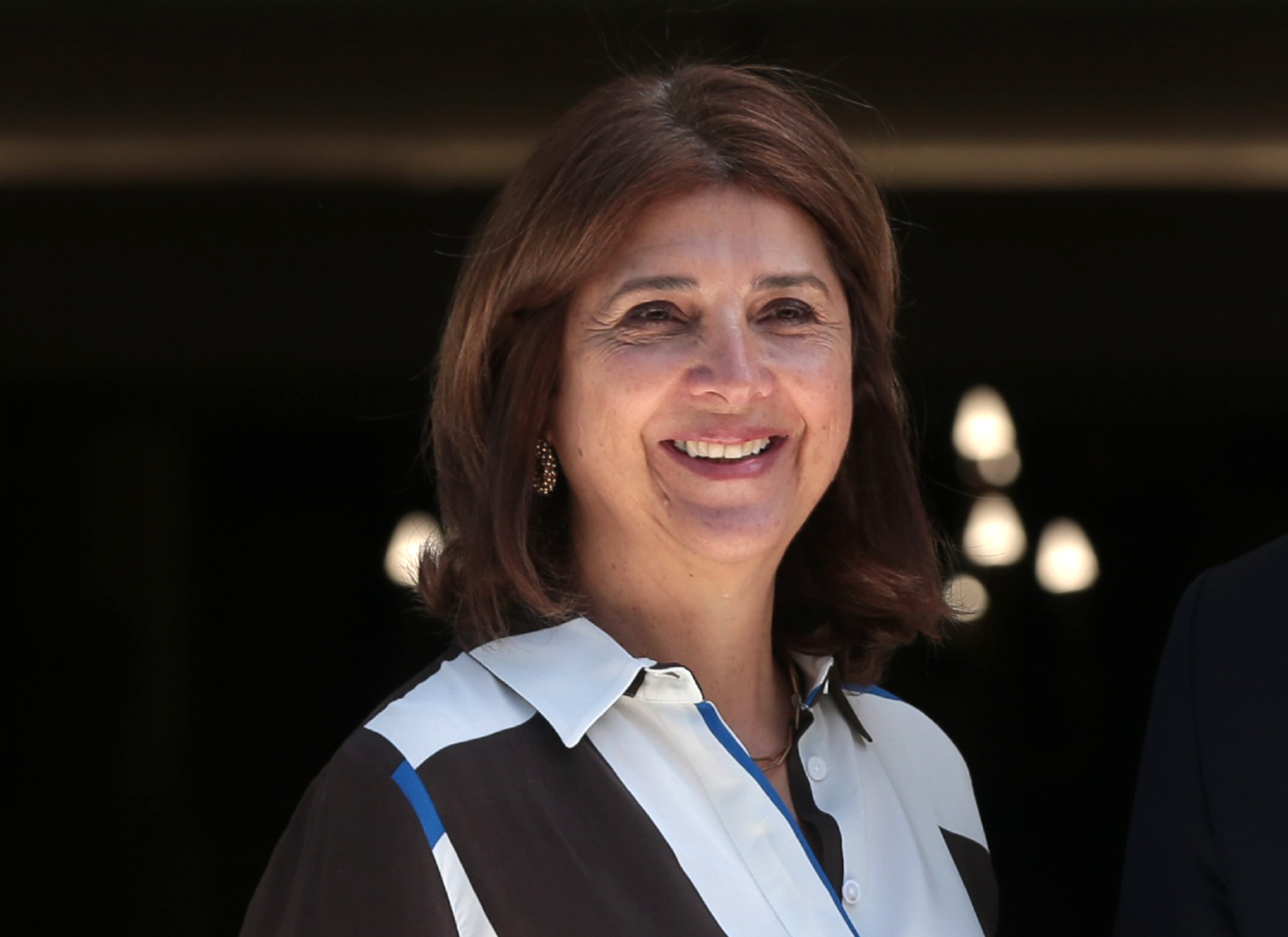
United Nations Cyprus problem envoy Maria Angela Holguin on Monday said that the window of opportunity for progress to be made on the Cyprus problem is closing, at the end of a UN “high-level week” in New York last week in which no progress was made.
“It is clear that the favourable window of opportunity we had throughout last year and earlier this year is gradually closing,” she told Turkey’s Anka news agency, before warning that “rising tensions in the Middle East and the eastern Mediterranean could have negative consequences for Cyprus”.
On this front, she stressed again that “the diplomatic space which is allowing for the revival of dialogue may not remain open for ever”.
Regarding her meetings with both President Nikos Christodoulides and Turkish Cypriot leader Tufan Erhurman last week and conflicting statements regarding the prospect of a tripartite meeting of the two leaders and the UN last week, she stressed that “such a meeting was not planned beforehand”.
Instead, she said, she had informed Erhurman that Christodoulides wished for such a meeting to take place, and Erhurman had asked, “is there a new proposal which would make such a meeting meaningful?”.
She said that in response, she had told Erhurman that “Christodoulides had reiterated the proposals he had presented during the most recent bilateral meeting between the leaders in Cyprus”, and that Erhurman as such declined to hold a meeting in New York.
Erhurman, she said, had found that “the meeting would not yield a positive result unless the necessary conditions for progress were met”.
Efforts to block Turkish Cypriot contacts ‘complicate an already complex issue’
She was also asked about the letter sent by the Republic of Cyprus’ permanent mission at the UN requesting that foreign diplomats not meet Turkish Cypriots, and said that such moves “absolutely” do not help efforts to create favourable conditions for negotiations to resume in earnest.
“These things only complicate an already complex issue. Negotiations do not arise spontaneously, nor do they stem from a hostile environment. The process requires understanding and accepting the other side and its existence,” she said.
She added that she had “discussed this point with the negotiators several times, particularly in the last month”.
Additionally, she spoke on the matter of confidence-building measures and said that one such measure which could be “implemented immediately” would be the creation of a bicommunal technical committee on natural disasters.
She said the two sides had agreed in principle to the creation of such a committee “some time ago”, but that they have not yet reached an agreement on “how to jointly respond to disasters which may occur anywhere on the island”.
On this matter, she said that “measures in areas such as irregular migration, mine clearance, and sports could also be implemented”, but that such measures would “require political will”.
Turning to the issue of crossing points, she said that the planned new crossing point in the eastern Nicosia suburb of Mia Milia could “significantly contribute to trade” between the two communities.
“However, so far, the political will to move forward has not been demonstrated,” she said.
Next Cyprus visit to focus on methodology of negotiations
Looking ahead to her next visit to the island, which is scheduled to take place next month, she said that she will “continue my work to create the conditions for an enlarged meeting with a constructive and concrete agenda”.
On this front, she said that both parties will be asked to propose approaches to possible future negotiations which “do not create obstacles initially, but rather open doors”.
“In every negotiation, the parties agree on a method to determine how the talks will be conducted,” she said, before adding that the UN aims to “call on the parties to jointly create a method by which they can begin negotiations on their own initiative”.
She stressed that the UN “will not dictate the outcome or the steps the sides will take” and said that “the UN is in Cyprus to facilitate, not to impose or dictate what should be done”.
To this end, she said that “negotiations should be conducted on the basis of a willingness to compromise, a search for consensus, and mutual benefit”, but that at present in Cyprus, these things “do not seem to be present”.
‘Preventing new disagreements in Cyprus is difficult’
Regarding the document listing the convergences reached in talks on the Cyprus problem up to now, she said that “consideration” was given to documents submitted by both sides between 2015 and 2017, during the last round of negotiations.
However, she said, the document will only be presented to the two sides when negotiations recommence in earnest.
“Sharing the document early could create a new debate on how past negotiation records should be interpreted. Submitting the document early would open a new chapter of disagreement. The document will only be provided when negotiations begin and it becomes useful,” she said.
On this matter, she said that “preventing new disagreements in Cyprus is difficult”, and that “unfortunately, there is always a reason to keep a dispute open”.
She also questioned the validity of continuing to abide by the same method as previous attempts to solve the Cyprus problem.
“If everything has always been done this way, perhaps that is precisely why not much progress has been made to date,” she said.




Click here to change your cookie preferences