
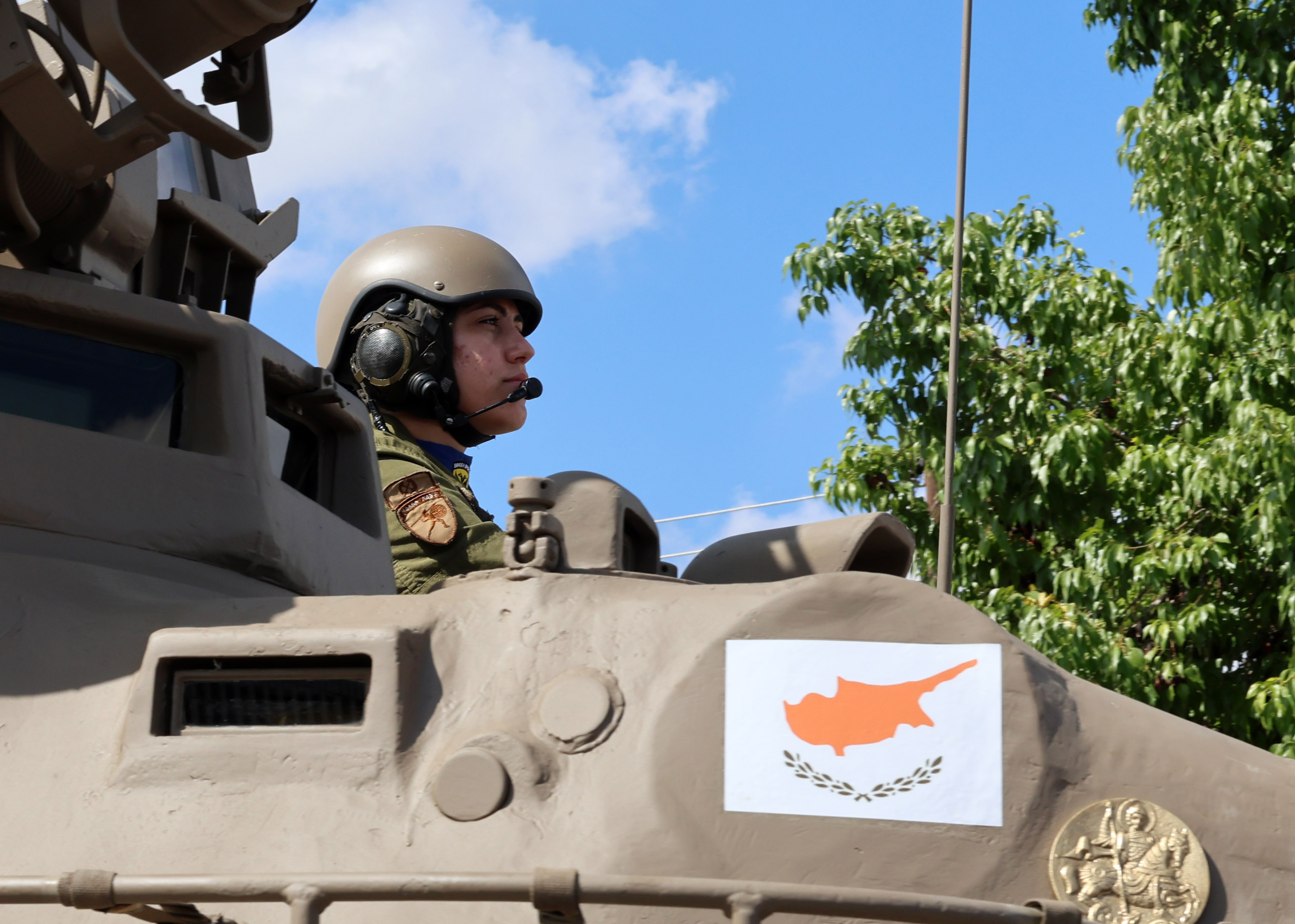
Matters of defence and military equipment “should not become the subject of pre-election exploitation”, defence minister Vasilis Palmas warned last week.
Criticism is welcome, he added in comments to the CyBC – but it should be made with caution, so as not to cause harm to the country and the National Guard.
A few days later, the Independence Day parade showcased our upgraded armed forces, the newfound sense of purpose confirmed by the participation of four other countries (France, Britain, the US and Egypt), two of them with aircraft.
Brand-new equipment was paraded, to applause from the crowd. There were drones and drone launchers, unmanned patrol boats, French anti-tank missiles, plus the Israeli Barak MX air and missile defence system, inevitably dubbed Cyprus’ Iron Dome.
Following the parade, Palmas spoke of modernisation and strategic partnerships. But it’s fair to question – and even criticise – this sudden rush to modernise the army by splurging out on new toys.
Palmas’ earlier statement to CyBC seemed to be saying that extensive rearmament shouldn’t be the subject of debate, and to question it would be tasteless ‘pre-election’ sniping.
But weapons do in fact cost money, which could’ve been spent elsewhere. Nor was the president elected on a promise of ramping up defence. It’s fair to ask if he even has a mandate for it, or if people want it.
This is not to question the merits of the policy itself. Maybe debating the point will end up showing that people do want it, as implied by the strong performance of nationalist parties in last May’s elections.
Or perhaps the conclusion will be that people don’t want it, but it’s still necessary for national security – though in that case you’d expect the government to provide better arguments than just empty fearmongering.
Even on the merits, though, some debate would be welcome.
What’s the endgame here? What exactly are we modernising for? A war with Turkey? Didn’t we join the EU precisely to allay our fears on that score?
Besides, the lessons of the past few years are that modern wars drag on and become unwinnable, even with state-of-the-art weapons. (Indeed, the increased parity provided by drones makes them even more unwinnable.) Any extended war would ravage Cyprus, just as other countries in our region have been ravaged.
Then there’s the money. Should the state be splashing out on weapons when energy costs are spiralling, the global economy is struggling, and almost a fifth of Cypriots are classed as being ‘at risk of poverty or social exclusion’?
Then again, it’s not our money. That’s the unspoken twist, namely that rearmament is an EU-wide imperative. Much of the cost of these new weapons will be borne by SAFE (Security Action for Europe), the programme that’s due to allocate Cyprus a total of €1.2 billion.
Talk of war is rife all over Europe, with politicians warning citizens to prepare themselves – and in fact the prevailing attitude is exactly like Palmas’ statement to CyBC: don’t question why.
In Europe, the threat being deployed is Russia – but without much debate on how urgent that threat is. Putin has repeatedly said he’s not interested in attacking Europe, though of course he would say that. There’s been evidence of harassment and sabotage, but no solid proof of Russia’s intentions. Russia Today, the main media mouthpiece – which might’ve been useful in gleaning those intentions – has been totally banned in the EU since 2022.
In our case, the ostensible threat is from Turkey – and the playbook is similar, namely to smother dialogue and contact as much as possible and isolate the other side, while simultaneously investing furiously in rearmament.
The Christodoulides government has been at pains to isolate the Turkish side, even more so than previous governments.
Diplomats were reportedly asked to refrain from meeting Turkish Cypriots at last week’s UN general assembly. Earlier, our foreign ministry urged diplomatic missions not to attend a briefing on the Cyprus problem that was being given by Turkish Cypriot leader Tufan Erhurman’s undersecretary Mehmet Dana. Both a music festival and a children’s football camp due to take place in the occupied north were cancelled, following Greek Cypriot pressure.
It begs a question – namely, if the threat of war is now so real and serious that millions must be spent on fancy new weaponry, why antagonise our belligerent neighbours in this very pointed way? Surely it would make more sense to engage with them, in a last-ditch attempt to prevent what’s coming?
Unless such questions are answered convincingly, the suspicion that all this ‘modernisation’ is just a way to funnel money into the coffers of arms manufacturers grows stronger than ever.




Click here to change your cookie preferences