
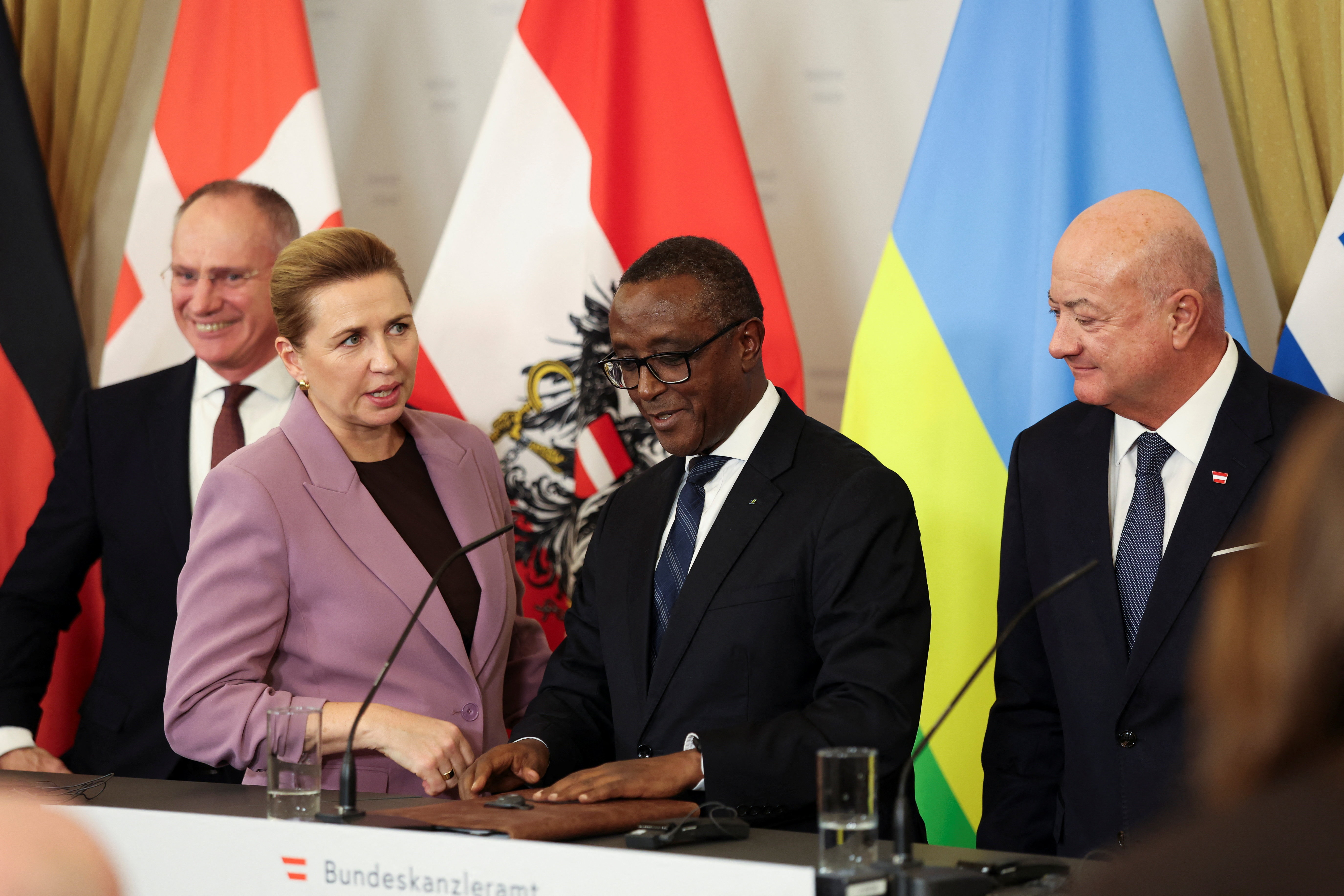
The Cyprus government has expressed interest in joining the five European Union member states working together to establish a migrant “return hub” in the eastern African nation of Rwanda, the deputy migration ministry said on Tuesday.
“We are interested in participating in the initiative, and we have already discussed this with the five member states which form the core of the initiative,” the deputy ministry told the Cyprus Mail, though it said thus far, “there has been no contact with Rwanda” regarding the plans.
It added that deputy minister Nicholas Ioannides plans to discuss the issue with ministers from Austria, Denmark, Germany, Greece and the Netherlands, the five states which are collaborating thus far, at the Council of the EU’s next justice and home affairs (JHA) council, which will take place on December 3 and 4 in Brussels.
The Dutch government on Monday evening said that it, the four other involved EU member states, and Rwanda are “working together to establish a return hub” in Rwanda, which will be “part of a broad-based partnership”.
The return hub will be established in accordance with European and international law. The persons in question will be returned to Rwanda, where they will be accommodated in an open, temporary facility. From there, they will be able to integrate into society in Rwanda, it said.
It added that the arrangement will give the migrants sent to Rwanda the right to reside there, “as well as access to education, the labour market, healthcare, and the legal system”, while maintaining “the option of returning to their country of origin”.
EU’s institutions agreed in June to allow opening of return hubs
The EU’s institutions agreed in June on a new migration regulation, which, among other things, foresees the opening of return hubs in third countries, to which irregular migrants can be sent.
Migrants can as such now be sent from an EU member state to a return hub in a third country, provided that the member state in which they find themselves has an agreement with the third country and that the third country respects international human rights standards.
However, plans to establish a return hub in Rwanda have been met with international concern, with United Nations high commissioner for human rights Volker Turk, himself an Austrian national, saying that he is “concerned about he human rights risks raised” by the plan, and that Rwanda “has its own set of human rights challenges”.
Amnesty International went further, describing the plan as “disgraceful” and saying that “sending people to a country they have never been to is irresponsible”,
“There is a real danger that the Rwanda deal will, with its limited chance for scrutiny, become a cruel black hole for human rights,” it said.
Rwanda says it can provide ‘safe, legal, dignified solution’
Rwandan Interior Minister Vincent Biruta, however, insisted on Monday that his is a “welcoming country for refugees and migrants”, and that his government is “committed to working with European partners to provide a safe, legal and dignified solution”.
“We believe this partnership will ultimately save lives by helping to stop criminal human smugglers who profit from migrants making desperate, dangerous journeys,” he said.
The plan is reminiscent of the United Kingdom’s attempts between 2022 and 2024 to deport irregular migrants to Rwanda, which was cancelled by Keir Starmer when Labour got into power.




Click here to change your cookie preferences