
The president’s celebration of Eoka as the foundation of the Republic sits uneasily with the compromises of 1960 and his stated ambition to reunify Cyprus
On October 1, President Nikos Christodoulides marked the 66th anniversary of the Republic of Cyprus by declaring that its birth was the culmination of the “purest” national liberation struggle: the 1955-59 campaign of Eoka. Days later he unveiled yet another monument to its fighters.
The president was seven weeks old when General George Grivas, nom de guerre Digenis, died on January 27, 1974. No baton was passed in the maternity ward. Ideas, however, outlive generals.
Eoka fought for Enosis, not the Republic
The irony with crediting Eoka as the Republic’s founder is that Eoka did not want the Republic. Its declared objective was Enosis, the union of Cyprus with Greece. Independence was negotiated as the alternative to both Enosis and partition: the option nobody wanted most, which is precisely why it was the only one everyone could accept. The state founded in 1960 was a partnership, not a Greek Cypriot nation-state. Honouring Eoka as its parent is like toasting a jilted suitor at the wedding.
There is also the matter of the next instalment. Grivas returned secretly in 1971 and founded Eoka B to drag President Makarios back towards Enosis. Its targets were no longer British soldiers but the government of the independent Republic. Grivas did not direct the coup of July 15, 1974; he had died six months earlier. But the organisation he created, by then increasingly under the influence of the junta, took part in the attempt to overthrow Makarios and opened the road to catastrophe.
Grivas’ legacy has two sides
The historical Grivas therefore has two faces: the commander of an anti-colonial struggle and the founder of an armed movement against Cyprus’ own elected government. Which Eoka is Christodoulides celebrating? Monuments, unlike historians, are not obliged to say. That is the convenience of ethnonationalism: heroes are purified, and failures are outsourced.
The recent anthem controversy reveals the same habit. The 1960 Constitution provided a common flag but no anthem, because the two communities could not agree on one. In November 1966, after Turkish Cypriots had ceased to take part in government, the remaining Greek Cypriot ministers adopted the Hymn to Liberty, the national anthem of Greece. No bicommunal consent was sought, because none was available.
The standard reply is that the north uses Turkey’s İstiklâl Marşı (Independence March). That is precisely the point. One cannot declare the northern state unlawful and then borrow its practices as the moral benchmark for the internationally recognised Republic. The chronology is unkind to the argument in any case: the Greek anthem arrived in 1966, 17 years before the 1983 declaration in the north. And it remains a curiosity, which even Brussels has yet to regulate, that citizens of an independent EU member state stand for the anthem of another. Beethoven’s Ode to Joy would at least have the merit of belonging to everyone.
A reunification vision built on compromise
None of this helps a president who says he seeks reunification. Celebrating an Enosis movement as the purest foundation of the Republic does not invite Turkish Cypriots into partnership; it reminds them why they insisted on constitutional safeguards in the first place. The contradiction sharpens when Christodoulides promises a reunited Cyprus without guarantor powers or intervention rights, as though EU membership had already settled the Turkish Cypriot security question. It has not. As I have argued in previous columns, a form of de facto Enosis has been achieved, not through annexation by Greece but through institutional absorption into the EU. Perhaps that is what the president is celebrating, if a little early.
His history of 1974 is similarly selective. He directs much of his indignation at President Recep Tayyip Erdogan, yet Erdogan was 20 years old in July 1974 and held no office. The intervention was ordered by the government of Prime Minister Bulent Ecevit, after the junta’s coup. Blaming Erdogan for 1974 is about as accurate as crediting Christodoulides for 1960.
This is where the Digenis analogy becomes forewarning. Grivas believed Cyprus had an overriding Hellenic destiny, to which even the authority of the independent Republic was subordinate. Christodoulides has no underground organisation, only a speechwriting office. But he risks perpetuating the underlying idea: that the Republic belongs primarily to Greek Cypriots, who alone may define its history, its identity, its security arrangements and its European destiny.
The flag that was designed for coexistence
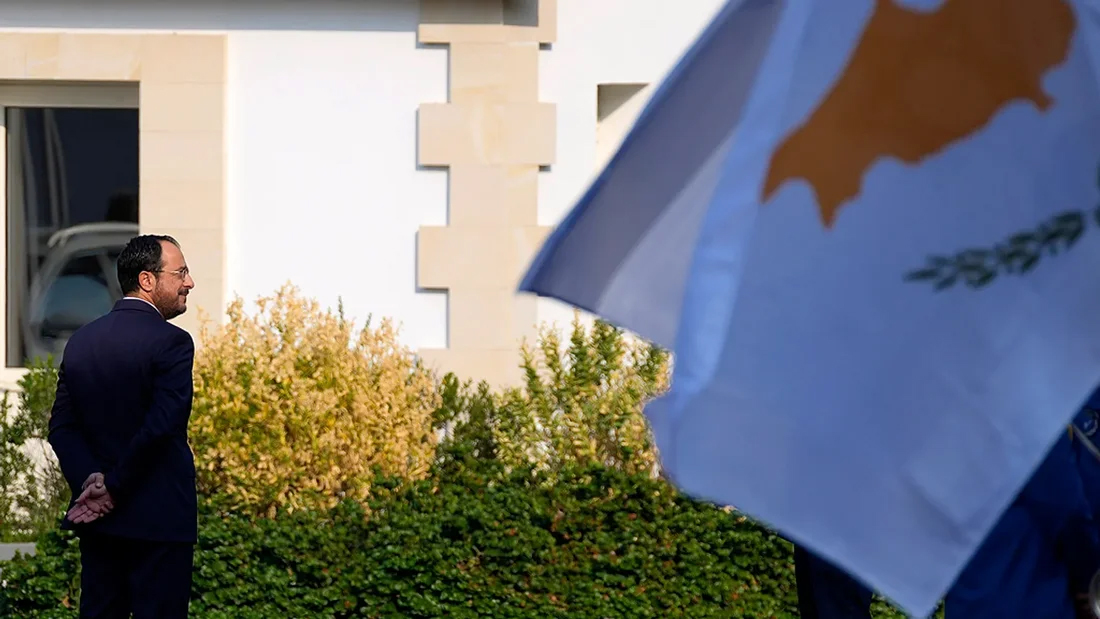
The irony is that he delivers these speeches beneath a flag designed by my uncle, the Turkish Cypriot artist Ismet V Guney. It may be the only national flag in the world composed chiefly by subtraction. It omitted the blue of Greece and the red of Turkey, the cross and the crescent. What remained was a copper-coloured island in a white field held by two olive branches. It was not Digenis’ flag. It was the flag of compromise and peace.
My cousin, the painter Nilgun Guney, spent her artistic life on images of liberated feeling, thought and longing, and exhibited alongside Greek Cypriot artists. Where her father gave the Republic a public symbol of coexistence, she explored the private freedom without which coexistence is impossible.
Christodoulides does not need to redesign the flag. He needs to understand it. Olive branches mean little when state ceremonies recycle grievance and communal ownership, and no quantity of procedural initiatives, international appearances or complaints about Turkish Cypriot intransigence can conceal a narrative that rejects the compromises on which peace depends. A president cannot speak of a window of opportunity while bricking it up with monuments.
Before the Republic was born, President-elect Makarios asked Ismet Guney what the flag was meant to represent. The answer still flies over the Presidential Palace; Christodoulides just needs to look at it to see it for what it is. If he cannot, history will place him beside Digenis, who spent his final years trying to destroy the Republic that flag was made for.





Click here to change your cookie preferences