
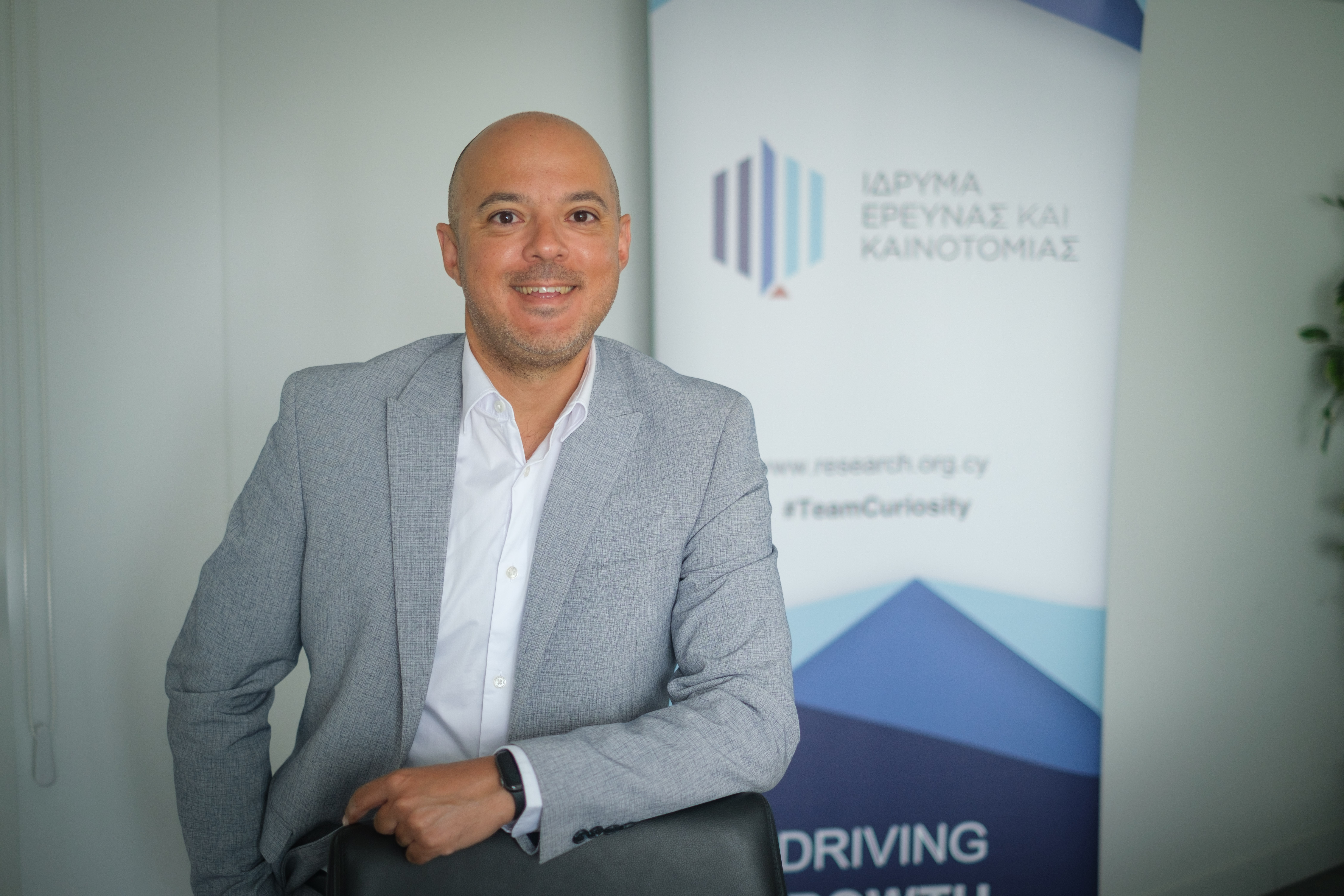
On the leap from startup to scale-up and Cyprus’ next innovation challenge
Cyprus has spent the past decade building an innovation ecosystem. For Research and Innovation Foundation (RIF) Director General Theodoros Loukaidis, the next test is whether that ecosystem can now produce companies that grow well beyond the island.
More than 800 startups and scaleups are already based in Cyprus, while the country has climbed to 34th place in the StartupBlink Global Startup Ecosystem Index 2026, up from 57th in 2021.
For Loukaidis, however, the next chapter is not simply about producing more startups. He said that “Building startups is important. Building companies that achieve international scale, create high-value jobs, attract investment and retain intellectual property in Cyprus is even more important.”
A startup ecosystem gaining depth
Looking back at the past decade, Loukaidis said Cyprus has positioned itself as an emerging innovation and technology hub by investing in research and innovation, strengthening entrepreneurship, attracting international companies and building a highly skilled talent base.
He described it as “A journey that began with a few has attracted many more”, with innovative companies drawing talent from around the world and that talent, in turn, creating startups and attracting new companies.
As the number of companies grew, so did demand for specialised services, investors, accelerators and startup communities, while, as Loukaidis put it, “The ecosystem gained depth. The connections became stronger. Confidence grew. Momentum accelerated.”
Today, more than 800 startups and scaleups are based in Cyprus, with international rankings also reflecting that progress.
In the StartupBlink Global Startup Ecosystem Index 2026, Cyprus ranks 34th, up from 57th place in 2021, making it Europe’s fastest-rising startup ecosystem for three consecutive years.
StartupBlink also places Cyprus 15th globally in the Innovators Business Environment Index, reflecting what Loukaidis described as the country’s favourable conditions for innovative companies to thrive.
At the same time, the WIPO Global Innovation Index 2026 places Cyprus 29th globally, with the report highlighting “Cyprus’ high effectiveness in turning innovation investments into tangible outputs”.
Loukaidis said Cyprus is “not only producing more startups, but also a broader and stronger pipeline of entrepreneurial talent”, with increasing numbers of founders, researchers and professionals seeking to transform ideas, technologies and research results into globally competitive businesses.
What has changed as well, he said, is that “the ambition, sophistication and international orientation of projects entering the ecosystem are growing”, reflecting “a maturing innovation culture and a rising confidence that world-class companies can be built from Cyprus”.

A broader startup landscape
The ecosystem is also becoming increasingly diverse.
Loukaidis pointed to the “remarkable diversity of Cyprus’ startup ecosystem”, with entrepreneurial activity spanning gaming, fintech, femtech, medtech, biotech, maritech, cleantech and greentech, artificial intelligence, proptech, robotics and defencetech.
Around those companies, he said, “Business angels and venture capital funds, incubators, accelerators, technology transfer offices, universities, centres of excellence and research institutes and most importantly corporates are all present and are actively supporting innovators and entrepreneurs.”
Government support has developed alongside that activity.
Building on Cyprus’ pro-business environment and its geostrategic location at the crossroads of three continents, Loukaidis said the country has built “a pro-innovation policy mix too”, with a robust framework of funding programmes and support mechanisms enabling startups to innovate, attract investments and scale internationally.
Those measures are complemented by competitive tax measures and talent incentives, while the country has also been investing in state-of-the-art research and technology infrastructures that are “accessible to everyone, including startups”.
At the same time, Loukaidis said Cyprus is becoming “increasingly embedded in the global innovation economy and expanding its influence within it”, adding that “The foundations have been laid. The momentum is real. The next growth chapter is now being written.”
The next frontier is scale
For Loukaidis, however, the focus is increasingly moving towards what happens after a startup has been created.
He said “The country’s innovation agenda is increasingly focused not only on creating new ventures, but on helping successful companies grow into globally competitive businesses that generate lasting economic and societal value.”
That means supporting companies through the entire journey, from idea validation and product development to scale-up, manufacturing and global expansion.
At the earliest stage, PRE-SEED offers up to €120,000 equity-free to establish a venture, validate the problem-solution fit and develop the first version of a product or service.
For companies further along, SEED provides up to €500,000 equity-free to help startups transform an initial prototype or minimum viable product into a market-ready solution with demonstrated technical performance and customer validation.
INNOVATE supports companies seeking to develop new products or significantly enhance the features and capabilities of existing ones, providing up to €1 million in funding.
Meanwhile, FAST TRACK INNOVATION offers up to €200,000 to help companies complete the final activities required for market launch.
Bringing private capital into the picture
Once companies have “successfully validated their products and demonstrated market demand”, the funding model begins to change.
Through BOOST, private investment is combined with public support. For every €2 invested through an equity-based investment, RIF contributes an additional €1 through a non-dilutive grant, helping companies execute ambitious scale-up plans while “minimizing founder dilution”.
Loukaidis noted that this is aimed at “fairly small ticket investments”, with the RIF grant reaching up to €300,000.
For companies that have already secured VC equity-based investments of at least €1 million, the DISRUPT programme provides up to €1.5 million equity-free in RIF funding to “pursue exponential growth, accelerate international expansion and build a significant global market presence”.
The next step for some companies is manufacturing.
Through STEP, innovative companies with validated and manufacturing-ready products can receive up to €2 million to establish production facilities in Cyprus, alongside a similar level of investment commitment from the company.
Getting research into the market
Loukaidis also sees another challenge in making sure more of the research produced in Cyprus finds its way into the economy.
He said “Cyprus has made significant progress in strengthening its research base”, but added that “The next challenge is ensuring that more scientific discoveries, technologies and intellectual property find their way into products, services and companies that create impact in the real economy.”
Increasing the flow of ideas “from laboratories to markets” is therefore becoming a growing priority for the country’s innovation ecosystem.
The PhD IN INDUSTRY programme helps companies recruit doctoral talent to carry out high-calibre R&D under academic supervision, while CO-DEVELOP supports partnerships between enterprises and research organisations to commercialise research results and bring new innovations to market.
Innovation only matters when it is adopted
For Loukaidis, creating innovation is not enough unless businesses and public-sector organisations actually use it.
He said “Innovation only matters when it is adopted”, arguing that strengthening the capacity of businesses and public-sector organisations to embrace new technologies and innovative solutions is critical for boosting productivity, improving competitiveness and sustaining long-term growth.
The AI IN GOVERNMENT programme gives innovative companies the opportunity to leverage “the transformative power of artificial intelligence” to develop and deploy solutions addressing real-world challenges faced by public-sector organisations, improving efficiency, service delivery and decision-making.
Through INNOVATION VOUCHERS, SMEs can also access specialised expertise, knowledge and technical services from innovative companies to solve business challenges and accelerate innovation adoption.
Beyond funding
Loukaidis also stressed that “Funding is only part of the equation”, with RIF providing a wider range of free support services around intellectual property ownership assessment, IP protection strategies, commercial opportunity evaluation, technology marketing and support in structuring commercial deals and partnerships.
The foundation also hosts events and participation in local and global events, while providing access to partners, customers and investors.
Support also extends to European funding, with RIF helping innovators apply for and secure funding from Horizon Europe through free-of-charge proposal pre-screening services, mentoring and pitching mock-ups.
The aim, Loukaidis said, is to help companies secure funding from “Europe’s most prestigious R&I funding programmes”, including those of the European Innovation Council.
Attracting talent and rewarding innovation
The government framework complements those programmes with a series of incentives aimed at making Cyprus more attractive to innovative companies and highly skilled professionals.
These include an effective IP Box tax rate of approximately 3 per cent, a 120 per cent tax deduction on eligible R&D expenditure and an income tax exemption of up to 50 per cent for relocating highly skilled professionals.
Startup Visa and Scientific Visa schemes are also part of the framework, alongside tax incentives for individuals and legal entities investing in local innovative companies.
Looking to the next stage, Loukaidis said “We are constantly upgrading our funding portfolio placing even more emphasis on mobilising private investment, transforming research into market opportunities and supporting companies to attract talent, expand internationally and achieve scale.”
For him, that is where Cyprus’ startup story now leads, with the country having already built a much stronger innovation base and the next growth chapter increasingly centred on one challenge.
As Loukaidis puts it, “Scale: The Next Frontier.”





Click here to change your cookie preferences