
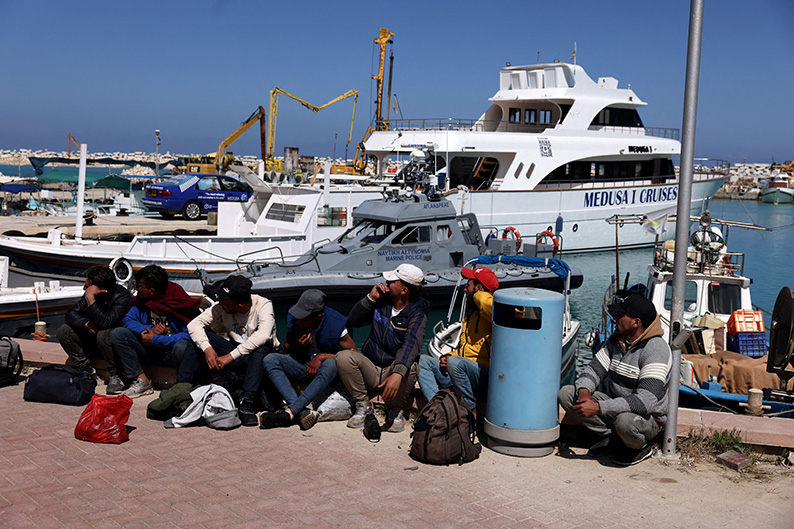
Cyprus is under migratory pressure due to the disproportionate level of arrivals over the last year and will therefore be eligible to access the ‘solidarity pool’, the EU’s solidarity tool for member states under migratory pressure, when the pact enters into application in mid-2026, the European Commission said in a report made public on Tuesday.
The European Commission announced it was taking a further step in implementing the pact on migration and asylum by launching the first annual migration management cycle, which provides a comprehensive overview of the asylum and migration situation in the EU, identifies the migratory situations member states are facing and proposes an annual solidarity pool, to be adopted by the Council.
The launch of the annual cycle is a key milestone in ensuring the effective implementation of the Pact as of June 2026, it said.
The Commission said its report “shows a continued improvement of the migratory situation during the reporting period – from July 2024 till June 2025 – with illegal border crossings down by 35 per cent, also due to enhanced cooperation with partner countries.”
“At the same time, challenges remain, such as continued pressure from irregular arrivals and unauthorised movements within the EU, the hosting of refugees from Ukraine, weaponisation of migration by Russia and Belarus at the external borders, and cooperation on returns and readmission.
“Member states “continue to make progress towards implementing the pact and ensuring that their national asylum, reception and migration systems are ready by June 2026. There is, however, a general need to speed up the pace of these reforms,” the Commission pointed out.
Based on the information and evidence from the European annual asylum and migration report, the Commission finds that across the Union, member states face various migratory situations and pressures.
“Greece and Cyprus are under migratory pressure due to the disproportionate level of arrivals over the last year. Spain and Italy are also under migratory pressure because of a disproportionate number of arrivals following search and rescue at sea in the same period.
“These four member states will therefore be eligible to access the solidarity pool,” the Commission said.
It added that Belgium, Bulgaria, Germany, Estonia, Ireland, France, Croatia, Latvia, Lithuania, the Netherlands, Poland and Finland are at risk of migratory pressure, either because of high numbers of arrivals in the preceding year, ongoing strains on their reception systems or the threat of weaponisation of migration that could create disproportionate obligations in the upcoming year.
They will have priority access to the EU migration support toolbox and their situation will be re-evaluated in an expedited manner depending on changes to their situation.
In addition, to assist member states facing hybrid threats and increasing drone incursions, the Commission will shortly launch a €250 million tender supporting the purchase of drone and anti-drone capabilities.
Bulgaria, Czechia, Estonia, Croatia, Austria and Poland face a significant migratory situation because of the cumulative pressures of the last five years. They will have the possibility to request the Council to grant a full or partial deduction from their contributions to the Solidarity Pool for the upcoming year.
To preserve the balance between solidarity and responsibility, the pact ensures that member states contributing to the solidarity pool will not be required to implement their solidarity pledges towards a member state under migratory pressure if the Commission has identified systemic shortcomings in that member state with regard to the new responsibility rules. The Commission will assess this situation in July 2026 and again in October 2026.
The Commission proposed the establishment of the first solidarity pool to address the needs of member states under migratory pressure. In line with the rules of the pact, this proposal is not public.
It is now for the Council to adopt the Commission proposal and agree on the size of the solidarity pool and on how each member state will contribute according to its fair share. Once the Council adopts the decision on the solidarity pool, the member states’ solidarity contributions will be public and legally binding.
Member States are free to choose the form of their solidarity contributions between people solidarity (relocation or responsibility offsets if applicable), financial support, and alternative measures or a combination of these measures.
Executive vice-president for tech sovereignty, security and democracy Henna Virkkunen said that “to manage migration in a fair and orderly way, solidarity and responsibility must go hand in hand.”
“With today’s [Tuesday] launch of the annual migration management cycle, we are putting the pact’s principles of solidarity and responsibility into practice – ensuring that member states receive the support they need, paired with greater responsibility in protecting our external borders, limiting secondary movements and speeding up procedures for asylum and return,” she added.
Commissioner for internal affairs and migration Magnus Brunner said “we are building a strong system that is fair and firm.”
“We are turning the page, showing control and unity, and supporting member states facing the most disproportionate pressures. Preserving this balance between solidarity and responsibility is key to our success. We must continue advancing on screening and procedures at the borders, a faster asylum process and effective returns,” he pointed out.





Click here to change your cookie preferences